 EN
EN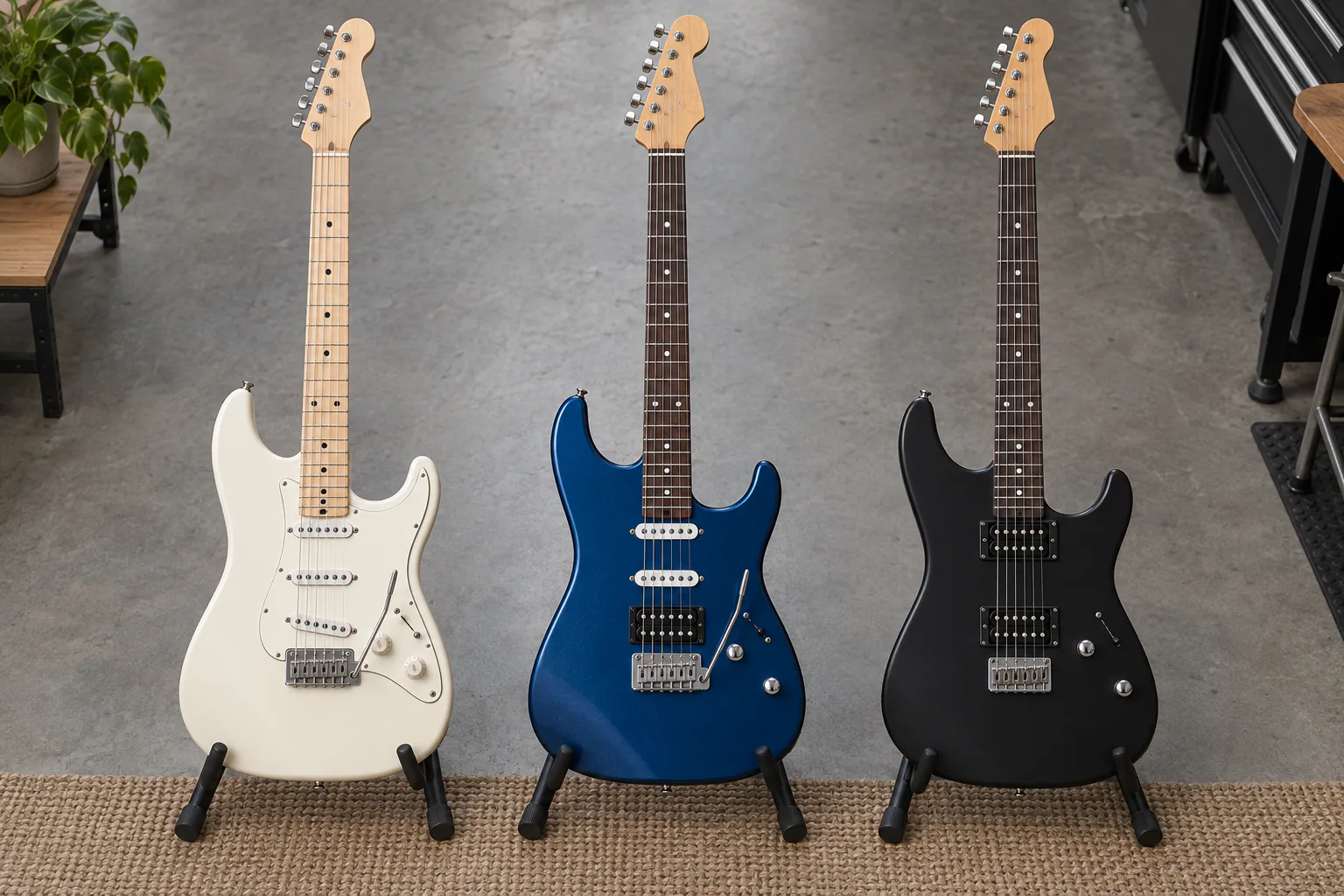
SSS, HSS and HH tell a buyer how many single-coil and humbucker-format pickups appear in the layout. They do not, by themselves, tell the buyer how the guitar sounds, how it is wired, how well it is made or which customers will buy it.
For a retailer or private-label buyer, that distinction is important. Three pickup layouts can support a useful range, or they can become three look-alike models competing for the same stock budget.
The practical answer: choose pickup layouts by customer use and assortment role. Write the pickup positions, exact components or approved functional requirements, selector map, control functions and hardware as one specification. Approve each model through the same playability and electronics tests. Do not promise a tone from the letters alone, and do not multiply finishes until each layout has a reason to exist.
Decode the letters, then keep asking questions
The common shorthand is straightforward:
- SSS: three single-coil-format pickup positions.
- HSS: a humbucker-format bridge position with two single-coil-format positions.
- HH: two humbucker-format positions.
The order normally follows the physical positions shown in the product context, but a sourcing file should also label bridge, middle and neck explicitly. A photograph and a switching diagram remove doubt.
The shorthand leaves many decisions open:
- Pickup construction, model or approved sample.
- Magnet and winding specification where relevant.
- Mounting and height-adjustment method.
- Selector type and number of positions.
- Volume and tone control functions.
- Potentiometer and capacitor requirements.
- Coil split, series/parallel, phase or other optional functions.
- Jack, shielding, grounding and wire routing.
- Bridge system, strings and setup used during evaluation.
Two guitars can both be labelled HSS and still have different switching, controls, output balance and customer position. Treat the letters as the first line of the electronics brief, not the whole brief.
Start with the job of each model
A useful assortment answers different customer questions.
One model may be intended as a familiar three-single-coil platform with a clear traditional visual identity. Another may give a buyer a humbucker-format bridge position while retaining two single-coil-format positions. An HH model may serve customers who prefer a simpler two-pickup layout or a different body and bridge direction.
Those descriptions deliberately avoid universal tone promises. Pickup response depends on more than format. Component design, height, strings, picking, amplifier settings, controls and the rest of the guitar all affect the result. Retail pages should describe the actual model and its verified functions.
Before adding a layout, ask:
- Which customer or playing situation is this model for?
- What does it add that an existing model does not?
- Can sales staff explain the switching and controls?
- Does the price and feature position leave room for the other models?
- Can the store support setup and electronics questions?
- Is demand broad enough for another finish or bridge variant?
If the answers for two models are almost identical, the range may need clearer positioning rather than another SKU.
SSS: make the three positions understandable
An SSS model often looks familiar to customers, which can tempt a buyer to leave the specification loose. Familiarity increases the need for precision because players may arrive with strong expectations about the selector and controls.
Record which pickup occupies the neck, middle and bridge positions. State whether the three units are identical or position-specific. Define the selector positions in plain language and show which pickups are active in each. Map each volume and tone control to the pickups or circuit it affects.
During sampling, compare the output of all three positions at consistent pickup height and playing force. Listen for abnormal hum, crackle, intermittent switching and a large unintended jump that makes the model difficult to demonstrate. Some noise characteristics may be normal for the approved design and test environment; the job is to distinguish expected behaviour from faults and poor installation.
The product page should not stop at “three pickups.” A simple control map helps retail staff and customers understand what the actual guitar does.
HSS: check the bridge relationship, not only the extra coil
An HSS layout is often chosen because the buyer wants a humbucker-format pickup at the bridge while retaining single-coil-format middle and neck positions. The visual idea is easy to recognise. The system still needs balancing and switching decisions.
Confirm the bridge pickup’s exact format and mounting. Record the middle and neck units, selector map and controls. If the project uses coil splitting or another optional function, show how it is activated and which selector positions it affects. Do not assume that every HSS guitar includes a split function.
Evaluate position-to-position balance through the agreed test equipment. Set pickup heights using the approved method before judging the result. If the bridge position dominates or falls behind, diagnose the pickup, height, circuit and playing condition rather than correcting the description with adjectives.
Also inspect physical clearance. The pickup route, pickguard or mounting ring, bridge and strings must align. Pole-piece appearance alone does not prove that the strings and pickup sit correctly. Check the full string path and the approved bridge setup.
HH: define the controls and optional functions
Two humbucker-format pickups can support a clean, understandable model, but the wiring may be simple or complex.
The buyer needs to specify the selector and controls. One volume and one tone? Separate volumes? Separate tones? A three-way selector? Push-pull coil split? Series/parallel options? None of those functions should be inferred from “HH.”
More functions are not automatically better for retail. Each function needs correct parts, assembly, testing, product copy and staff explanation. A straightforward model that works consistently may be more useful than a feature-heavy model whose controls are not documented.
When optional switching is approved, test it at several selector and control positions. Confirm that the product page, hangtag and any diagram use the same names. A push-pull control shown online but absent from the shipped model is a serious catalogue error, even if the guitar otherwise works.
The pickup layout does not define the whole guitar
Assortment comparisons often isolate the electronics and forget the rest of the instrument.
Use a common specification structure across SSS, HSS and HH:
| Area | What to define | Why it matters |
|---|---|---|
| Product role | Target customer, channel and price position | Prevents internal duplication |
| Body | Shape, dimensions, construction and finish | Pickup layout is not body identity |
| Neck | Joint, profile, scale, nut and fret count | Controls feel and geometry |
| Bridge | Fixed or approved tremolo system | Affects routing, setup and support |
| Pickups | Format, position, model or controlled requirement | Defines the actual components |
| Switching | Selector positions and active pickups | Makes functions testable |
| Controls | Volume, tone and optional functions | Keeps copy and wiring aligned |
| Hardware | Tuners, jack, knobs, strap buttons and mounting | Supports repeat production |
| Setup | Strings, relief, action and intonation method | Makes sample comparisons meaningful |
| Branding | Logos, model code, labels and artwork | Prevents mixed identities |
| Packing | Accessories, protection and carton | Protects controls and hardware |
Use the OEM guitar specification-sheet guide to keep these fields in one controlled record.
Bridge choice can create more difference than another finish
An SSS, HSS or HH model can use a fixed bridge or one of several tremolo-style systems. That decision affects routing, hardware, setup, strings, tuning behaviour, packing and after-sales questions.
Treat the bridge as its own functional choice. Do not assume that an HSS model must have a tremolo or that an HH model must have a fixed bridge. Decide from the target customer and approved design.
For a tremolo-equipped sample, define the setup state, spring arrangement where applicable, bridge position, string set and tuning test. For a fixed bridge, define the hardware, adjustment and intonation method. Compare models using their intended setup rather than declaring one bridge type universally more stable.
Too many combinations can quickly fragment inventory. Three pickup layouts multiplied by two bridges and four finishes produce twenty-four variants before left-handed or fret-count options are considered. A buyer should earn each combination with a clear demand or product role.
Test the switching map, not only the output
The fastest electronics check—plug in, hear sound, approve—misses many faults.
Create a switching map before the test. For every selector position, list the pickups that should be active and the controls that should work. Add any push-pull or mini-switch state. The person testing the sample should be able to follow the map without interpreting the wiring from memory.
Then:
- Inspect pickup, selector, control and jack installation.
- Confirm the approved strings and basic setup.
- Connect the named cable and agreed test equipment.
- Test every selector position at consistent control settings.
- Operate every knob and switch through its full range.
- Move the cable gently at the jack and listen for interruption.
- Tap or play each pickup carefully to confirm the map.
- Compare output at controlled pickup heights and playing force.
- Listen for crackle, dropouts, excessive unintended noise and loose parts.
- Repeat after normal handling and any adjustment.
Record the test equipment and environment well enough for another person to repeat the check. Do not use one noisy room or unfamiliar amplifier as the only evidence that a component is defective.
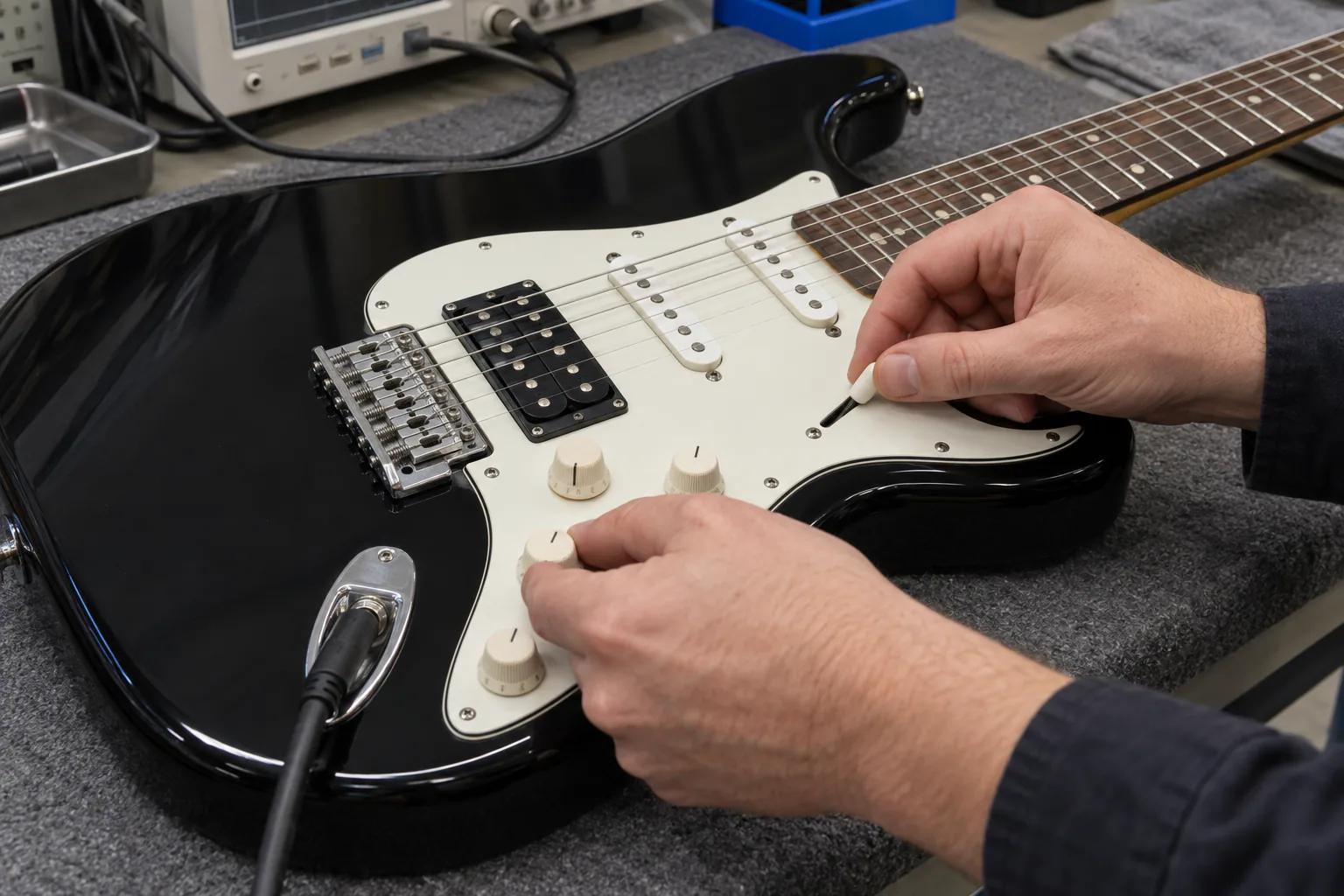
The existing electric guitar and bass electronics QC guide goes deeper into wiring, signal, controls and production sampling.
Match pickup height and setup to the approved method
Pickup height affects the comparison. So do string type, string age, action and player force.
Record where height is measured, how the string is fretted during measurement and what the approved distance is for each pickup side or position. If the project uses a reference sample rather than a fixed number, preserve that sample state and record actual measurements.
Do not adjust heights casually until three positions sound “the same.” Different pickup positions and designs may have intentionally different response. The goal is to reproduce the approved model and avoid unintended imbalance.
After any height change, check string clearance under firm playing, selector balance and mounting stability. Return the final accepted positions to the specification. A sample that sounds right after an undocumented bench adjustment cannot guide bulk production.
Planning a private-label electric guitar range?
Send Vinesmusical the target customer, body and neck reference, SSS, HSS or HH direction, pickup and switching requirements, bridge, finish, branding and packing scope. We can identify open decisions before sample approval. Share your project requirements.
Build a small assortment matrix
A useful first matrix can fit on one page. Give each model one primary job.
| Model role | Pickup layout | Bridge direction | Main customer need | Evidence required before adding variants |
|---|---|---|---|---|
| Familiar three-position platform | SSS | Approved fixed or tremolo design | Clear traditional layout and controls | Sales feedback and model-level sell-through |
| Mixed-layout option | HSS | Approved design | Bridge humbucker format plus two single-coil positions | Demand for the distinct switching/use case |
| Two-pickup platform | HH | Approved fixed or tremolo design | Simple two-pickup identity or documented options | Clear separation from the HSS model |
This is a planning example, not a required product lineup. A buyer may need one layout, two or all three. The point is to show why each model exists before finishes and cosmetic packages are added.
Use model codes that preserve the electronics identity. If a pickup or switching revision changes, update the suffix or revision record in a way that purchasing, production and after-sales teams can trace. Do not let two circuits share one unchanged model code when replacement information differs.
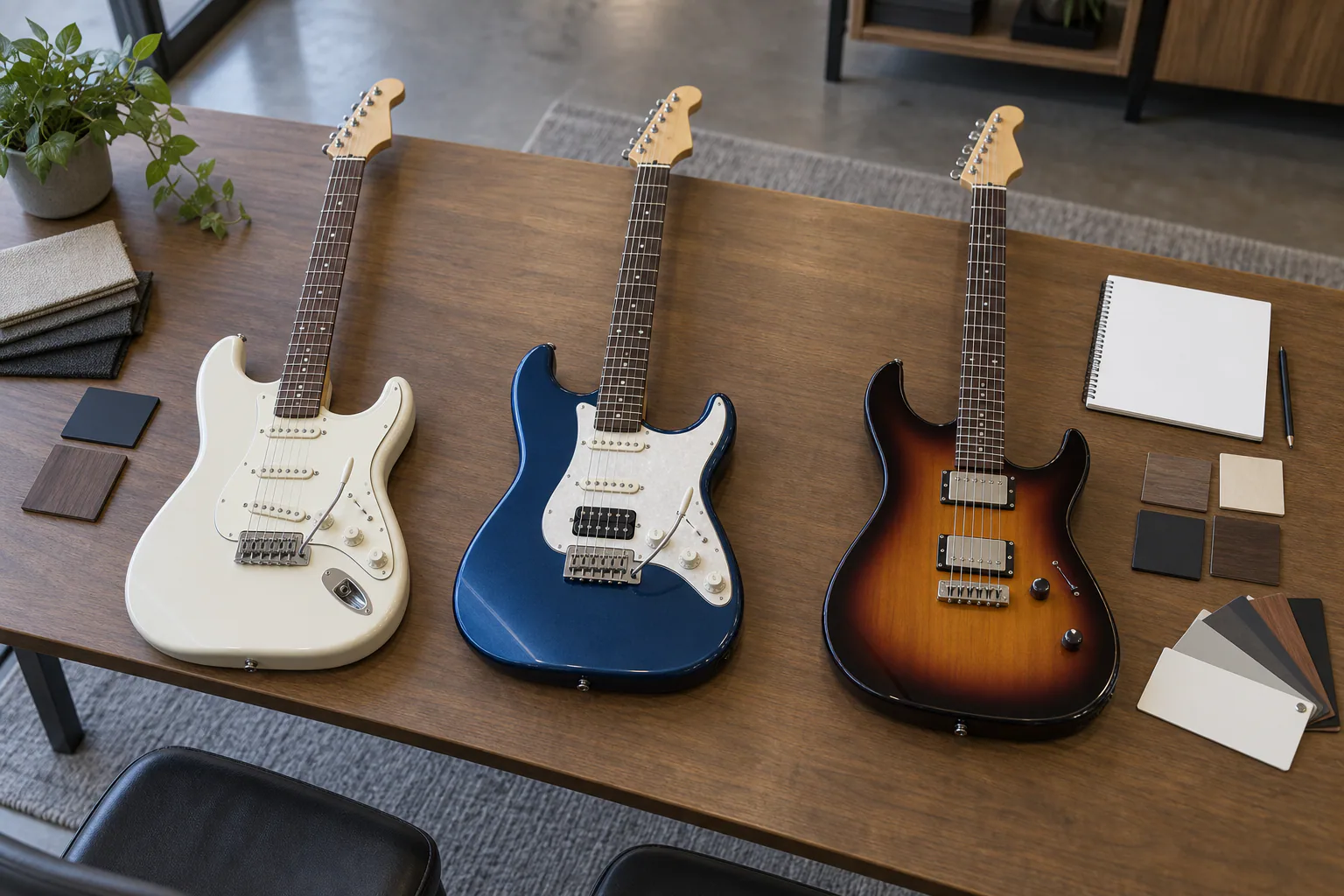
Product pages should answer controls before adjectives
A customer comparing electric guitars wants to know what the controls do.
Near the top of a model page, show:
- Pickup layout and named positions.
- Selector type and position map.
- Volume and tone controls.
- Optional switching functions, if actually fitted.
- Bridge type and approved setup description.
- Scale, neck, fret and body information.
- Verified materials and hardware.
- Included items and packaging.
Use close photographs of the actual pickups, selector, controls, bridge and output jack. If a diagram is used, make it model-specific. Product schema and specification tables should match the visible model.
Avoid turning format names into unsupported tone claims. “Humbucker” and “single-coil” describe a component format or construction direction; phrases such as “the ultimate metal tone” or “authentic vintage sound” need product-level evidence and a clear context. Buyers gain more trust from precise controls and honest demonstrations than from broad promises.
Plan service and replacement information before launch
Retail staff will eventually receive questions about a noisy switch, loose jack, damaged knob or replacement pickup. The product record should help them identify the shipped circuit.
Keep:
- Wiring diagram and revision.
- Pickup identifiers or controlled specification.
- Potentiometer, capacitor, selector and jack information.
- Knob and mounting-hardware references.
- Approved pickup-height method.
- Troubleshooting steps suitable for retail support.
- Replacement or service route agreed for the program.
Do not publish a repair procedure that should be handled by a qualified technician. The store-facing document can begin with safe checks—cable, amplifier, battery if relevant, selector and visible looseness—then route the case appropriately.
Packaging can move controls and damage finishes
Electric guitars have projecting switches, knobs, tremolo arms and output hardware. Accessories placed loosely in the same compartment can mark the finish or load a control during transport.
Approve the instrument and pack-out together. Remove or secure a tremolo arm as specified. Protect switches and knobs from carton pressure. Restrain cables, tools and paperwork. Check the headstock, neck support and body edges. Inspect the guitar again after the packaging test and operate the controls once more.
The OEM guitar packaging approval guide provides a practical way to document materials, support points and included items.
Common purchasing mistakes
Using the letters as a tone guarantee
SSS, HSS and HH identify pickup formats and positions. Approve the actual components, circuit and complete guitar.
Copying one switching diagram to every model
Each selector and optional function needs a model-specific map.
Adding too many combinations
Prove the role of each pickup layout before multiplying bridges, colours and decorative options.
Comparing samples at random pickup heights
Use one recorded measurement method and return accepted settings to the specification.
Testing only one selector position
Operate every control and switch state through the full map.
Letting product copy run ahead of the sample
Publish only the functions and parts present on the approved model.
Buyer FAQ
What do SSS, HSS and HH mean on an electric guitar?
SSS refers to three single-coil-format pickup positions. HSS refers to a humbucker-format bridge position with two single-coil-format positions. HH refers to two humbucker-format positions. The letters do not define the complete wiring or quality.
Which pickup layout is best for a new guitar retailer?
There is no universal best layout. Choose the model or small mix that matches the store’s customers and gives each SKU a distinct reason to exist. Confirm switching, controls, bridge, setup and price position before adding variants.
Does every HSS guitar have coil splitting?
No. Coil splitting is an optional circuit function and must be specified, sampled, tested and described. It cannot be inferred from HSS.
Are all HH guitars wired the same way?
No. Selector positions, volume and tone controls, coil options and component choices vary. Use a model-specific wiring and control map.
How should a buyer compare pickup output?
Use the approved strings and setup, record pickup height, connect to agreed test equipment, keep control settings consistent and compare every selector position at similar playing force. Note differences in the rest of the guitar.
What should be checked before production approval?
Confirm component identity, installation, selector map, controls, jack, grounding and intended noise behaviour. Play every fret, check setup and intonation, retest after adjustments and verify that the written product information matches the sample.
Final buyer checklist
- Every model has a named customer and assortment role.
- SSS, HSS or HH positions are shown in the drawing.
- Actual pickup components or approved functional requirements are recorded.
- Selector and control maps are model-specific.
- Optional coil or switching functions are explicitly approved.
- Bridge, strings and setup are part of the comparison.
- Pickup-height measurement is repeatable.
- Every selector position and control has been tested.
- Adjustments return to the controlled specification.
- Product copy and photographs match the circuit shipped.
- Model and revision codes distinguish electronics changes.
- Replacement and support information are prepared.
- Packaging protects switches, knobs, jack, bridge and finish.
Make every layout earn its place
SSS, HSS and HH are useful labels because they make the first visual difference easy to discuss. Good range planning goes one step further.
Define the customer job, complete the wiring and control record, approve the whole guitar and keep the retail explanation honest. Add a model when it creates a clear choice, not simply because another three-letter configuration exists. That approach produces a smaller, stronger assortment and a specification the factory can repeat.
If you are developing SSS, HSS or HH electric guitars for wholesale or private-label distribution, send Vinesmusical the target market, body and neck references, pickup and switching requirements, bridge, setup, finish, branding and packing plan. Contact us to review the project before sampling.