 EN
EN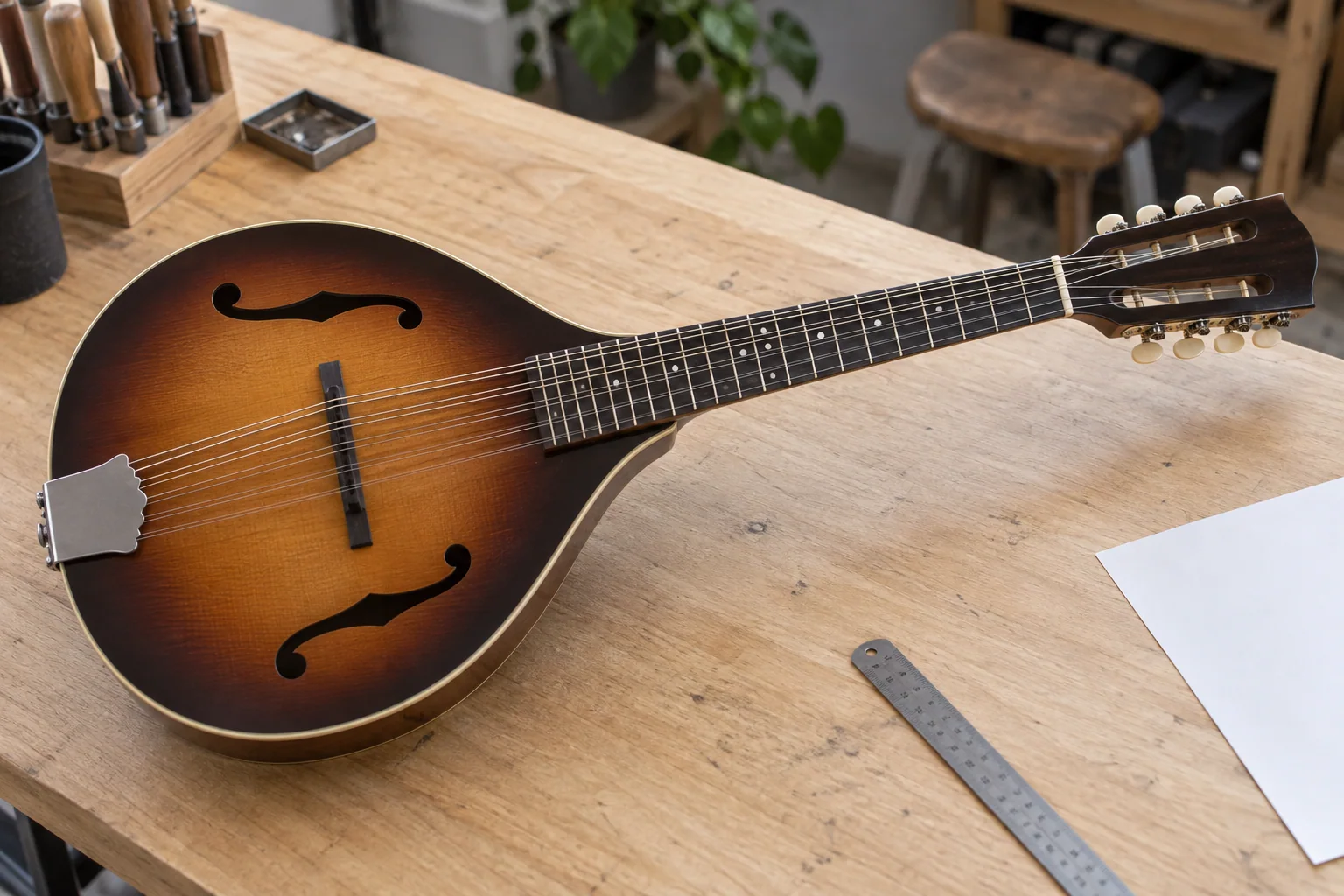
A buyer can describe a product as an “eight-string mandolin” and still leave most of the important decisions open. The phrase confirms the instrument family and the usual idea of four paired courses. It does not tell a factory which player the model is for, how the neck should feel, which tuning the setup must support, what bridge system should be used, or how the sample will be judged.
Those gaps matter in wholesale and private-label work. Two mandolins can look similar in a catalogue image yet feel very different at the nut, respond differently under a pick, or require different setup work before they are ready for a retailer. If those differences are discovered only after the first sample arrives, the buyer loses time deciding whether the sample is wrong or the original brief was incomplete.
The practical answer is to build the specification around use, construction and approval—not around a photograph alone. This guide covers the points an importer, distributor or retail buyer should settle before asking a factory to quote and sample an eight-string mandolin.
In brief: define the target player and market first; record the tuning and four paired courses; control the scale, nut, neck and string spacing as one playability system; identify compatible bridge, tailpiece and tuner choices; and approve setup, appearance and packaging against one written revision.
Start with the buyer and the product's job
The first useful line in a mandolin brief is not a wood species. It is a short description of who will buy the instrument and what they expect from it.
A beginner model for a broad retail programme has different priorities from a stage-oriented electro-acoustic instrument. A traditional bluegrass assortment, a folk-instrument range and a compact travel line may all include an eight-string mandolin, but they do not necessarily need the same neck feel, body platform, visual details or accessory pack.
Give the factory enough commercial context to make sensible proposals:
- Target country or region.
- Intended player level and main musical use.
- Retail channel: specialist shop, general music retailer, online sales, education or another channel.
- Expected product position within the buyer's range.
- Acoustic or amplified use.
- Reference products or features the buyer likes—and the exact points that should not be copied.
- Estimated quantity by model and finish.
- Branding and packaging direction.
This is not a request to reveal confidential sales plans. It is a way to avoid a familiar problem: a supplier proposes the lowest-cost interpretation while the buyer has a more demanding retail position in mind.
Confirm what “eight strings” means in the specification
For a conventional eight-string mandolin, the strings are arranged in four paired courses. A good specification records the course layout and intended tuning rather than leaving the setup team to infer it from the instrument name.
The reason is simple. String gauges, nut slots, bridge compensation and action are connected. If the planned tuning or string set changes late, a sample that was comfortable under one setup may no longer feel or intonate the same way. A buyer does not need to prescribe every workshop operation, but the target setup must be clear enough for the factory to choose compatible parts and prepare the sample correctly.
Record at least:
- Number of courses and strings.
- Intended tuning or buyer-approved reference tuning.
- String brand and set if the buyer requires a specific one, or the required gauge direction if alternatives are acceptable.
- Whether replacement sets must be included in the retail pack.
- Any market-specific warning, labelling or accessory requirement.
If the product line may later include alternative tunings, treat that as a separate version until the effect on nut, bridge, setup and packaging has been reviewed. A change in tuning is not merely a different line of text on the product page.
Treat scale, nut and neck feel as one system
Wholesale specifications often list scale length and nut width as independent numbers. Players experience them together with neck profile, course spacing, fretwork, action and string tension.
Scale length
The scale should be measured and stated using one agreed method. Do not rely on a product name such as standard, full size or traditional. If a reference sample is used, record the measured result and where it was taken. The factory drawing, sample and final product page should all use the same definition.
Scale length affects feel, fret spacing and bridge position. It also interacts with the intended string set and tuning. A small change can be acceptable when it is intentional; an unexplained change between the drawing and the sample is not.
Nut width and course spacing
Nut width alone does not describe how much room a player has. The spacing between the four courses and the distance between the two strings within each course both influence comfort. The outer strings also need enough margin from the fingerboard edges.
Ask the factory to document:
- Overall nut width.
- Spacing of the four courses at the nut.
- Pair spacing within each course.
- String spread at the bridge.
- Fingerboard width at agreed reference points.
- Edge margin for the outside strings.
A clear close-up with a scale can support the record, but the approved dimension belongs in the specification. Photographs alone are unreliable because perspective changes apparent spacing.

Illustrative visual: paired courses and neck details that buyers should record in the specification.
Neck profile and fretwork
Terms such as slim, comfortable and vintage are useful conversation starters, not approval standards. When neck feel matters to the range, provide a reference instrument or profile measurements at agreed fret positions. Confirm whether the sample is being approved by measurement, by hand feel, or by both.
Fret ends, level, crown and polish should be reviewed under normal playing conditions. A sample can look clean in photographs and still have sharp ends or uneven response. The buyer should also agree how much seasonal movement is acceptable and how the instrument will be conditioned before setup and inspection.
Choose a body platform before discussing decoration
The body shape influences tooling, construction, visual identity, case fit and price. A-style and F-style are common starting points, but they are not complete specifications. Our A-Style vs F-Style Mandolins guide explains the commercial differences in more detail.
For the selected platform, record:
- Body outline and overall dimensions.
- Flat, carved or other approved top and back direction.
- Soundhole style and placement.
- Binding, purfling and edge treatment.
- Top, back and side construction described accurately as solid, laminated or another confirmed method.
- Bracing or internal construction where it is a model-critical requirement.
- Finish type, colour reference and acceptable natural variation.
Avoid upgrading ordinary variation into a defect after the sample is approved. Wood grain and colour are not printed graphics. If appearance is important, approve a range with several examples instead of choosing one unusually figured sample and expecting every unit to match it exactly.
The buyer should also decide which decorative features have real retail value. A complex scroll, elaborate binding or highly figured veneer may help one assortment and add unnecessary cost or visual noise to another. Decoration should support the product position rather than compensate for an unclear specification.
Match bridge, tailpiece and tuners to the model
The bridge, tailpiece and tuners form a practical system. They control string anchoring, adjustment, serviceability and part of the player's daily experience. Selecting them from separate catalogue images without checking compatibility creates avoidable sample revisions.
Bridge and compensation
Record the bridge type, material direction, adjustment method and saddle or compensation approach. The factory should confirm that the bridge fits the top geometry and provides a workable adjustment range after setup.
During sample review, check that the bridge sits correctly, remains stable under normal tuning, and allows the instrument to reach the approved action without being at the end of its adjustment. Intonation should be checked using the agreed tuning and string set, not a temporary set fitted only for photography.
Tailpiece
The tailpiece must anchor all eight strings securely, allow practical restringing and suit the body design. Examine the edges, cover and fastening method. A cover that looks attractive but rattles, catches a string end or is difficult to remove will become a service issue for the retailer.
Tuning machines
Confirm the tuner layout, ratio direction if specified, button style, finish and replacement availability. The string paths should be clean and logical, without rubbing against neighbouring posts or sharp edges. Check that buttons turn consistently and that the headstock drilling matches the approved drawing.
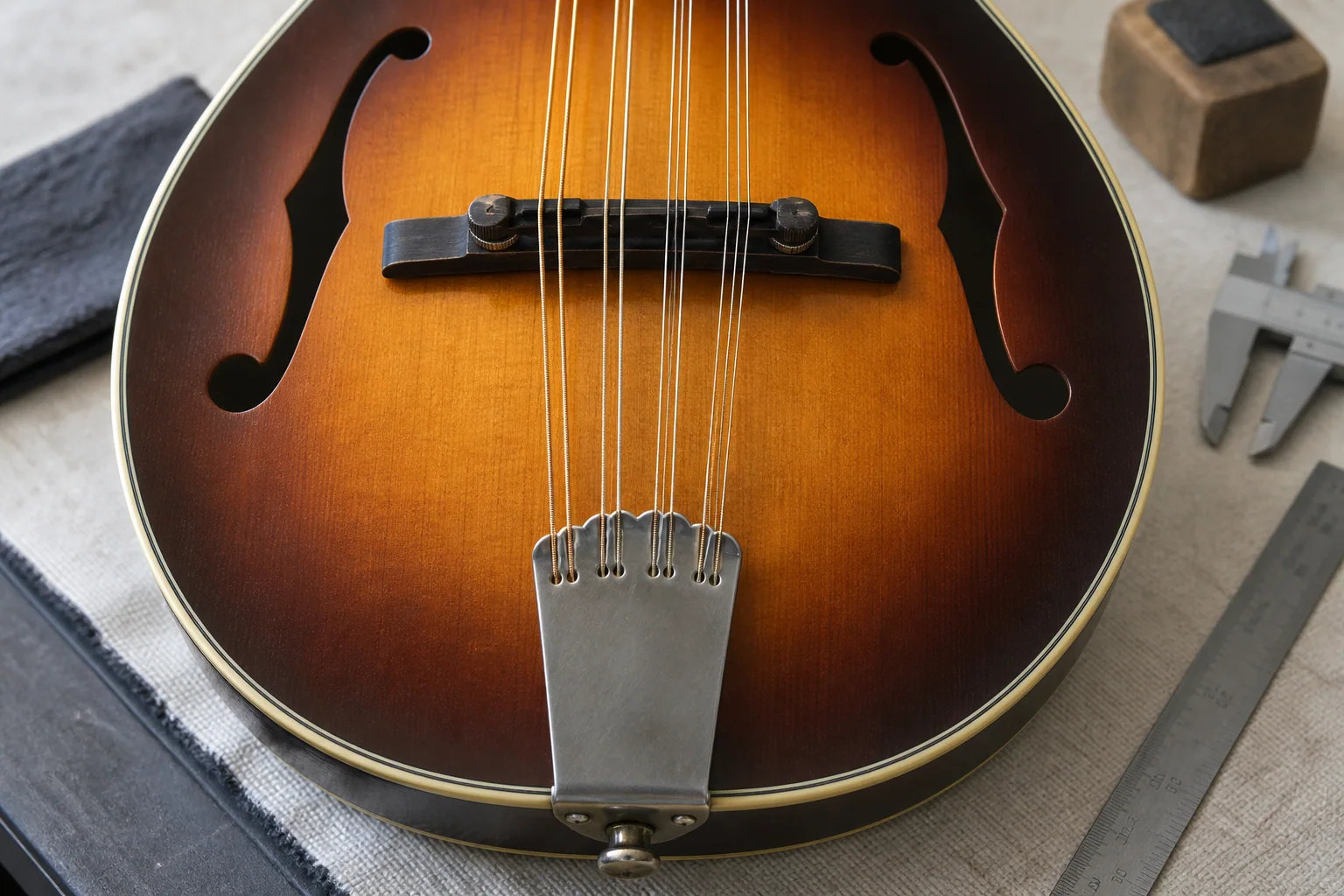
Illustrative visual: bridge and tailpiece details reviewed during mandolin sample approval.
The goal is not to write a longer component list. It is to make sure the selected parts work together on the actual sample.
Planning a mandolin project? Send the intended player, body direction, tuning, estimated quantity, branding and packaging requirements through the Vinesmusical contact page. We can review which decisions are confirmed and which still need a proposal before sampling.
Decide whether amplification belongs in the first model
An acoustic mandolin and an amplified version should not be treated as the same item with one extra component. A pickup or preamp affects routing, bridge or soundboard details, controls, battery access, output connection, weight, packaging and inspection.
If amplification is required, specify:
- Passive pickup, active preamp or another approved system.
- Pickup location and installation method.
- Control functions and expected control order.
- Output-jack location.
- Battery type and access if the system is active.
- Cable or accessory inclusion.
- Functional checks and the reference amplifier or signal path used during approval.
If the buyer is uncertain about amplified demand, it may be better to approve a clear acoustic model first and develop the electronics version as a controlled second project. That keeps the first sample focused and prevents an open electronics question from delaying every other decision.
Build sample approval around evidence, not impressions
A useful sample review separates measurable requirements from judgement calls.
Measurements may include scale, nut width, course spacing, action, body dimensions, weight range where agreed, logo position and carton size. Judgement is still needed for neck feel, finish appearance, acoustic response and general retail impression. Both types should be recorded.
Start from a dated specification. Mark the sample with a project code and revision. Review it in a consistent order:
- Confirm model identity and document revision.
- Check body, neck, scale and course layout.
- Inspect construction, finish and branding.
- Tune the instrument with the intended string set.
- Play across the fingerboard and listen for unwanted buzzes or dead notes.
- Check action, neck relief and bridge adjustment range.
- Review intonation and tuning-machine operation.
- Test electronics if fitted.
- Check accessories, labels and packaging.
- Record each requested change in one consolidated revision.
Avoid sending comments through several disconnected messages. “Lower the action,” “change the bridge” and “use a different string set” may describe one connected setup issue. A consolidated review lets the buyer and factory see how one change affects another.
Our OEM guitar specification sheet guide provides a practical way to organise model decisions, while the sample development guide explains how to control revisions before bulk production.
Include retail packaging in the approval
Compact instruments are still vulnerable to movement, bridge pressure, tuner impact and humidity changes during transport. The packaging brief should state whether the bridge remains in playing position, which accessories are packed with the instrument, and how the neck and body are supported.
Check:
- Inner protection around the headstock, bridge and body edges.
- Instrument movement inside the carton or case.
- Accessory placement so hard objects cannot mark the finish.
- Product labels, barcode locations and carton marks.
- Retail carton appearance and master-carton arrangement.
- Instructions for tuning, setup or bridge position where buyers require them.
A strong sample in weak packaging is not an approved retail product. Test and approve the complete pack before the bulk order is released.
Eight-string mandolin specification checklist
Before requesting a final quotation or sample, confirm that the brief answers these questions:
- Who is the intended player and where will the model be sold?
- Which body platform and construction direction are required?
- Are the four paired courses and intended tuning written down?
- Are the scale, nut, course spacing and neck profile defined?
- Are bridge, tailpiece and tuner choices compatible?
- Are finish, branding and natural-variation expectations clear?
- Is the model acoustic or amplified, and are the electronics requirements complete?
- Which measurements and playing checks will be used for approval?
- Which accessories, labels and packaging are included?
- Who owns the current revision and closes sample comments?
Frequently asked questions
Does “eight-string mandolin” always mean four paired courses?
That is the conventional arrangement, but a commercial specification should still state the course layout and intended tuning. The written record prevents assumptions and connects the string arrangement to the nut, bridge and setup.
Should a wholesale buyer specify every material before asking for a quotation?
Not necessarily. Confirm the materials that are essential to the product position and mark the rest as open for proposal. The important point is to distinguish a required choice from a factory suggestion so quotations can be compared on the same basis.
Is an A-style or F-style mandolin better for a first private-label model?
Neither is automatically better. The right choice depends on target player, retail position, visual expectations, construction direction and budget. A buyer should compare the commercial role of each platform before choosing decoration or finish.
What should be checked on the first mandolin sample?
Check the approved dimensions, four-course layout, neck feel, fretwork, setup, tuning stability, bridge adjustment, intonation, finish, branding and packaging. If electronics are fitted, test the complete system and control logic as well.
Can one approved sample control bulk production?
The sample is an important physical reference, but it should be supported by a dated specification, drawings or measurements, finish references, component list and packaging approval. Hidden or measurable details are easily lost when the sample is the only record.
A clearer brief produces a more useful sample
An eight-string mandolin project does not need a complicated engineering file on day one. It does need a clear distinction between confirmed requirements, acceptable proposals and open questions.
Begin with the player and the product's role. Then close the connected decisions around tuning, course layout, scale, neck, hardware, setup and packaging. When the sample arrives, review it against the same document instead of relying on memory or a group of reference photos.
Vinesmusical supports B2B OEM/ODM projects for brands, importers, distributors, wholesalers and private-label buyers. The company was established in 2014 and operates a company-owned factory of approximately 10,000 square metres across five floors, with an 80-person team and monthly capacity of approximately 7,000 guitars. Vinesmusical has 13 years of OEM/ODM experience, holds third-party BSCI certification, and has an in-depth factory audit report completed by an independent company.
To discuss an eight-string mandolin programme, review our current finished-instrument range and send your requirements. Include the intended market, player, reference model, specification direction, estimated quantity, branding and packaging. We will separate confirmed points from questions that need technical review before a sample is started.