 EN
EN
An acoustic-electric guitar is not automatically a higher grade of acoustic guitar. It is an acoustic guitar fitted with an electronics system for amplified use. That extra system can add value for the right customer, but it also adds specifications to approve, tests to perform and questions the retailer must be ready to answer.
For a buyer building a store range or private-label program, the useful comparison is not “basic versus premium.” It is unamplified use versus a genuine need to connect the instrument to a PA, amplifier, interface or other agreed equipment.
The short answer: choose the acoustic platform first—body, scale, neck, construction, finish and setup—then decide whether a verified electronics package serves the target customer. Compare the acoustic and acoustic-electric versions on the same physical standards. Test the amplified model both unplugged and connected. Keep the pickup, preamp, controls, battery and output-jack information in the product record rather than reducing the difference to “with EQ.”
Begin with the customer’s playing situation
A customer practising at home may value a comfortable, stable acoustic guitar and never connect it to anything. A singer performing in small venues may need reliable amplified output and accessible controls. A school may prefer simpler instruments with fewer batteries and parts to manage. A recording customer may care about both microphone use and a direct signal, without expecting the two to sound identical.
Those are use cases, not price points.
Before requesting a quotation, define the intended channel:
- General music retail.
- Beginner or student programs.
- Singer-songwriter and small-stage use.
- Worship or group performance.
- Travel and compact instruments.
- Private-label online retail.
- Rental, classroom or institutional programs.
Then ask what proportion of shoppers actually need onboard electronics. A store that adds a pickup to every body shape and finish can create a large assortment without adding much choice. A clearer range may use a few acoustic models for straightforward playing needs and a smaller number of well-documented acoustic-electric models for amplified use.
Compare the acoustic instrument first
Electronics should not hide the instrument underneath.
Use one checklist for both versions:
- Body shape and measured dimensions.
- Scale length and neck joint reference.
- Nut width, neck profile and string spacing.
- Top, back and side construction stated in precise material language.
- Bracing and internal workmanship relevant to the approved design.
- Bridge, saddle and nut material or specification.
- Fretwork, relief, action and playing condition.
- Finish colour, sheen and acceptable natural variation.
- Hardware, tuners, strap-button requirements and included accessories.
- Branding, label, serial or model information and packaging.
The recent acoustic guitar body-shapes guide explains why a familiar outline is not a complete body specification. The same principle applies here. A cutaway, preamp panel or output jack cannot stand in for dimensions, construction and setup.
If the acoustic and acoustic-electric products share one platform, document which parts are genuinely common. If they differ in bracing, body depth, cutaway, bridge area, hardware or finish, do not describe them as the same guitar with a pickup added.
“With pickup” is not a usable specification
The phrase appears in inquiries because it is quick. It leaves nearly every important electronics decision open.
A buyer should record, as applicable:
- Pickup or transducer type.
- Pickup location and installation method.
- Passive or active system.
- Preamp model or approved functional specification.
- Control functions and control order.
- Tuner function if present.
- Battery type, access and supplied status.
- Output-jack type and location.
- Internal wire routing and restraint.
- Mounting hardware, fasteners and service access.
- Test equipment and acceptance method.
- Packaging clearance around controls and jacks.
If a named branded system is required, confirm the exact model and authorised supply. If the project uses an unbranded or custom system, the functional description and approved sample become even more important. Avoid phrases such as “high quality pickup” unless the page explains what was tested and on which model.
Treat electronics as a complete system
An acoustic-electric guitar can produce sound through an amplifier and still be poorly approved.
The pickup, preamp, controls, power source, output jack, wiring and installation work together. A change to one part can affect noise, balance, access, service or packing. The buyer therefore needs a system record, not a list of disconnected components.
During sampling, photograph the external controls and the relevant internal installation. Record part labels or revision markings where appropriate. Check whether connectors lock correctly, whether wires can move into contact with the body and whether the battery is restrained. Confirm that the cable exits without forcing the jack or colliding with the player.
Test the system through agreed equipment. A factory bench, buyer office and retail store may use different amplifiers, cables and rooms. The record should name enough of the signal chain to make a repeated check meaningful.
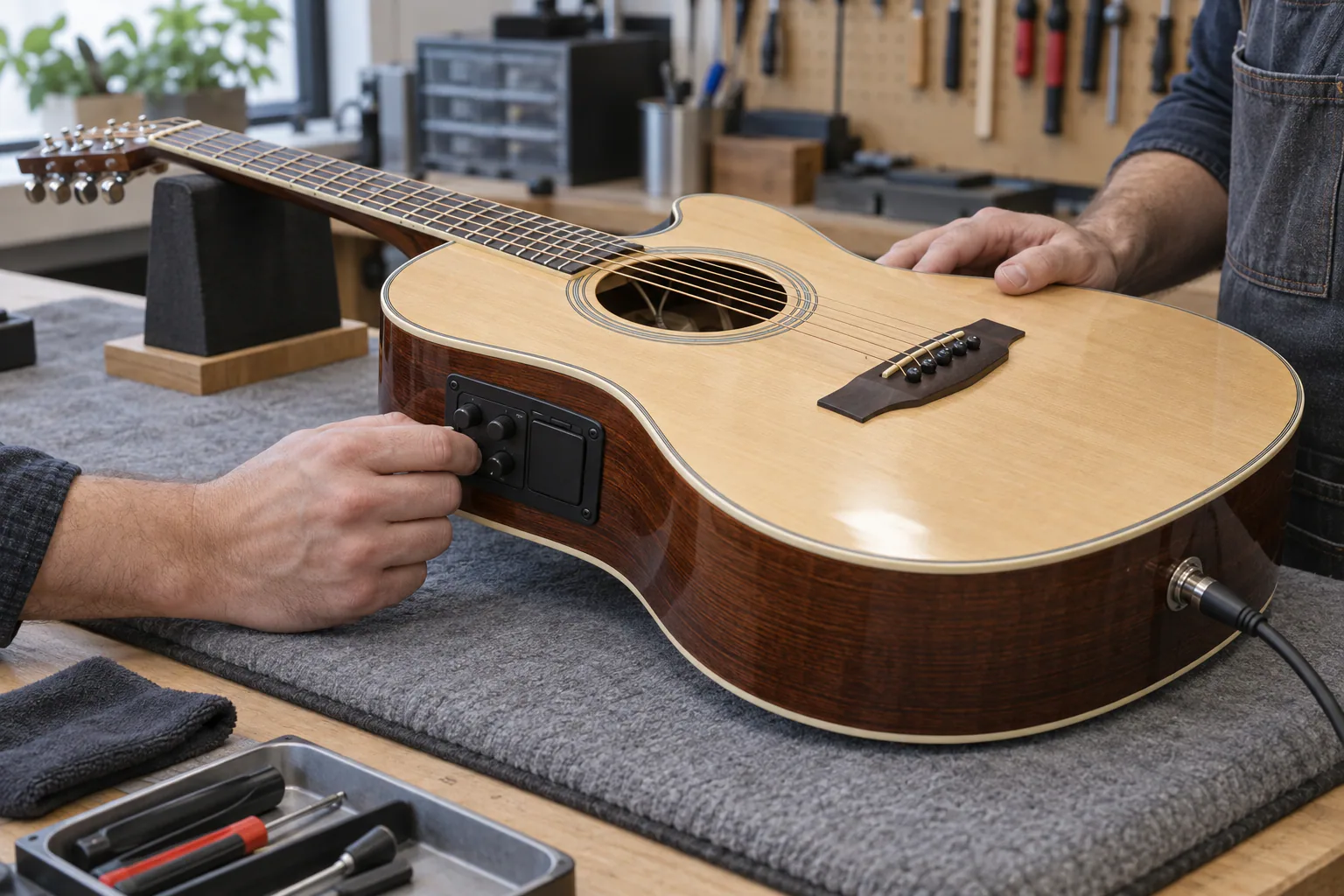
Check amplified response course by course and position by position
For a six-string acoustic-electric guitar, play each string at several positions and with realistic force. Listen for large output differences, intermittent signal, unexpected distortion, rattles and control noise. Strum chords softly and firmly. Move the cable gently at the jack. Operate every knob, slider, switch and tuner function through its working range.
Do not use this test to promise that every pickup will reproduce the instrument exactly as a microphone would. The goal is to approve the specified system for the intended use and to identify obvious imbalance or faults.
Retest after the instrument has been handled, tuned and packed. Intermittent connections may appear only after movement. A battery door that seems acceptable on the bench may become awkward when the guitar is inside its bag. A control panel can sit too close to a case wall or carton support.
The electric guitar and bass electronics QC guide provides a broader signal-and-controls framework. Adapt it to the actual acoustic-electric system instead of copying electric-guitar acceptance points without review.
Cutaway and electronics are separate decisions
Many retail ranges combine a cutaway body and onboard electronics, so buyers may begin to treat them as one package. They solve different needs.
A cutaway changes upper-fret access and body geometry. Electronics provide a signal path for amplified use. A model can have either feature, both or neither.
Document them separately:
| Decision | Question for the buyer | Sample evidence |
|---|---|---|
| Cutaway | Which outline and access are required? | Drawing, full-body photo and physical access check |
| Pickup | What sensing system is approved? | Part/system record and installed sample |
| Preamp | Which controls and functions are required? | Control map and connected test |
| Output jack | Where should the cable connect? | Location, hardware and movement check |
| Battery | How is power installed and serviced? | Access test and packing clearance |
This prevents a later substitution such as moving an approved electronics package into a different cutaway body without reviewing installation, acoustic response and packaging.
Plan the range around use cases
A retailer rarely needs every acoustic model in both plain and acoustic-electric form on the first order.
Start with a small matrix. Put customer use across the top and product decisions down the side. A beginner-focused model may prioritise setup consistency and clear product information. A performance-oriented acoustic-electric may add a cutaway, accessible controls and a thoroughly tested output. A compact travel model may require a separate check for control placement, bag fit and balance.
Avoid filling the matrix with finishes before the functional products are clear. Three body shapes, four colours and two electronics choices can turn into twenty-four combinations. Many of those combinations may be visually different but commercially redundant.
Use distinct models where the use case, geometry, construction or electronics changes. Use controlled options where only an approved finish or branding element changes. Keep enough common parts to support repeat orders without presenting every shared component as proof that the instruments perform identically.

Compare quotations by scope, not by the lowest total
An acoustic-electric quotation may include an electronics system, battery, cable, bag or upgraded carton—or it may not. A lower total can simply represent a smaller scope.
Use separate lines for:
- Base instrument specification.
- Cutaway or body variation.
- Pickup and preamp system.
- Electronics installation and related hardware.
- Branding and artwork.
- Accessories.
- Bag or case.
- Inner and export packaging.
- Testing, inspection or documentation requirements.
- Sample and revision scope.
Ask suppliers to identify alternatives rather than silently substituting. If a pickup system changes, the buyer should be able to see the affected price, function, sample and delivery discussion. The OEM guitar pricing-factors guide explains why material, finish, quantity, customisation, packing and quality requirements need to be compared on matched assumptions.
Developing an acoustic or acoustic-electric range?
Send Vinesmusical the target customer, body and neck reference, construction direction, acoustic or amplified use, electronics needs, branding and packing plan. We can review the open fields before sampling. Share your project requirements.
Sample approval needs two listening sessions
For an acoustic-electric model, plan an unplugged evaluation and a connected evaluation.
Unplugged
Confirm identity and revision. Inspect the body, neck joint, bridge, saddle, nut, frets and finish. Measure using the agreed method. Play every fret and string. Listen for buzz, rattle, choking, loose parts and uneven response. Check tuning behaviour after normal playing.
Connected
Use the agreed cable and test equipment. Confirm power, output, tuner and every control. Play single notes and chords across the neck. Listen for imbalance and intermittent faults. Move the cable at the jack without applying abusive force. Check for handling noise or internal rattle.
After adjustment
Record anything changed during the session. A saddle, battery restraint, wire route or control can be corrected on the sample without appearing in the product specification. The final approved state, not the sample’s arrival state, should control production.
Use the sample-development guide to turn comments into dated revisions and close open decisions before the order moves forward.
Product pages must distinguish features from evidence
An honest acoustic-electric product page can be detailed without sounding inflated.
State the model’s intended use, body and neck data, verified construction, finish, electronics system and included items. Show photographs of the actual approved or production model. Include clear images of the controls, output jack and battery access where relevant.
Avoid generic claims such as “professional sound,” “perfect for stage” or “premium electronics” when the page provides no test, part or product context. A more useful sentence names what the player can see and use: the model includes the specified pickup/preamp system, lists the control functions and shows how power is accessed.
Keep an educational illustration labelled as an illustration. It may explain a signal path or buying decision, but it is not proof that a listed model contains the hardware shown.
Use consistent naming in the H1, specification table, Product schema, image ALT text, quotation and packing list. “Acoustic-electric,” “electro-acoustic” and local market terms may all appear in searches, but one product record should not switch terms so often that the model becomes unclear.
After-sales planning is different for the amplified model
Both guitars need basic setup and care information. The acoustic-electric version adds service questions:
- Which battery is used, and is it supplied?
- How should the battery be installed and removed?
- What do the controls do?
- Which cable connection is expected?
- What should staff check if no signal is present?
- Is the output jack also a strap attachment point?
- Which parts can be replaced without damaging the instrument?
- What revision of the electronics system is in this batch?
Prepare simple, model-specific answers. Do not ask retail staff to diagnose a custom system from a generic preamp leaflet. Keep replacement components and revision records aligned with the shipped batch.
Schools, rental programs and high-turnover stores should consider who will maintain batteries and inspect jacks. A feature that helps one performer can create avoidable support work in a channel that rarely uses amplification.
Packaging must protect controls and service points
A plain acoustic guitar and its acoustic-electric version may not fit a bag or carton in exactly the same way.
Check the control panel, battery door, jack and cable hardware against the bag lining, neck support and carton inserts. Nothing should carry pressure from the packaging. Accessories should not move across the finish or strike the preamp area. If a battery is included, its packed state should follow the approved safety and product instructions.
Photograph the complete pack-out and list every included item. Inspect the instrument again after the packaging test. The OEM guitar packaging approval guide shows how to record materials, support points, accessories and test results for repeat production.
Common assortment mistakes
Treating acoustic-electric as a quality grade
It describes an instrument with electronics, not an automatic improvement in acoustic construction or setup.
Adding electronics to every option
Build around customer use. Too many nearly identical variants can divide inventory and complicate support.
Approving only through an amplifier
Inspect and play the acoustic instrument unplugged before judging the electronics.
Accepting “pickup with EQ” as the full record
Define the system, controls, power, output, installation and test method.
Reusing one photograph
Show whether the exact model has controls, a cutaway, jack and battery access. The image must match the listing.
Forgetting after-sales information
Retailers need model-correct battery, control and troubleshooting notes before the first customer asks.
Buyer FAQ
Is an acoustic-electric guitar better than an acoustic guitar?
Not automatically. It is the better fit when the intended player needs onboard amplification and the system is properly specified and tested. For unamplified practice, teaching or simple retail use, a well-approved acoustic model may be the clearer choice.
Does acoustic-electric always mean cutaway?
No. A cutaway and an electronics system are separate product decisions, even though they are often combined in retail models.
Can the acoustic and acoustic-electric versions share one specification?
They can share controlled base-platform fields, but the amplified version needs its own electronics, installation, test, packing and support information. Any body or construction difference must also be recorded.
What should a retailer test on an acoustic-electric sample?
Test the instrument unplugged for workmanship, setup and playability. Then connect it to agreed equipment and check power, output, string balance, controls, tuner, noise, cable movement and installation. Retest after adjustments and packing.
Should every model in a retail range have an acoustic-electric option?
Usually not without a clear use case. Start with the customers and channels that need amplification, then build a small, understandable model matrix.
What information belongs on the product page?
List the actual body and neck specification, verified construction, finish, electronics system, control functions, power access, output connection and included items. Use photographs of the exact model and avoid unsupported performance claims.
Final buyer checklist
- Target customer and amplified use are defined.
- Acoustic platform is approved before electronics are used as a selling point.
- Cutaway and electronics are documented separately.
- Pickup, preamp, controls, power and output jack are recorded.
- Unplugged and connected test methods are written.
- Every string, fret and control has been checked.
- Adjustments made during sampling return to the specification.
- Product photos show the exact model and electronics.
- Battery and control instructions are prepared.
- Variant count reflects real customer needs.
- Quotation lines separate the base instrument and added scope.
- Packaging clears controls, jack, battery door and accessories.
Choose the function before the feature
The strongest acoustic and acoustic-electric ranges begin with different customer jobs, not a ladder of adjectives.
Approve the guitar as an acoustic instrument. Add electronics where amplified use justifies the extra system. Record that system in enough detail to sample, test, describe, pack and support it. When the range is built this way, customers can see why each model exists and the supplier can repeat the model that was actually approved.
If you are planning a private-label acoustic or acoustic-electric guitar project, send Vinesmusical the target customer, body and neck direction, construction, setup, electronics, branding and packaging requirements. Contact us to review the specification before sampling.