 EN
EN Español
A buyer comparing a bajo quinto and a bajo sexto can settle the first question without a long specification sheet. Count the paired courses. A bajo quinto has ten strings arranged in five courses. A bajo sexto has twelve strings arranged in six courses.
That answer is simple. The purchasing decision is not.
For a music retailer, importer or private-label buyer, the missing course changes more than the number on a hangtag. It affects the instrument’s identity, the neck and bridge layout, the string set, the product information customers need and the way a sample should be evaluated. It can also change which players will recognise the model as the instrument they came to buy.
The practical answer: treat bajo quinto and bajo sexto as two separate products from the first inquiry. Give each one its own model code, course diagram, tuning reference, sample record, product-page copy and packing checklist. If a store plans to carry both, make the difference visible to purchasing, sales staff and customers instead of relying on the word “quinto” or “sexto” to do all the work.
Start with the musical category, not the English translation
The word bajo can send an unfamiliar buyer in the wrong direction. It does not make either instrument an electric bass. It also does not turn the bajo sexto into a standard twelve-string acoustic guitar.
The Library of Congress identifies the bajo sexto as a Mexican musical instrument. Smithsonian Folkways documents its place in conjunto and Tejano music, where it works with the accordion and contributes rhythm, chords and bass movement. Texas A&M University describes the bajo quinto as the ten-string version of the twelve-string bajo sexto.
Those sources establish a useful product boundary. A retailer should present both instruments in their own regional and musical context. A page called “bass guitars,” a generic twelve-string specification or an acoustic-guitar tuning card will not explain the product correctly.
This matters even if customers already know what they want. Search filters, staff training, warehouse labels and invoices still need unambiguous names. One loose translation can travel from an inquiry into a quotation and then into a carton mark.
Count courses before comparing features
The safest first line in a sourcing brief is literal:
- Bajo quinto: ten strings arranged in five paired courses.
- Bajo sexto: twelve strings arranged in six paired courses.
Write “paired courses,” not only “10-string” or “12-string.” The course description tells the reader how the strings are organised for playing. It also gives production and quality teams a common way to discuss nut slots, course spacing, bridge positions and setup.
Next, add a diagram. Number the courses and show the two strings within each course. State whether the list runs from the lowest-sounding side to the highest or in the opposite direction. Record the intended tuning and any unison or octave relationship within a pair. Do not assume that a familiar note list will be interpreted in the same order by the buyer, factory, photographer and person writing the customer card.
The actual approved string set belongs beside the diagram. Material and gauge influence tension, nut fit, saddle behaviour, action and the way the paired strings settle. A sample evaluated with one set and a production batch shipped with another is not the same approved setup.
Do not turn the comparison into a list of stereotypes
Buyers sometimes want one sentence that says which instrument is “brighter,” “deeper,” “more traditional” or “easier.” Those descriptions are not reliable purchasing specifications.
The finished result depends on the whole instrument: body dimensions, top and back construction, bracing, scale, neck profile, course spacing, string set, bridge work and setup. Electronics and amplification add another layer. Two bajo sextos built to different designs may feel less alike than a casual category description suggests.
Use the category distinction to identify the product. Use a physical sample and controlled measurements to approve how the selected model actually performs.
When a player says one sample feels crowded, ask where. Is the space within each pair too tight? Are the gaps between courses unsuitable? Does the outer course approach the fingerboard edge? Does the neck profile create the problem rather than the width? A useful comment leads to a place, a condition and a measurable revision.
A retail buyer should compare complete product briefs
Once identity is fixed, compare the two models using the same headings. This prevents the extra course from hiding other differences.
| Decision area | Bajo quinto record | Bajo sexto record | Why keep it separate |
|---|---|---|---|
| Product identity | Ten strings, five paired courses | Twelve strings, six paired courses | Stops model and listing errors |
| Intended channel | Named player and retail use | Named player and retail use | Avoids a generic “regional instrument” brief |
| Tuning | Course order and pair relationships | Course order and pair relationships | Prevents copied diagrams |
| Installed strings | Approved set or complete material and gauge record | Approved set or complete material and gauge record | Keeps setup repeatable |
| Geometry | Scale, body, neck, nut, spacing and bridge reference points | Scale, body, neck, nut, spacing and bridge reference points | Allows meaningful sample comparison |
| Construction | Verified materials and structure | Verified materials and structure | Keeps claims tied to the actual model |
| Electronics | None or approved system | None or approved system | Separates acoustic and amplified variants |
| Branding | Model name, label and artwork revision | Model name, label and artwork revision | Avoids copied product identity |
| Packing | Approved bag/case, protection, accessories and carton | Approved bag/case, protection, accessories and carton | Reduces warehouse mix-ups |
The OEM specification sheet guide provides a useful base, but the course diagram and string information must be adapted for each instrument.
Decide whether the range needs one instrument or both
A specialist conjunto retailer may have a clear reason to carry both. A broader music store may be better served by introducing one model carefully, training staff and learning what local players request before adding a second.
The decision should come from the customer base, not from a desire to make the catalogue look larger.
Ask the sales team:
- Do customers use the names bajo quinto and bajo sexto precisely?
- Which instrument do local teachers, performers and ensembles request?
- Are shoppers replacing an existing instrument or discovering the category?
- Can staff explain the five-course and six-course distinction?
- Can the store support replacement strings and basic setup questions?
- Is there enough verified information to build two genuinely distinct listings?
If those answers are unclear, begin with interviews and reference instruments. A handful of conversations with working players can prevent a buyer from ordering a visually plausible model that does not fit the local use.
If both instruments enter the range, do not position one as merely a smaller or cheaper version of the other. Give each page an answer-first definition, a course diagram, model-specific specifications, actual photographs of the approved product and a link to the other model for comparison.

Keep model families understandable
After the instrument choice, a buyer may consider cutaway, electronics, finish or trim options. This is where a simple range can become difficult to control.
A useful model code should reveal the stable product identity before the option. For example, a buyer might reserve distinct prefixes for quinto and sexto models, then add controlled suffixes for an approved electronics or finish variant. The exact code system is less important than using it consistently across the quotation, sample label, artwork, carton and product feed.
Avoid creating a separate SKU for every small visual change before the base model is proven. Each SKU needs photographs, specifications, inventory, replacement information and a repeat-order record. A wide assortment with thin documentation is harder to sell and easier to mix up.
The same caution applies to acoustic-electric versions. An output jack in a photograph does not define the electronics system. Record the pickup or transducer type, preamp and controls where applicable, battery access, installation, cable clearance and test method. Only publish features that exist on the approved model.
Planning a bajo quinto or bajo sexto range?
Send Vinesmusical the target market, reference instrument, five- or six-course direction, tuning, string set, model options, branding and packing needs. We can identify missing decisions before the first sample is evaluated. Share your project requirements.
Evaluate samples with the intended player
A purchasing team can verify dimensions, workmanship and documents. A player familiar with the intended musical setting should also evaluate the sample.
Start by confirming the label and course count. Tune the instrument with the approved string set and written diagram. Play every string alone and each pair together. Listen for uneven response within a course, rattles, binding, dead notes and unexpected contact at the nut, frets or bridge.
Then play the chords, bass movement and rhythmic patterns the instrument is expected to handle. Note where reach, pressure, course spacing or neck shape affects the player. Retune and repeat. A comment about tuning stability is more useful when the record also says how the strings were installed, settled and played.
Measure relief and action with named reference points. Record the tool, capo or fretting method, measurement fret and environment. Check outer-course clearance along the fingerboard, not only at the nut. Inspect the bridge and saddle for course alignment and clean contact.
The detailed bajo quinto sample-inspection guide covers a ten-string, five-course evaluation. The bajo sexto sourcing guide explains how to build the six-course brief and retail plan. Use the two records together when the range includes both products.
Compare acoustic and amplified variants separately
“With pickup” is not a complete variant description. It also should not distract from the acoustic instrument underneath.
First approve the model unplugged: identity, construction, string path, neck, fretwork, bridge, finish and setup. Then test the electronics as a separate system. Connect the sample to the agreed equipment. Operate every control. Move the cable gently at the output jack and listen for interruption. Play all courses at realistic force and check whether the response is even enough for the intended use.
Inspect the installation inside and outside the body. Wires, battery bags, preamps and jacks should be secure and should not introduce rattles or interfere with packing. The user must be able to access any battery or control as intended without damaging the instrument.
The electric guitar and bass electronics QC guide offers a reusable test structure, but acceptance points should be adapted to the actual system in the bajo model.
Product pages should answer the first five questions quickly
A good listing does not begin with a paragraph of adjectives. It helps the right customer identify the instrument.
Near the top of the page, state:
- Is this a bajo quinto or a bajo sexto?
- How many strings and paired courses does it have?
- What tuning and string reference applies to this exact model?
- Is it acoustic or fitted with the specified electronics?
- What verified dimensions, materials and included items describe the product shown?
Use photographs of the approved sample or production model for commercial pages. A generated image may help explain a course-count concept in an educational article, but it should not stand in for product evidence.
The page title, structured product data, specification table, image ALT text and downloadable material should all use the same model name. If a Spanish description is supplied for a Mexican market, have a knowledgeable speaker review the instrument terminology. Smooth translation is not enough if the wrong category name survives.
Packaging and after-sales details are part of the comparison
Paired-course instruments bring predictable support questions. Customers may ask which replacement set fits, how the courses are tuned, whether a pickup battery is included or where an accessory sits in the case.
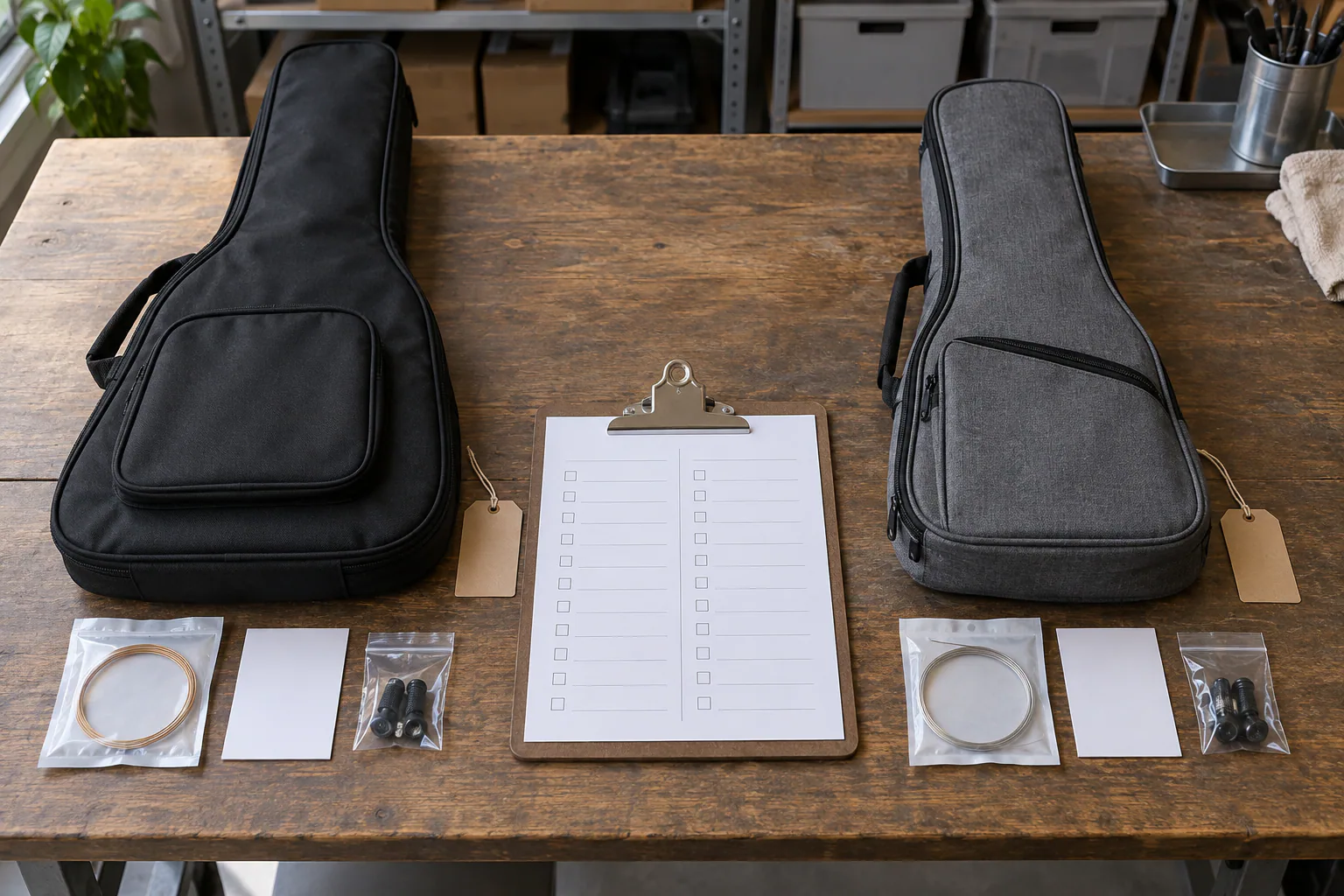
Prepare those answers while the approved sample is on the inspection table. Photograph the string package, tuning card, accessories and final pack-out. Confirm that the course information matches the model. A bajo quinto card inside a bajo sexto carton is a small printing error with a large customer effect.
Check headstock clearance and tuner protection carefully. More tuning machines create more contact points that can be loaded by a tight bag or carton. Support the neck and body without forcing the bridge, controls or headstock against the packaging. Repeat the instrument check after the pack-out or transport test.
Use the packaging approval guide to record the materials, positions, accessories and test result rather than approving a packing arrangement from one photograph.
Common purchasing mistakes
Treating the instruments as one configurable SKU
Five and six courses affect product identity and core geometry. Use separate specifications and model records.
Copying the tuning card
Write and verify the course order, pair relationships and installed string set for each model.
Using a standard acoustic-guitar template unchanged
Add course spacing, pair layout and model-specific playing checks. Do not assume “10-string” or “12-string” supplies the missing detail.
Ordering both before confirming demand
Use local player and retailer evidence to decide whether one or both instruments belong in the assortment.
Publishing an illustrative image as product proof
Use the final approved product for listings, quotations and claims. Label educational visuals honestly.
Approving the instrument but not the documentation
The correct sample can still be sold badly if its name, tuning, strings, images or packing record are wrong.
Buyer FAQ
What is the main difference between a bajo quinto and a bajo sexto?
A bajo quinto has ten strings arranged in five paired courses. A bajo sexto has twelve strings arranged in six paired courses. Each should have its own tuning, string, geometry, setup and product-information record.
Is a bajo sexto just a twelve-string acoustic guitar?
No. The shared string count does not make the categories interchangeable. A bajo sexto has its own regional musical role, product identity and setup requirements.
Is a bajo quinto an electric bass?
No. The word bajo does not place it in the electric-bass category. It is a distinct paired-course instrument associated with regional Mexican music.
Should a retailer carry both?
Carry both when customer demand, staff knowledge and product information support two clear listings. A general store may prefer to establish one model first rather than duplicate an unfamiliar category.
Can one product specification cover both instruments?
No. A shared template can provide headings, but the identity, course diagram, tuning, strings, dimensions, setup, artwork and packing record must be model-specific.
What should a buyer send before requesting a sample?
Send the intended instrument, target player and market, reference or drawing, course layout, tuning, installed string requirement, main dimensions, construction direction, electronics if any, finish, branding and packing scope. Mark unresolved items as open questions.
Final checklist
- The inquiry says bajo quinto or bajo sexto, not only “bajo.”
- The number of strings and paired courses is written explicitly.
- Course order, tuning and pair relationships are diagrammed.
- The approved string set is recorded.
- Geometry and setup use shared measurement points.
- Each instrument has its own model code and revision.
- Acoustic and amplified variants have distinct verified fields.
- Player evaluation uses the intended strings and tuning.
- Product copy and images match the approved model.
- Replacement-string and tuning information is ready.
- Packaging protects the actual headstock, tuners, body and bridge.
- Changes return to the controlled specification before production.
Keep the difference visible
The most useful comparison is not a claim that one instrument is universally better. It is a clear decision about which players and retail channel the product must serve.
Count the courses first. Then keep the five-course and six-course records separate through sampling, approval, listing, packing and repeat orders. That discipline gives the customer the instrument named on the page and gives the buyer a product that can be ordered again without reconstructing the decision from memory.
If you are developing a bajo quinto, a bajo sexto or a coordinated range of both, send Vinesmusical the target market, reference, course layout, tuning, string set, model direction, branding and packaging requirements. Contact us to review the product brief before sampling.