 EN
EN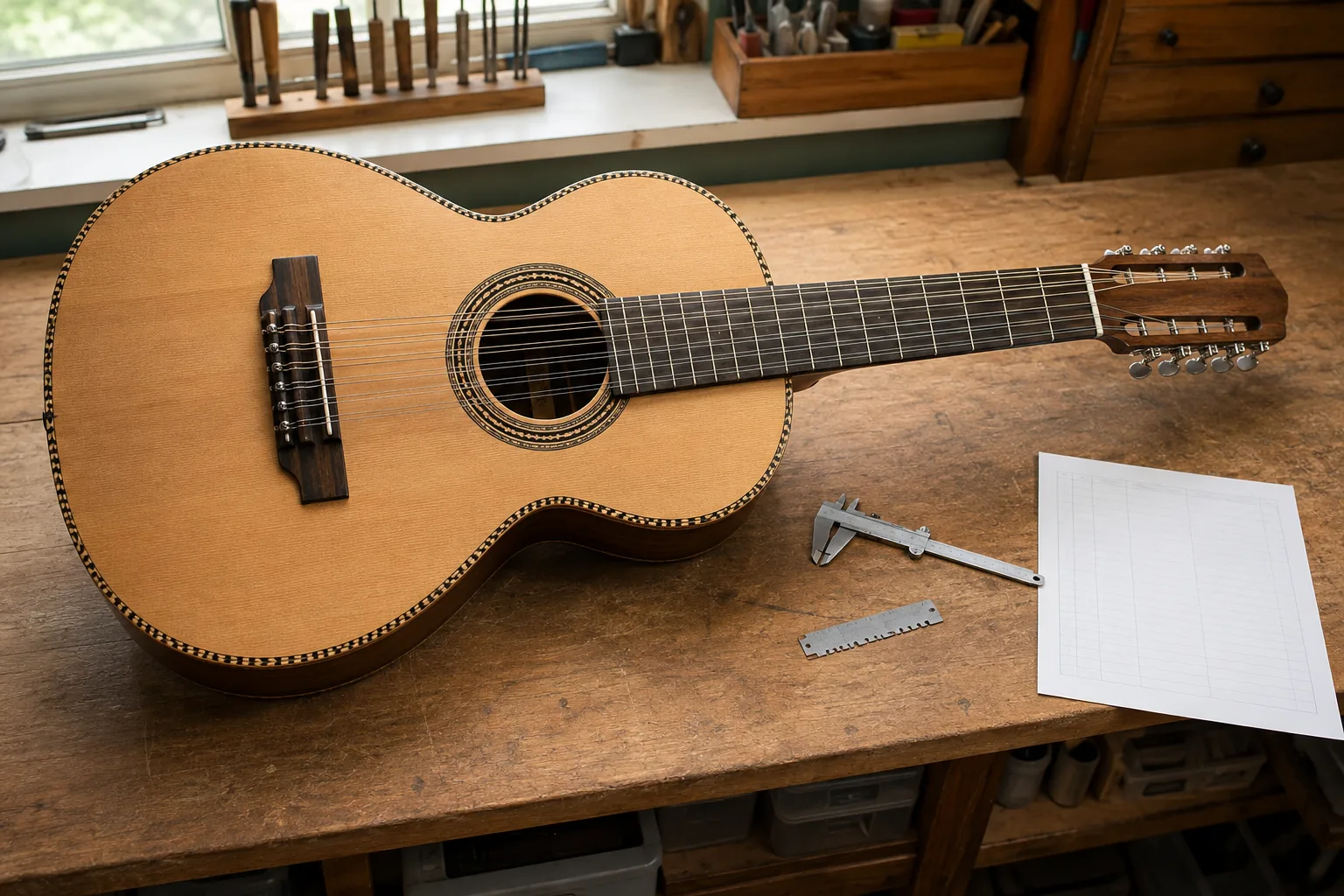
A bajo quinto sample is easy to approve too quickly.
The finish looks clean. The instrument tunes up. The pickup produces sound. A buyer takes a few photographs, sends an approval message and moves on to the order. Weeks later, the production file still does not explain the five paired courses, string set, setup method or which details made the sample acceptable.
That is not a complete approval.
For a wholesale buyer, the sample is both an instrument and a production reference. It should be measured, played, photographed and compared with a dated specification. Any change agreed during inspection needs to return to the drawing and model record.
The short answer: confirm that the instrument is a bajo quinto with ten strings in five paired courses, then inspect scale, body, neck, nut, bridge, course spacing, setup, intonation, finish, electronics, labeling and packing. Record the method as well as the result. The factory cannot repeat an approval that exists only in somebody’s memory.
Confirm that the sample is a bajo quinto
Start with identity before quality.
Texas A&M University describes the bajo quinto as a ten-string version of the twelve-string bajo sexto. That distinction is useful in a purchasing file. A bajo quinto is not an electric bass despite the word “bajo,” and it is not a viola caipira simply because both can have ten strings.
The sample label and specification should state:
- Product type: bajo quinto.
- Ten strings arranged in five paired courses.
- Acoustic or acoustic-electric version.
- Cutaway or non-cutaway body, if that choice is part of the range.
- Model code and current revision.
- Target market and customer group.
Keep bajo quinto and bajo sexto documents separate. A shared folder called “bajo instruments” invites the wrong tuning card, carton label or photo to enter a product listing. Use distinct filenames, model prefixes and image folders from the start.
The same care applies to website navigation. A buyer searching for a bajo quinto should not land on an electric-bass page. Related instruments can link to one another, but their specifications and search intent remain different.
Make the sample record before the inspection meeting
An inspection works better when the buyer knows what will be checked.
Prepare a sheet with the latest drawing, material description, finish reference, electronics requirement, string set, tuning, setup method and packing list. Add spaces for the actual measurements and comments. Put the revision date on every page.
Photographs should be planned too. Capture the front, back, sides, headstock, nut, fretboard, bridge and label. Add close views of any issue and place a ruler or gauge in the frame where the measurement matters. A photo of a caliper beside the instrument is not evidence unless the reading and contact points are visible.
The OEM specification sheet guide can be adapted to the bajo quinto. Keep product-specific course and string fields instead of using a six-string guitar form unchanged.
If the sample has already been revised, include the previous issue list. Inspect the correction first. Do not let a new attractive detail distract from an old unresolved problem.
Measure identity and geometry before playing
A short measurement pass establishes whether the sample matches the intended platform.
Check overall length, body length, upper and lower widths, waist, depth, scale length, nut width and any body-joint reference used in the drawing. Confirm the neck centerline and bridge position. On a cutaway model, compare the cutaway shape with the approved outline rather than judging it from memory.
Measure using agreed reference points. “Body depth” might mean the wood rim only, or the finished dimension including top and back arch. “Nut width” can mean the full nut or the outer-string spread. Write the method next to the result so the factory and buyer use the same definition later.
The goal is not to collect numbers for their own sake. Geometry affects cases, cartons, playing feel and the ability to reuse accessories. A small body-outline change can make an approved bag too tight. A bridge moved to correct intonation can alter the visual balance of the top.
Record the actual sample values. If a value differs from the brief but the buyer prefers the sample, update the controlled specification. Do not leave the drawing wrong and rely on a note saying “follow sample.”
Inspect the five paired courses as a system
The ten strings work in five courses, so inspect them as five playing units as well as ten individual strings.
At the nut, look for consistent spacing within each pair and comfortable spacing between courses. Each string should sit in a slot suited to its gauge. Slots that are too tight can bind during tuning. Slots that are too loose can allow sideways movement or noise. The top of the string, slot depth and break angle should follow the approved setup approach.
Follow every string from tuner to bridge. Look for contact with adjacent posts, sharp bends and crossed paths. Operate each tuner and feel for excessive play or uneven resistance. Several tuning cycles will reveal more than one quick turn.
At the bridge, confirm the same course logic. Paired strings should not suddenly spread or pinch. Check saddle contact, string anchoring and the relationship between bridge position and the approved intonation method.
Use the approved string set during inspection. A different gauge changes tension and can change relief, action, nut behavior and intonation. If the commercial brand may change, the production file still needs material and gauge information plus an approval process for equivalents.
Play single strings and both strings in every course. A pair can sound uneven even when each string works alone. Listen for rattles, sitar-like noise, dead response and strong imbalance. Note whether the problem follows the string, fret position or course.
Check the neck and frets by method, not impression
“The neck feels good” is a useful player reaction, but it is not enough for production control.
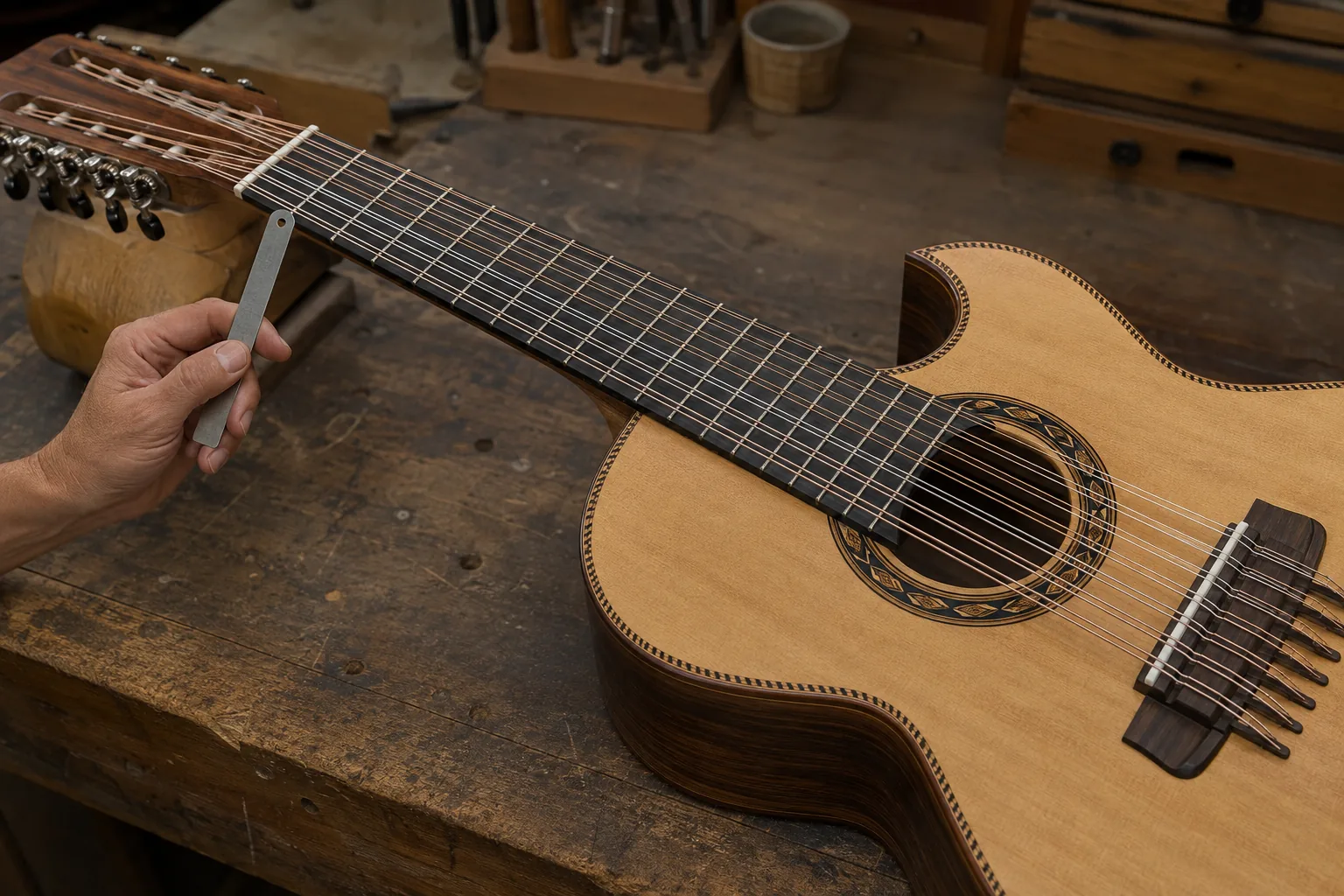
Measure relief with the instrument tuned to the approved tuning and string set. Record the capo position, fretting point, measurement fret and tool. Measure action at the named fret from the same surfaces each time. Note the environment if humidity or temperature could explain a material difference.
Then play every fret on every string. Use light and firm attack. Test fretted notes and full courses. Listen across the neck rather than only in the comfortable chord area. Check for high frets, loose fret ends, sharp edges and finish buildup along the fingerboard.
Inspect neck alignment visually and by measurement. The outer courses need suitable clearance from the fingerboard edges. A neck can meet the centerline on paper while the string path leaves one outer course too close to the edge.
Feel the back profile from the first position toward the body. If the buyer approved a reference profile, use profile templates or measured points. Descriptions such as “comfortable C” are subjective and are interpreted differently by different teams.
The fretboard and neck finishing guide provides a broader checklist for feel, fretwork and clean finishing.
Evaluate tuning and intonation in the intended setup
Write the tuning in a fixed course order and show the octave or unison relationship within each pair. Do not assume the reader knows which end of the list comes first.
Tune slowly and observe how the strings settle. Stretch new strings using the agreed method, retune and repeat the playing check. A sample approved immediately after installation may behave differently after the strings have settled.
Use one intonation method for the buyer and factory. State the tuner, reference pitch, fretted positions and acceptable evaluation method. Heavy fretting pressure can make a result look worse, especially with paired steel strings. The person checking production should be able to reproduce the sample test.
If one course requires correction, diagnose before changing the drawing. Check string condition, nut behavior, saddle contact and playing pressure. Document any saddle or setup adjustment made during the inspection. The final approved state, not the arrival state, should control production.
Avoid publishing a detailed customer tuning guide until the final string set and sample setup are approved. The retail instructions must describe the instrument customers will actually receive.
Review the body, bridge and internal noises
Inspect the top, back, sides and neck joints under angled light. Look for gaps, excess adhesive, uneven binding channels and finish sinking that may reveal surface preparation issues. Natural wood grain should be judged against an approved variation range, not compared with one exact photograph.
Press and release gently around the bridge, body edges and areas where hardware is installed. Shake the instrument carefully and listen for loose parts. Play at several volumes. A buzz that appears only under a stronger attack can be missed during a quiet office inspection.
Look inside with suitable light. Confirm that braces, wiring and any accessible components are secure and clean. The purpose is not to reverse-engineer another brand’s design. It is to verify that the sample matches the buyer’s approved construction and contains no obvious loose or unfinished work.
The bridge deserves a separate photo. Record its position, shape, saddle, string anchoring and surrounding finish. If the design includes an adjustable feature, document its approved operating position and adjustment limits.
Check cutaway and non-cutaway models separately
Current market offerings show both cutaway and non-cutaway bajo quintos. That makes body style a real assortment decision, not a detail the factory should choose on the buyer’s behalf.
A cutaway can improve access to upper frets, but the buyer still needs to evaluate balance, appearance and internal construction. A non-cutaway may suit a traditional visual direction, but that does not make it automatically better for every player.
If both are in the range, inspect them as separate models. Do not approve one body and assume the other will inherit the same setup. Confirm body dimensions, case fit, bracing or reinforcement records, finish boundaries and model photography for each version.
For the first order, a retailer may prefer one body style with a clear customer reason. Extra variants create more samples, images, cartons and replacement records. Add a second shape when the channel can explain and support the difference.
Preparing a bajo quinto sample?
Send Vinesmusical the target customer, approved reference or drawing, ten-string five-course layout, tuning, string set, cutaway choice, electronics, branding and packing needs. We can review the inspection fields before the sample is evaluated. Send your requirements.
Test acoustic-electric versions as instruments and systems
For a pickup-equipped model, inspect the acoustic sample first. Electronics should not hide a fret buzz, loose brace or weak setup.
Then connect the instrument to the agreed test equipment. Operate every control through its full range. Move the cable gently at the jack and listen for interruptions. Check output from every course at realistic playing force. Look for excessive noise, loose wires, poorly secured batteries and hardware that touches the body or packing.
Record the pickup or preamp version. A similar control panel may hide a different internal component. If the supplier proposes an equivalent, test and approve it as a change rather than accepting it under the old sample record.
Review cable direction and player clearance. A jack location that works on a bench may interfere with a strap, chair or case. Pack the instrument with the electronics accessories included and confirm that no hard component presses into the finish.
The electronics QC guide covers signal, control and installation checks that can be adapted to an acoustic-electric bajo quinto.
Approve finish and wood as ranges
One sample cannot represent every natural grain pattern. Buyers should approve the species or material, construction and a practical appearance range.
Photograph color and sheen under neutral light. Include the front, back, sides and neck. If the project uses figured material, define what variation is acceptable and how pieces will be matched. Do not promise customers that every instrument will copy the sample’s grain.
Check binding, rosette, purfling and marquetry at close distance. Decorative lines should meet cleanly, especially around the waist and cutaway. Look for trapped dust, polishing marks, finish buildup near frets and rough transitions around the neck joint.
Use original, authorized artwork and branding. A reference model can guide proportion or market position, but another manufacturer’s logo, signature decoration or distinctive protected design should not enter the sample.
The natural wood variation guide explains how buyers can approve visual ranges without turning every normal grain change into a defect.
Read labels and product information before packing
The sample should carry the same type of information planned for sale. Check the model code, product name, origin, importer details where applicable and any serial or batch method. Make sure “bajo quinto” remains consistent across the instrument label, carton and web copy.
A bilingual retail sheet may be useful for Mexico and the United States, but translation should be reviewed by a fluent reader familiar with the product. Do not translate “bajo” into electric bass. Do not let a bajo sexto description remain in a reused template.
The tuning card, string reference and basic care instructions should match the tested sample. A customer cannot use a generic twelve-string acoustic-guitar guide for a ten-string five-course instrument.
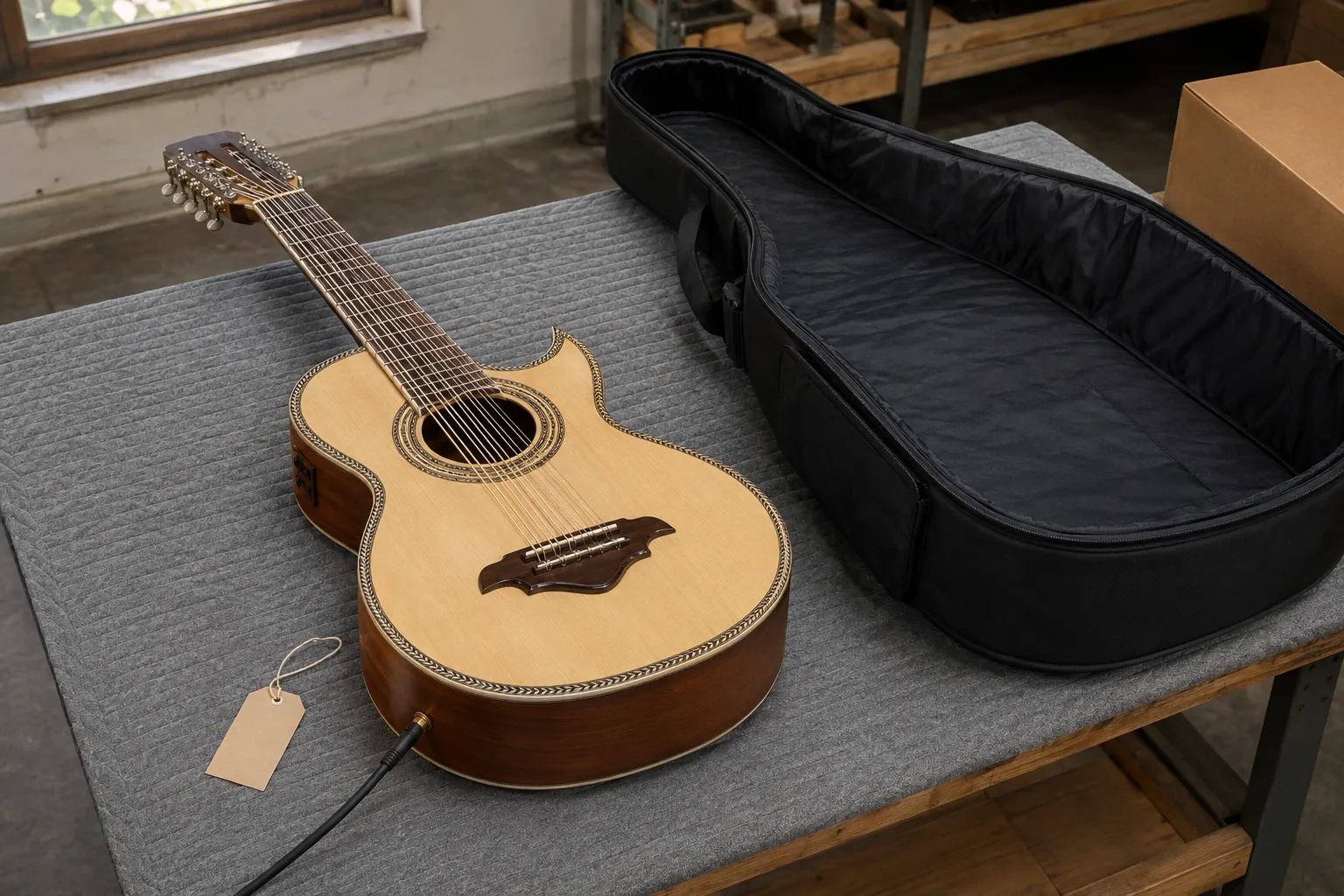
Photograph the final pack-out. Record the bag or case, headstock support, body protection, accessories and carton. Check that tuners and bridge hardware do not carry pressure from the case or carton. The packaging approval guide explains how to turn one successful pack-out into a repeatable packing standard.
Bajo quinto sample-inspection checklist
Identity and specification
- Product is identified as a bajo quinto.
- Ten strings are arranged in five approved paired courses.
- Model code, revision, acoustic/electric version and body style match.
- Tuning order, octave relationships and string set are recorded.
- Drawings and materials match the quotation.
Dimensions and construction
- Scale, body, depth, nut and key reference dimensions are measured.
- Neck centerline and bridge position are correct.
- Course spacing is consistent at the nut and bridge.
- Top, back, sides, neck and fingerboard construction match the brief.
- Cutaway, binding and decoration match the approved outline and files.
Playability
- Relief and action are measured with the agreed method.
- Every fret on all ten strings has been played.
- Both strings in every course sound cleanly together.
- Tuning stability and intonation pass the recorded test.
- Fret ends, neck profile and outer-course clearance are acceptable.
Electronics and appearance
- Acoustic response is checked before amplification.
- Output, controls, jack and internal installation pass.
- Finish color and sheen sit within the approved range.
- Natural wood variation matches the documented limits.
- Branding is original, authorized and the correct revision.
Retail and packing
- Product name and origin are accurate on all labels.
- Tuning and replacement-string guidance match the sample.
- Bag or case and accessories match the packing list.
- Protection points and carton fit are approved.
- Final photos and issue list are attached to the approval record.
Turn comments into controlled changes
An inspection report should separate observations, required changes and optional ideas. “Bridge looks slightly high” is an observation. “Reduce the approved action target using the stated measurement method” is a change. The difference matters.
Give each required change an owner and a revision. Ask for evidence of correction. If the change affects geometry, material, electronics or packing, update the relevant document before approval.
Avoid approving by chat alone. Messages are hard to find and can separate a photograph from its explanation. Store the final approval record with the model drawing, specification, finish references and packing sheet.
The sample development guide provides a practical way to move from comments to a controlled sample revision.
Frequently asked questions
How many strings does a bajo quinto have?
A bajo quinto has ten strings arranged in five paired courses. The course layout, tuning and gauges still need to be written in the product specification.
Is a bajo quinto a bass guitar?
No. It has a distinct acoustic, double-course construction and role. Product pages and quotations should not group it with electric basses simply because its name includes “bajo.”
Is a bajo quinto the same as a bajo sexto?
No. A bajo quinto uses five courses and ten strings, while a bajo sexto uses six courses and twelve strings. They also need separate model, tuning, setup and retail records.
For the six-course comparison, see the bajo sexto sourcing guide.
What should a buyer inspect first?
Confirm identity, model revision, ten-string five-course layout and installed string set. Measurements and playability results are unreliable if the wrong model or strings are being inspected.
Should the buyer approve a pickup-equipped sample only through an amplifier?
No. Inspect acoustic playability and unwanted noises first, then test the installed electronics, controls and output using a written method.
Can the approved physical sample replace the specification sheet?
No. The physical sample is valuable, but it does not explain material wording, acceptable variation, test methods, labeling or packing. The sample and controlled document should be approved together.
Conclusion
A bajo quinto sample earns approval through evidence, not through a general impression.
Count and inspect the five paired courses. Measure the instrument using shared reference points. Play all ten strings across the fingerboard. Test electronics, read the labels and pack the sample as a customer will receive it. Then return every accepted change to the controlled specification.
That record helps purchasing compare suppliers, helps production repeat the sample and helps the retailer publish accurate product information.
If you are preparing a bajo quinto for wholesale or private-label distribution, send Vinesmusical the reference, drawing, course layout, tuning, string set, model direction, electronics and packing requirements. Contact us to review the sample-inspection brief.