 EN
EN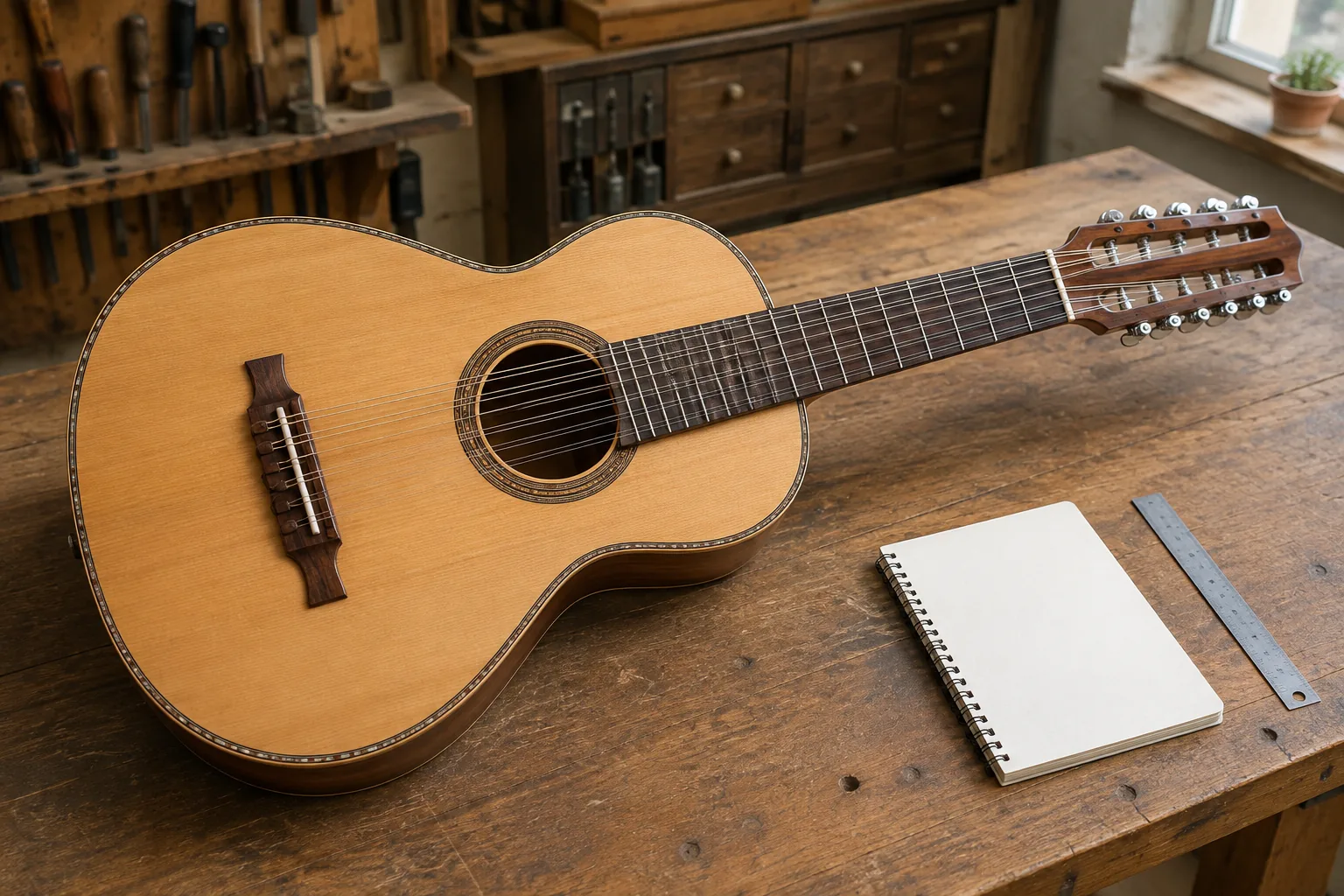
A bajo sexto can be described accurately in one line and still be ordered badly.
Yes, it is a large twelve-string instrument with six paired courses. That identifies the category. It does not tell a factory which tuning, string set, scale, body, neck, electronics, finish or packing a retailer expects.
The missing decisions matter because a bajo sexto is not simply a standard twelve-string acoustic guitar with a different label. The Library of Congress classifies it as a Mexican musical instrument, and Smithsonian Folkways describes its established role in Conjunto and Tejano music, where it supplies rhythm, chords and bass movement alongside the accordion.
The short answer: define the intended player and sales channel first. Then document twelve strings in six paired courses, tuning and octave relationships, string set, measured geometry, neck and course spacing, acoustic or amplified format, materials, finish, retail information and packing. Approve the sample and the written product record together.
Start with the player, not the option list
A Conjunto-focused retailer and a general guitar shop may introduce the same instrument differently.
The specialist store may serve experienced players who ask about course layout, tuning, pickup response and traditional body choices. The general retailer may need clearer category education, a replacement-string answer and sales staff who can explain why the product is not a regular twelve-string acoustic.
Before requesting a quotation, write a short channel brief:
- Where will the instrument be sold?
- Are the buyers experienced bajo sexto players, students, schools or mixed customers?
- Will the product be used mainly acoustically, on stage or both?
- Does the store need one core model or a good/better assortment?
- Which language or languages are required for listings and product cards?
- What setup and replacement-string support can the retailer provide?
This information helps both parties choose meaningful features. It does not justify guessing unapproved specifications. The supplier still needs a drawing or measurable reference.
A product range should have a reason. One acoustic model and one acoustic-electric model can be useful if they serve clearly different players. Three finishes and two cutaway shapes may create more stock than the store can explain. Start with the smallest assortment that gives customers a real choice.
Preserve the six-course identity
Smithsonian Folkways describes a twelve-string, six-course instrument that supports bass movement and chords in classic conjunto instrumentation.
For an OEM or wholesale brief, write the identity explicitly:
Bajo sexto: twelve steel strings arranged in six paired courses, with tuning and octave relationships shown in the approved diagram.
Do not stop at “12-string.” A standard twelve-string acoustic guitar may also have six paired courses, but its intended tuning, scale, body, neck, string set, setup and playing role can differ. Using one product as a shortcut for the other creates a sample that looks familiar but serves the wrong player.
Keep the bajo sexto separate from the bajo quinto as well. The bajo quinto uses ten strings in five courses. A model name, carton label or tuning card copied between them can cause a preventable retail error.
The safest project folder uses separate model codes, specifications, artwork and photographs. Cross-links can help customers compare the categories, but shared files should not blur them.
Define the tuning, string order and octaves
Tuning information needs more than six note names.
State whether the course list runs from the lowest-sounding course to the highest or the reverse. Show the two strings within every course and identify whether they are in unison or an octave relationship. Number the strings or courses on the drawing so the nut, bridge and setup notes use the same language.
Name the approved string set. If a particular commercial set may not always be available, record material and gauges and require approval for an equivalent. A string substitution can change tension, relief, action, nut behavior, balance and intonation.
The tuning card for customers should be checked against the final sample. Do not copy a diagram from a standard twelve-string acoustic guitar. Do not rely on sales staff to explain an ambiguous high-to-low list.
During sample approval, tune using the written order and the agreed pitch reference. This tests whether the document and the instrument agree. If an experienced player prefers a different setup, treat that as a proposed product change and record it before production.
Build the product brief around six courses
The product brief should connect the market decision with measurable construction and test fields.
| Field | Buyer decision | Approval evidence |
|---|---|---|
| Product identity | Bajo sexto for the named channel | Twelve strings, six courses and correct model code |
| Tuning and strings | Notes, order, octaves, material and gauges | Installed set matches the written diagram |
| Scale and frets | Measured scale, fret count and body-joint reference | Drawing and physical sample agree |
| Neck and nut | Profile, width, reinforcement and course spacing | Relief, feel and outer-course clearance are checked |
| Body | Outline, length, width, depth and cutaway choice | Dimensions and case fit are verified |
| Construction | Top, back, sides, neck and fingerboard wording | Sample matches the quotation without vague substitutions |
| Bridge and saddle | Layout, location and setup approach | Six courses align and intonation is checked |
| Finish | Color, sheen, decoration and acceptable variation | Neutral-light photographs and range references |
| Electronics | Acoustic or acoustic-electric system and test method | Output, controls, jack and installation pass |
| Branding and labels | Original artwork, model name and origin text | Correct revision appears on product and carton |
| Packing | Bag or case, accessories, protection and carton | Complete pack-out is photographed and tested |
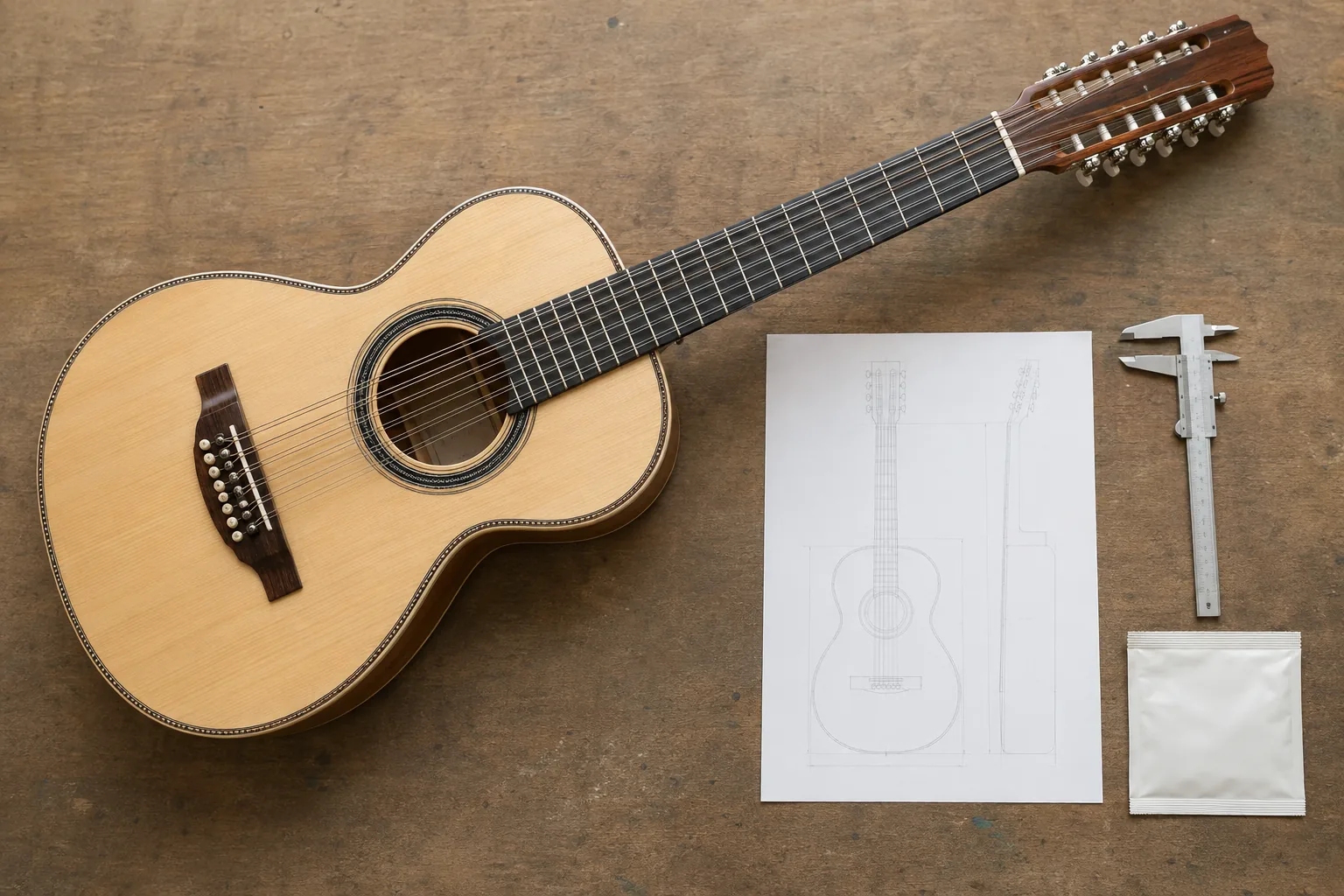
Use the OEM specification sheet guide as a starting structure, but add the paired-course information a bajo sexto needs.
Use market references without copying a competitor
An official product page can show how the market currently presents a bajo sexto. For example, a current Oscar Schmidt bajo sexto lists a solid top, electronics, scale, nut width, finish and gig bag as separate specifications. That is useful evidence that buyers compare the complete configuration, not just the product name.
Those specifications belong to that model. They do not prove that another supplier uses the same materials, dimensions or components. They should not be copied into a Vinesmusical brief unless the buyer has independently chosen and approved them.
A market reference works best when the buyer labels its purpose:
- Body proportion reference only.
- Player feel reference only.
- Electronics feature reference only.
- Retail positioning reference, not a construction specification.
Remove or replace trademarks, logos and distinctive protected artwork. Ask for an original headstock, decoration and brand treatment. If the reference is a physical instrument, measure it and note which measurements will control the new project.
The goal is to communicate expectations, not to produce a counterfeit or a confusingly similar product.
Compare acoustic and acoustic-electric models honestly
An acoustic-electric model adds a system that must be specified, installed and tested. It is not automatically the better option for every store.
For an acoustic model, focus on playability, response, stability and the intended unamplified use. For an amplified model, keep all those checks and add pickup balance, controls, jack, battery access if applicable, internal wiring and noise tests.
Ask where the player will connect the instrument. A stage performer, school ensemble and home player may need different levels of control and simplicity. Avoid choosing electronics because a control panel looks impressive in a product photograph.
If the range includes both versions, give them separate model codes and product images. Make the difference visible early in the title and packaging. Warehouse staff should not have to search for a small jack to tell the cartons apart.
The electronics QC guide gives a useful framework for checking signal, controls, installation and intermittent faults.
Developing a bajo sexto range?
Send Vinesmusical the target store and player, reference instrument or drawing, twelve-string six-course layout, tuning, string set, acoustic or amplified direction, branding and packing needs. We can review the missing decisions before sampling. Send your project requirements.
Let the intended player review the sample
Measurements do not replace playing.
Ask a player familiar with the bajo sexto to evaluate the sample using the approved tuning and strings. The player should check chord work, bass movement, course balance, reach, neck feel, upper-position access where relevant and response at realistic playing force.
Record comments in observable language. “Feels wrong” is a starting point, not a factory instruction. Ask where the problem appears and under what playing condition. It may lead to course spacing, nut shape, neck profile, action, fretwork or string choice.
Play every fret on every string. Listen to individual strings and complete courses. Check for buzzing, dead notes, rattles and uneven pairs. Retune after playing and observe stability. Measure relief and action using the written method.
Test intonation using agreed fretting pressure and measurement points. Paired courses can make a small disagreement more noticeable. Before moving a saddle or changing the design, rule out worn strings, poor seating, nut binding and inconsistent playing pressure.
The sample development guide explains how to record revisions and close open issues before production.
Compare quotations line by line
A useful bajo sexto quotation should be traceable to the product brief.
Compare the same scope across suppliers:
- Twelve-string, six-course configuration.
- Body and cutaway choice.
- Scale, neck, nut and key dimensions.
- Top, back, sides and construction wording.
- Finish and decoration.
- String set and setup scope.
- Pickup or preamp version and accessories.
- Branding, labels and product information.
- Bag or case and carton protection.
- Sample, inspection and change-control process.
- After-sales parts and response procedure.
If a line is missing, mark it as open. Do not assume the lowest total includes the same case, electronics or finish standard. The factory quotation guide shows how to separate product, customization and packing scope.
Ask for MOQ, price and timing in the actual quotation after the configuration is defined. Generic numbers in a blog post are not useful for a live order.
Plan retail information while the sample is being approved
A new product category needs more explanation than a familiar guitar model.
Prepare the product title, short definition, course diagram, tuning, string reference, verified materials, dimensions, electronics, included accessories and origin information while the sample is available. Photograph the actual approved model when possible. AI or illustrative images should never be presented as evidence of a shipped product.
For Mexico and the United States, a bilingual sheet may reduce sales and support friction. Have both languages reviewed by people who understand the instrument. The translation must preserve bajo sexto as the product name and avoid confusing it with electric bass or a generic twelve-string acoustic.
Give staff a short comparison answer:
- Bajo sexto: twelve strings in six courses, used in the Conjunto and regional Mexican music context.
- Bajo quinto: ten strings in five courses.
- Standard twelve-string acoustic guitar: a separate product category with its own tuning, setup and playing context.
Link to the detailed bajo quinto sample-inspection guide when customers or buyers need the ten-string comparison.
Approve packing as part of the product
A large body, broad neck and twelve tuners create specific protection points.
Check the headstock and tuner clearance inside the bag or case. Make sure the bridge and top do not carry pressure from accessories. Secure loose cables, batteries, tools and literature so they cannot mark the finish. Confirm the body cannot move enough to strike the carton wall.
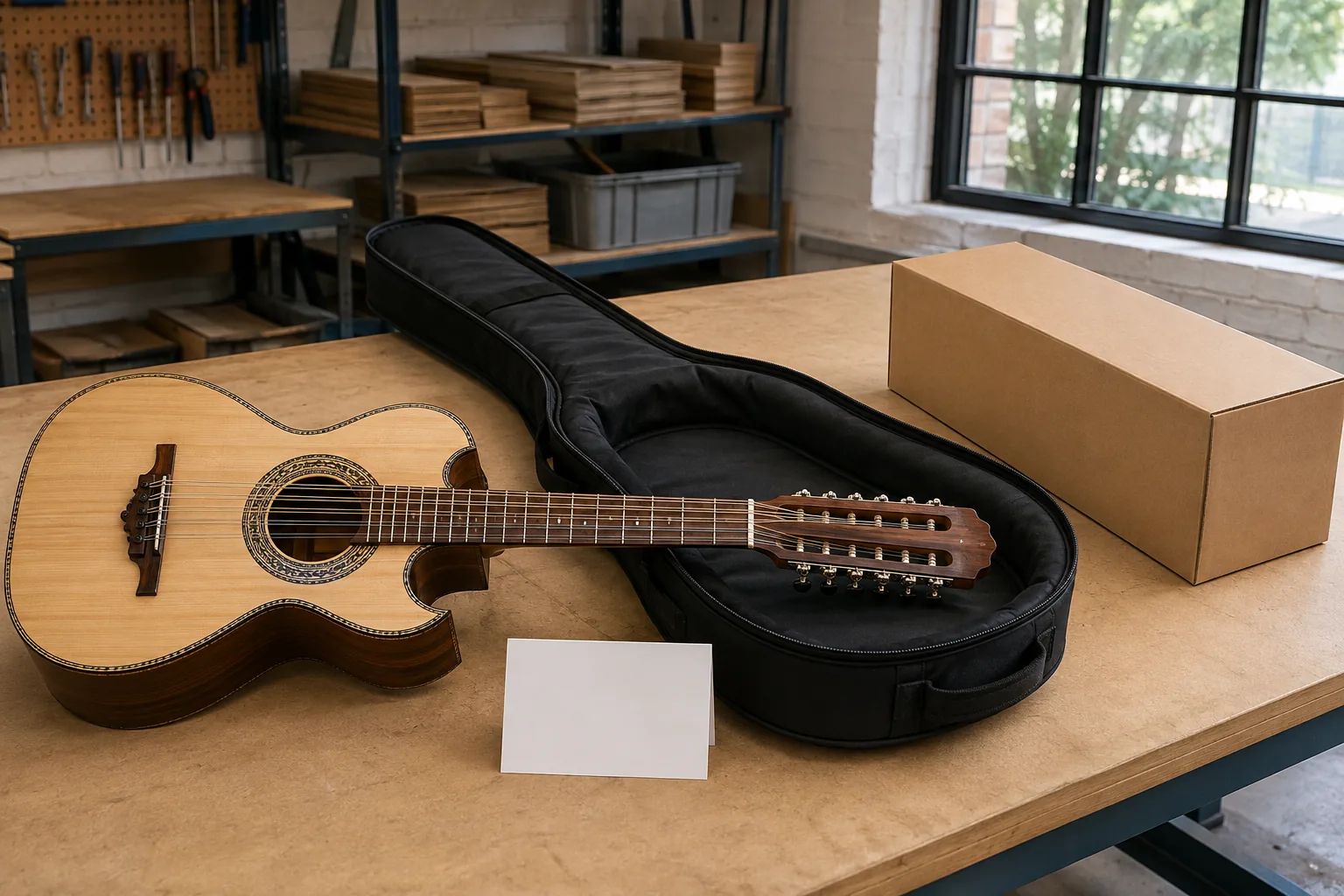
Pack the approved sample exactly as production will be packed. Photograph each layer. Record the bag or case model, inner supports, accessory locations, carton dimensions and labels. If the product will be shipped in mixed loads or by parcel during sampling, state which handling condition the pack is intended to address.
Inspect the instrument again after a packing or transport test. Look at tuning-machine alignment, neck, bridge, finish and electronics. A box can arrive without visible damage while the instrument inside has been loaded at one contact point.
The packaging approval guide provides a step-by-step way to approve protection and pack-out accuracy.
Bajo sexto sample-approval checklist
Product identity
- The model is named and labeled as a bajo sexto.
- Twelve strings are arranged in six approved courses.
- The tuning diagram states order and octave relationships.
- The installed string set matches the sample record.
- Bajo quinto, electric-bass and standard twelve-string guitar files are not mixed in.
Construction and setup
- Scale, body, nut and key dimensions match the drawing.
- Neck alignment, outer-course clearance and bridge position are verified.
- Materials and solid/laminated construction match the quotation wording.
- Relief, action and intonation are checked by the agreed method.
- Every fret, string and complete course has been played.
Appearance and electronics
- Finish color and sheen sit within the approved range.
- Natural wood variation is documented honestly.
- Binding, rosette and original branding match approved files.
- Acoustic performance is checked before electronics.
- Pickup, controls, output, wiring and jack pass the test record.
Retail and packing
- Product title, definition, tuning and string reference are accurate.
- Origin, importer and model information are correct.
- Bilingual text has been reviewed where required.
- Bag or case, accessories and protection match the packing list.
- Final sample photos, measurements and change list are stored together.
Build repeat orders from controlled evidence
The approved sample should become a practical production standard.
The factory record needs the final drawing, material descriptions, finish range, setup method, electronics version, branding files and packing sheet. The buyer should retain the same information. If the physical sample is stored, label it with the model and revision.
During production, check consistency at the points that can drift: neck and course alignment, nut and bridge work, fret condition, setup, finish, electronics and packing. Use a sampling plan suited to the order and risk. Do not wait until final inspection to discover that a string or component changed.
Any approved change needs a date and affected models. A new pickup cannot quietly enter only the latest batch. A revised carton should not carry an old product card. The batch consistency guide explains how buyers can monitor repeatability without treating every natural variation as a defect.
Frequently asked questions
How many strings and courses does a bajo sexto have?
A bajo sexto has twelve strings arranged in six paired courses. The project should still define tuning, octave relationships, string gauges and course spacing.
Is a bajo sexto the same as a twelve-string acoustic guitar?
No. The shared string count does not make the categories interchangeable. A bajo sexto has its own musical role, tuning and product expectations. It needs a separate specification and retail description.
What is the difference between a bajo sexto and a bajo quinto?
The bajo sexto has six courses and twelve strings. The bajo quinto has five courses and ten strings. Each needs its own tuning, setup, model code and product information.
Should a retailer choose acoustic or acoustic-electric?
Choose from the intended players and selling context. An acoustic-electric model adds electronics, installation and testing work. Some retailers may need both, while others are better served by one clearly positioned model.
What should be fixed before requesting a quotation?
At minimum, define product identity, course layout, tuning, string set, body direction, main dimensions, construction, finish, electronics, branding and packing scope. Open fields should be marked rather than silently assumed.
How can a retailer reduce problems on repeat orders?
Approve the physical sample with a controlled specification and test method. Keep change records, verify incoming components and monitor course alignment, setup, electronics, finish and packing during production.
Conclusion
A bajo sexto sourcing project works best when the channel, product and production record agree.
Start with the players the retailer actually serves. Preserve the twelve-string, six-course identity. Write the tuning and string set clearly. Measure the reference, inspect the sample, prepare honest retail information and approve the pack-out.
Those steps give the factory something repeatable and give the retailer something it can explain with confidence.
If you are planning a bajo sexto range for Conjunto, regional Mexican music or general instrument retail, send Vinesmusical the target channel, reference, course layout, tuning, string set, model direction, electronics, branding and packing needs. Contact us to review the sourcing brief before sampling.