 EN
EN Español
 Português do Brasil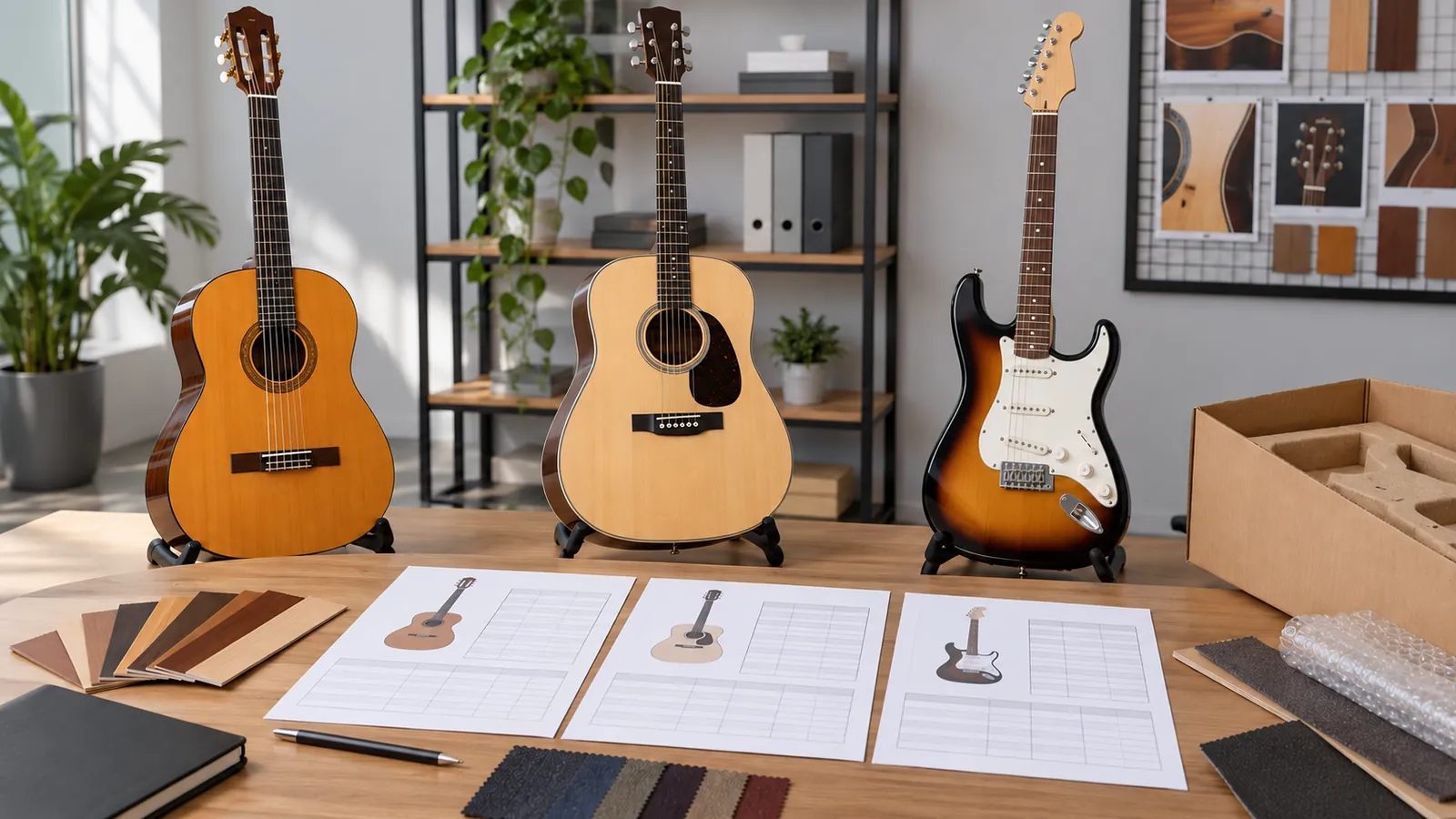
Most quotation problems start before a supplier calculates a price. The buyer sends a product photo, a target price and a quantity, while the supplier must guess the customer level, the exact model scope, the packaging and the inspection standard. Two factories can then return quotations that look comparable but include very different products and services.
For a music-store chain, a useful supplier brief should define six things before quotation: the commercial role of each model, the product specification, the approved appearance, the packaging system, the sample and inspection process, and the records needed for repeat orders. The brief does not need to be a technical encyclopedia. It needs to remove the assumptions that can change cost, consistency or launch timing.
This guide explains how purchasing, product and retail teams can build that brief for classical, acoustic, electric-guitar and electric-bass programs.
Images in this guide are AI-generated illustrations. They do not document factory tests or real customer projects.
Start with the commercial job of the range
A supplier cannot recommend a sensible construction or quotation scope without knowing what each product is expected to do in the assortment. “Entry guitar” is too vague. Entry for a specialist guitar shop may be different from entry for a general music retailer, a regional chain or an online promotion.
For each model, state:
- the intended buyer or player profile;
- where it will be sold: store, online, marketplace or a combination;
- whether it is a permanent SKU, a seasonal item or a test listing;
- the position of the model in your good-better-best structure;
- the adjacent models it must not duplicate;
- whether the product is intended for normal retail, education, rental or another defined application.
This information keeps the supplier from solving the wrong problem. A finish option that works well for a small seasonal order, for example, may create unnecessary complexity in a permanent multi-store program. A feature that helps one sales story may also create service work that the chain does not want.
Give every model a role, not only a name
An internal model name such as “A100” does not explain its role. Add a short statement: “full-size classical guitar for first-time adult buyers,” “dreadnought-style acoustic guitar for the core wall,” or “four-string electric bass for an entry-level private-label range.” This statement becomes a practical filter when teams discuss specifications, samples and later changes.
If your assortment is still being built, review the existing Vinesmusical guide to wholesale guitar assortment planning before sending the supplier brief.
Build one assortment matrix before separate specification sheets
The assortment matrix gives the factory a view of the whole program. It should show one row per proposed SKU and enough columns to identify what is shared and what is unique.
Useful columns include product family, body format, scale or size reference, string count, pickup concept where relevant, finish family, branding method, packaging level, target channel, sample priority and forecast status. Do not fill uncertain cells with invented precision. Mark them “to be confirmed” and assign an owner and deadline.
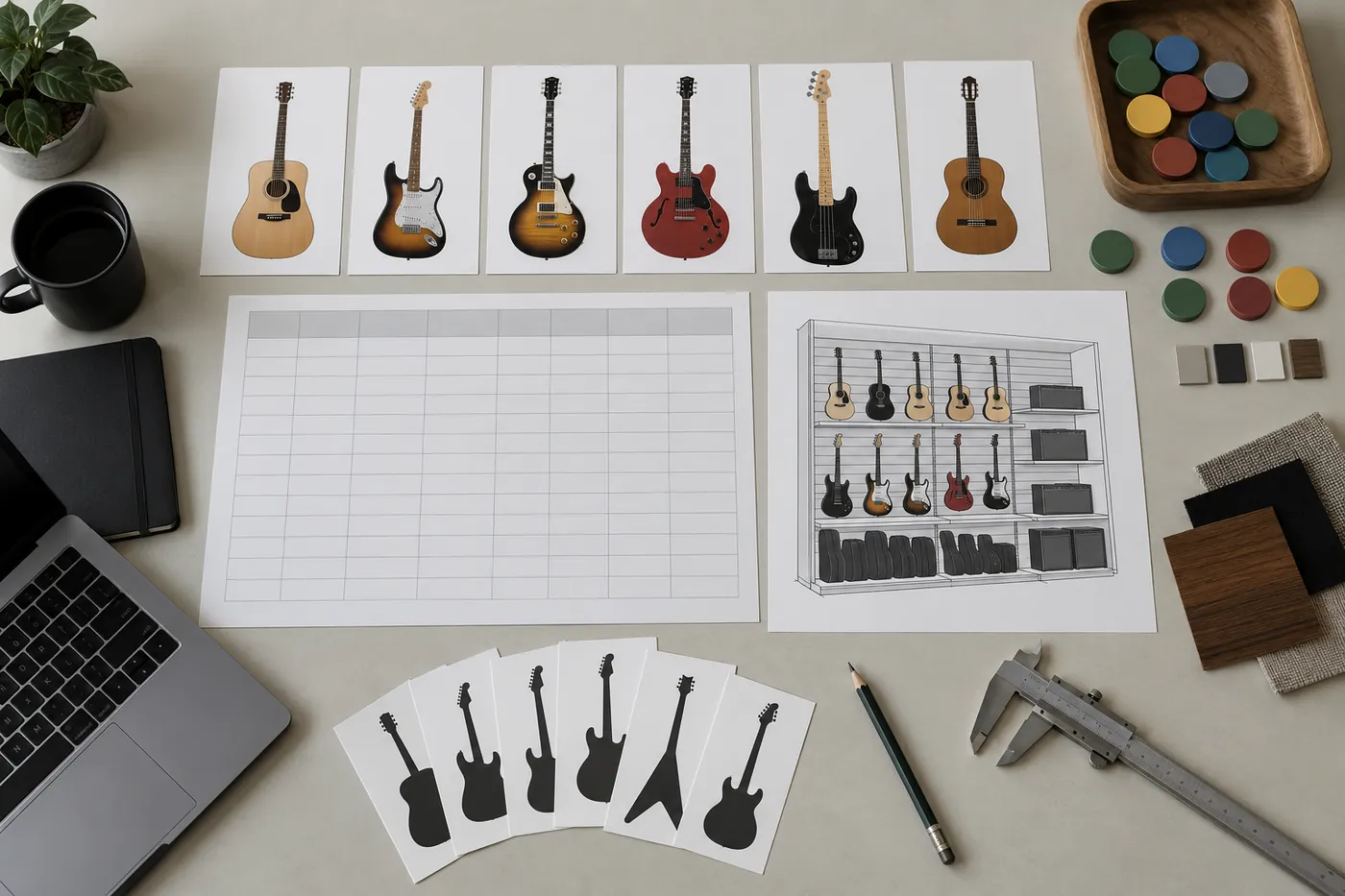
The matrix also exposes accidental duplication. If three models differ only by a color that has not been validated with customers, the product team can reconsider the range before tooling, artwork or packaging work begins.
Separate shared requirements from SKU-specific requirements
Music-store chains often have requirements that apply to the entire program: brand placement rules, carton markings, barcode format, document language, inspection booking process and spare-label policy. Keep these in a program-level document.
Then create a short specification sheet for each SKU. This reduces repeated text and prevents teams from updating one model while leaving a conflicting requirement in another file.
Define the product identity precisely
A quotation should identify what is being quoted. A useful product identity block normally includes:
- instrument family and intended configuration;
- body shape or size reference;
- key material and construction descriptions that the buyer has actually approved;
- neck, fingerboard and bridge requirements;
- hardware and electronics concept where applicable;
- finish, color and gloss level;
- branding locations and methods;
- included accessories and packing components;
- the revision number and date of the specification.
Avoid using a reference photo as the specification. Photos are helpful for appearance, but they rarely define hidden construction, dimensions, material grade, hardware source, setup condition or packaging. If the team does not know a detail, ask the supplier to state the proposed solution clearly in the quotation rather than silently assuming it.
Use the OEM guitar specification-sheet guide to turn those requirements into a controlled file. The Products overview groups the instrument families before model-specific discussions begin.
Make acceptable alternatives visible
Some buyers want an exact component; others are open to a supplier-proposed equivalent. Both approaches can work, but the brief must say which one applies. Use language such as “buyer-specified,” “supplier proposal required,” “equivalent subject to sample approval,” or “no substitution without written approval.”
This is especially important when quotations are compared. A lower figure may reflect a different component or process rather than better purchasing value.
Describe setup and functional acceptance
“Playable” is not an inspection instruction. The supplier brief should explain how the sample and production instruments will be judged without promising unverified numerical limits.
Define the checks that matter to the program: neck condition, fretwork, tuning function, action and relief review, intonation where applicable, nut and saddle workmanship, control operation, jack stability, unwanted noise, visible finish defects and basic accessory fit. Numerical tolerances should come from an approved specification, reference sample or documented test method—not from a generic article.
Also state the condition under which measurements are taken. String type, tuning, instrument acclimation and measurement location can change the result. A number without a method can create more disagreement than clarity.
Lock appearance with evidence, not adjectives
Words such as “natural,” “vintage,” “dark red” or “high gloss” are open to interpretation. Use a controlled appearance package:
- a dated color or finish reference;
- clear photos under neutral lighting;
- artwork files with dimensions and placement;
- a record of approved deviations;
- a physical sample or signed reference panel when appearance is commercially critical.
For wood products, buyers should also distinguish between a controlled finish target and natural material variation. If the retail team expects every piece to look identical, the supplier needs to know that before quotation and sampling.
Treat packaging as part of the SKU
Packaging is not an afterthought for a chain. It affects warehouse handling, store receiving, online fulfillment, damage reporting, barcode control and customer presentation.
The brief should identify:
- individual protection and contact points;
- inner and outer carton expectations;
- case or bag inclusion, if any;
- accessory location and restraint;
- moisture or surface protection requirements when specified;
- carton marks, barcode type and label position;
- country and language requirements for printed material;
- whether the same pack must support store and e-commerce handling;
- how the buyer will approve a pack-out sample.

A packaging quotation is only comparable when the included components and pack-out method are clear. Ask the supplier to list exclusions rather than leaving the buyer to discover them after the sample stage.
Put branding and artwork under revision control
Private-label projects often involve several files: headstock mark, soundhole label, back plate, hangtag, carton artwork, barcode label and manual. File names such as “logo-final-new.ai” are not reliable control.
Create an artwork register with a unique file name, revision, date, application method, location, dimensions, color reference and approval status. The quotation should state which artwork operations are included and which depend on final files.
Do not send production artwork through multiple informal chat threads. A single controlled folder and written approval record reduce the chance of an old version returning during a repeat order.
Define the sample path before asking for a production price
The buyer and supplier should agree what the sample is expected to prove. One sample may confirm basic construction; another may be needed to confirm final branding, finish and packaging. Calling every unit “the sample” hides these different purposes.
A practical sequence can include:
- specification review and open-question list;
- supplier proposal and quotation assumptions;
- development or appearance sample as required;
- buyer feedback tied to the specification revision;
- corrected or final approval sample where necessary;
- a signed approval record that identifies remaining deviations;
- production control based on the approved reference.
The sequence should reflect the risk of the project. The supplier brief should not promise that every project needs the same number of rounds.
The sample-development guide explains that stage in more detail. Keep the sample purpose attached to its specification revision so the chain can distinguish a development decision from final approval.
Planning a private-label guitar range? Send your assortment matrix, draft specifications and packaging requirements through the Vinesmusical contact page. We can review the open questions before a quotation is treated as comparable.
Specify quotation assumptions and exclusions
A useful quotation is more than a total. Ask suppliers to present a consistent breakdown or assumption table covering:
- quoted model and specification revision;
- included branding operations;
- included packaging and accessories;
- sample scope and whether sample-related work is separate;
- inspection or document scope included in the offer;
- tooling or one-time items, if applicable and confirmed;
- order or color assumptions that affect the quotation;
- validity conditions and unresolved technical questions;
- explicit exclusions.
Do not force a supplier to insert unconfirmed MOQ, lead time or price promises simply to fill a template. Those items should be confirmed for the exact project and commercial conditions.
Design the inspection plan around buyer risk
The brief should identify what will be inspected, when and against which evidence. Common gates are incoming review of critical materials, in-process checks, final functional and appearance checks, and pre-shipment inspection. The exact plan depends on the program.
For each checkpoint, identify:
- the reference specification and sample revision;
- the defect or function being checked;
- the method and evidence required;
- who can approve a deviation;
- how nonconforming units are identified and rechecked;
- what record the buyer expects to receive.
Inspection is most useful when it is connected to the supplier brief. A generic checklist cannot protect a feature that was never clearly defined.
Plan change control and repeat orders
Music-store chains usually need repeatability across seasons and replenishment orders. Add a change-control clause to the brief: materials, components, construction, color, artwork and packaging may not change without documented review when they affect the approved product.
The buyer should maintain a revision history and archive the approved specification, artwork, sample record and inspection criteria. The supplier should identify proposed substitutions before production rather than recording them after shipment.
For reorders, the team should review what has changed: regulations, labels, carton marks, component availability, retail feedback or internal SKU rules. “Same as last order” is not a safe instruction if no one checks the last approved reference.
Questions a chain should ask the supplier
Use the supplier conversation to test how clearly the project can be controlled, not only how confidently it can be sold.
Ask:
- Which requirements are clear, and which need buyer confirmation?
- What assumptions were used to calculate the quotation?
- Which details will be fixed by specification, and which depend on the approved sample?
- How are artwork and specification revisions controlled?
- What evidence can be provided for sample review and final inspection?
- How are proposed component or process changes communicated?
- Can the supplier explain the packaging pack-out and label-control process?
- Which records can support repeat orders?
Specific answers are more useful than broad claims of quality.
A concise supplier-brief checklist
Before requesting quotation, confirm that the package contains:
- a one-page commercial overview;
- an assortment matrix with one row per SKU;
- a revision-controlled specification for each model;
- controlled appearance and artwork references;
- packaging and label requirements;
- a defined sample purpose and approval path;
- functional and appearance review criteria;
- inspection evidence expectations;
- change-control and reorder rules;
- a list of open questions and owner for each answer.
If several items remain open, ask the supplier to quote a clearly identified base scope and list optional or unresolved elements separately. That produces a more honest starting point than a single figure built on hidden assumptions.
FAQ
What should a music-store chain send a guitar supplier first?
Send a commercial overview, assortment matrix, model-level specifications, appearance references, packaging requirements and a list of unresolved questions. A photo and target price alone do not define a comparable quotation.
Should every guitar SKU have a separate specification?
Yes. Program-wide requirements can be shared, but each sellable SKU should have a clear identity and revision-controlled specification. This prevents color, hardware, branding and packaging details from being mixed between models.
How detailed should setup tolerances be before quotation?
Document the checks and the measurement method. Add numerical limits only when they are genuinely approved for the project. Unverified generic numbers can create false precision.
Can one sample approve both the instrument and the packaging?
Sometimes, but not automatically. The buyer should state which parts of the sample are being approved. Final branding or packaging may require separate evidence or a later reference.
How can buyers compare quotations from different factories?
Use the same revision of the brief and require suppliers to list assumptions, inclusions, alternatives and exclusions. Compare scope before comparing the headline figure.
What should be controlled for repeat orders?
Keep the approved specification, artwork, sample record, packaging pack-out and inspection criteria. Require written review of changes that affect the approved product.
Conclusion
A good supplier brief does not make a project rigid. It makes decisions visible. It tells the supplier what the retail program needs, shows where proposals are welcome and records what must be approved before production.
Vinesmusical works on B2B OEM/ODM projects for finished guitars. The company was founded in 2014, has about 80 employees, operates from an owned 10,000-square-meter five-floor facility and reports monthly capacity of about 7,000 guitars. Its available third-party evidence includes BSCI certification and a third-party in-depth factory audit report. These facts do not replace project-specific verification, so buyers should request the documents relevant to their own approval process.
Send your requirements: share your assortment matrix, model scope, branding files and packaging brief through Contact Us or email info@vinesmusic.com. Ask for a project review before relying on a final quotation.