 EN
EN
Ask three suppliers what wood is best for a bajo quinto and you may receive three confident answers. One may talk about projection. Another may lead with appearance. A third may quote a familiar species without explaining whether it is solid, laminated, veneered or simply a color name.
That is why “best wood” is a poor starting point for a wholesale project.
The practical answer: define the job of the instrument first. Then specify the top, back, sides, neck, fingerboard and bridge separately. Record construction, material description, appearance range and verification method for each part. Approve the finished sample as a complete instrument. A species name alone cannot guarantee sound, stability, workmanship or repeatability.
This approach does not make the specification unnecessarily complicated. It prevents two suppliers from quoting materially different instruments under the same short description.
Start with the buyer and the retail position
The same material direction can make sense in one range and fail in another.
A specialist Conjunto retailer may care about a familiar response, stage use and service knowledge. A general music store may need a clear step-up structure that staff can explain without overstating technical claims. An importer building a private-label line also has to consider repeat orders, replacement information, photographs and product-page accuracy.
Write down the intended market before selecting wood:
- Who is expected to buy and play the instrument?
- Is it an entry, core or upper-position model in the range?
- Will the store sell mainly in person, online or through dealers?
- Is the proposed instrument acoustic or acoustic-electric?
- Which appearance differences can the sales channel explain honestly?
- What level of natural variation can the buyer accept across a shipment?
These questions affect the brief. They do not create a universal ranking of materials.
Keep the product identity clear as well. A bajo quinto has ten strings arranged in five paired courses. It should not share its technical file with a bajo sexto, electric bass or generic ten-string instrument. The bajo quinto versus bajo sexto guide explains why the names, course layouts and product records need to remain separate.
Define construction before naming a species
The words spruce, cedar, mahogany or maple do not tell a buyer how a part is built.
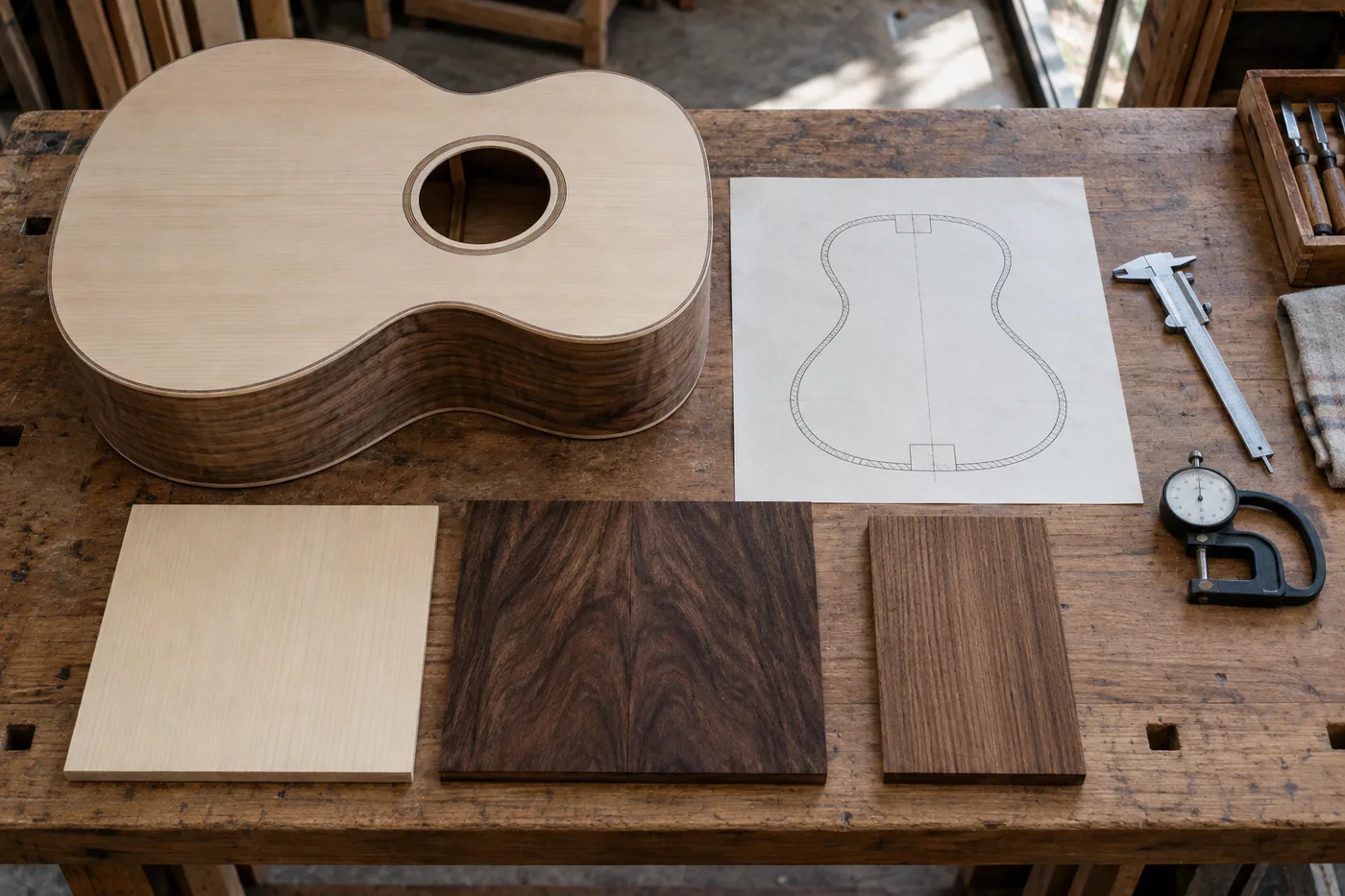
For each body component, state the construction first. Is the top solid or laminated? How are the back and sides described? Is a visible surface the structural material, a veneer or a decorative layer? If a supplier uses a trade name, ask what physical material the name refers to in the quoted model.
The specification should list at least:
- Top construction and material description.
- Back construction and material description.
- Side construction and material description.
- Neck construction and joint method.
- Fingerboard and bridge material descriptions.
- Binding, rosette, overlay and other decorative materials where relevant.
- Finish type, color direction and transparency.
- Approved sample or reference for appearance.
Avoid a single field called “body wood.” It hides the very differences that affect quotation comparison and product copy.
Do not rely on an edge photograph as the only proof of construction. Binding, finish and lighting can make a photograph difficult to interpret. Connect the written specification with material records, a physical sample and the supplier’s explanation of the build.
Treat the top as part of a working system
Buyers often focus on the top because it is prominent in retail descriptions. That attention is reasonable, but the top does not work alone.
Its dimensions, thickness control, bracing, bridge relationship, finish and assembly all matter. So do the neck angle, setup and strings fitted to the sample. A familiar species does not compensate for poor geometry or inconsistent workmanship.
In the product brief, separate four decisions:
- Construction: how the top is made.
- Material: the approved description used by the factory and buyer.
- Appearance: acceptable color, grain and visible variation.
- Performance review: how the complete sample will be evaluated.
Ask the supplier to show how the proposed top is identified in the bill of materials and sample record. Review the bracing reference for that model rather than assuming that a broad style name defines every internal detail.
If two top options are under consideration, compare complete samples made to controlled specifications. Changing only the label on a quotation does not produce useful evidence.
Specify the back and sides separately
Back and side construction is easy to lose in a short sales description.
That creates problems later. The buyer may approve photographs that show one appearance while the quotation assumes another construction. A product page may say “solid wood” when only the top is solid. A shipment inspection may have no written reference for natural variation.
List the back and sides on separate lines even when they use the same material description. Record construction, matching expectations, color range and finish. If a center strip, decorative veneer or multi-piece back is part of the design, state it clearly.
Side material also needs a workable production reference. Bending and assembly are factory processes, not marketing phrases. The buyer does not need to dictate an unverified process value, but it should ask how the supplier controls the approved material and checks the finished body.
Natural figure should not be confused with workmanship. Grain and color can vary within an approved range. Cracks, open joints, finish contamination and poor fit are different issues and belong in the defect checklist.
The natural wod variation guide provides a method for separating acceptable appearance variation from objective defects.
Do not overlook the neck, fingerboard and bridge
The body receives most of the attention in a wood discussion, but the player handles the neck and fingerboard continuously.
Record the neck construction, material description and any reinforcement. Confirm the neck profile, width references and finish direction on the sample. If the project uses an alternative material or construction, review serviceability and labeling rather than treating it as a quiet substitution.
For the fingerboard and bridge, use precise descriptions that both sides understand. Ask how material identity is controlled and how changes are approved. A color description alone is not enough if the commercial listing uses a specific material name.
Inspect fretwork, bridge fit, nut and saddle work as finished components. Material choice does not excuse sharp fret ends, poor seating, inaccurate placement or untidy adhesive cleanup.
For a paired-course instrument, nut and bridge work deserve particular attention. The buyer should review course spacing, string paths and setup on the complete bajo quinto. The bajo quinto sample-inspection guide covers these product-level checks in more detail.
Use names that survive purchasing, production and sales
Material language often changes as it moves from supplier quotation to purchasing sheet, factory work instruction, carton label and retail page.
Create one approved naming table. It should show the internal material name, the buyer-facing description and any wording that must not be used. Where the exact species or commercial name requires documentary support, agree on the evidence before publishing the claim.
Do not turn an attractive color name into a botanical claim. Do not use “all solid” when the approved construction does not support it. Do not copy a competitor’s tone description into the product page.
If a substitute is proposed, record it as a change. Review availability, construction, appearance, sample impact and product-copy impact. Silence is not approval.
The same rule applies to sustainability and origin claims. Use only documentation that applies to the material, supplier and transaction in question. A general company statement does not prove every claim for every model.
Connect incoming material to the model file
A warehouse photograph shows that wood is present. It does not show that the material belongs to the quoted bajo quinto or that it has passed the factory’s incoming check.
Ask what records connect incoming material to the current model. Useful fields may include supplier, receipt date, material description, dimensions, visible condition, quantity and acceptance decision. The exact system can vary, but the connection should be explainable.
Review how material is stored and identified. Ask what the factory monitors and what happens when incoming material does not meet its controlled requirements. Do not insert a universal moisture number into the buyer brief without reviewing the material, process and destination conditions.
The incoming material inspection guide gives buyers a practical framework for reviewing records without pretending that one warehouse visit proves complete control.
Preparing a material brief
Send your requirements with the target market, model direction, top/back/side construction, preferred appearance, finish, branding and estimated quantity. Vinesmusical can review which fields still need definition before sampling. Commercial terms remain project-specific.
Approve an appearance range, not one perfect photograph
One unusually figured sample can become a bad bulk standard.
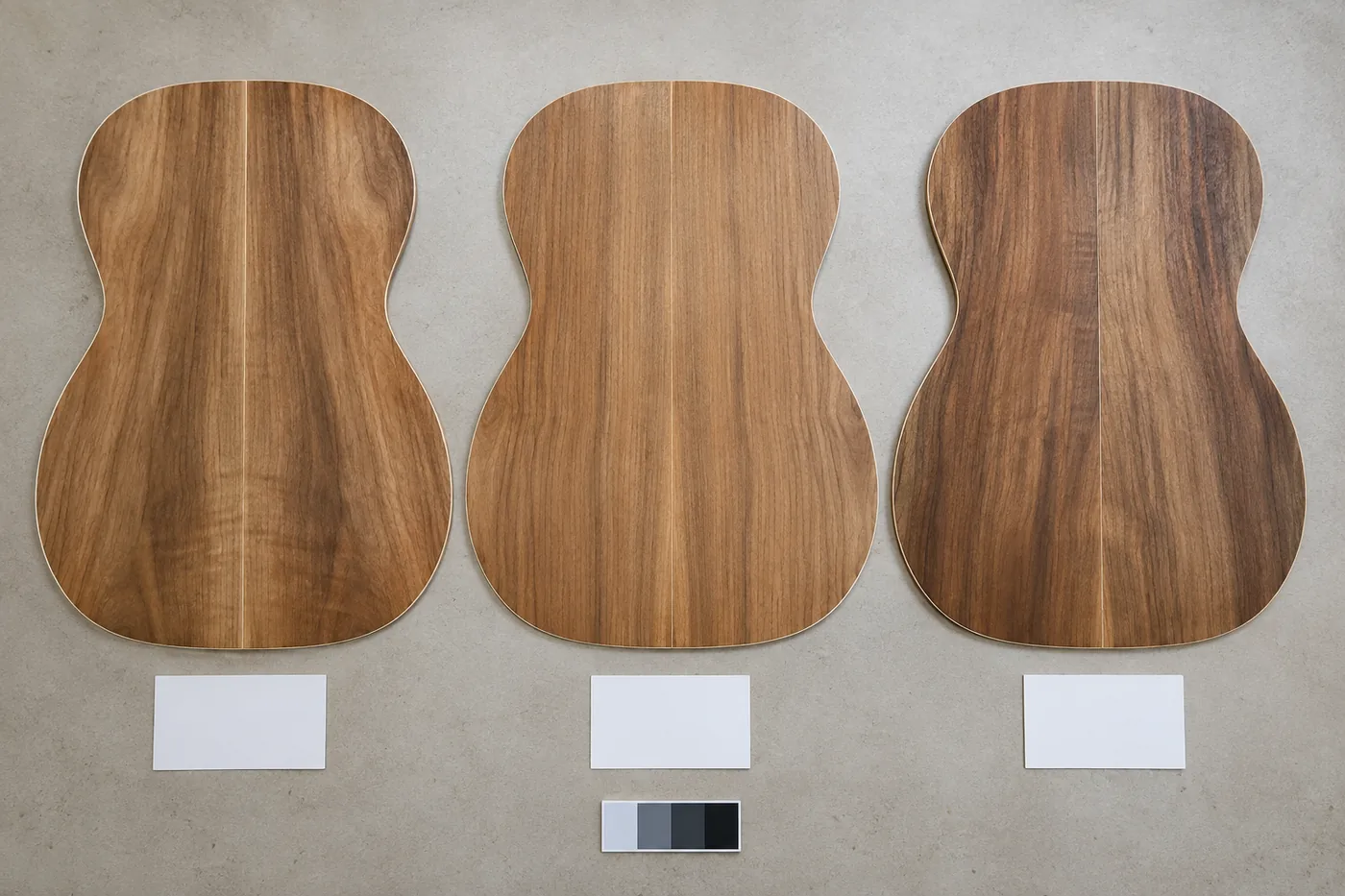
Before the sales team photographs the approved instrument, ask whether its grain, color and contrast represent the proposed production range. If appearance is commercially important, review several examples under consistent lighting.
Use original, unfiltered images. Keep the camera angle and light reasonably consistent. Save the files with the model revision and date. Mark which images show acceptable variation and which show an objective defect.
Write the acceptance language in ordinary terms. For example, the buyer may define a general color family, contrast range, matching expectation and excluded visible marks. The factory can then connect those references to inspection.
Do not demand that every unit copy the grain of a single sample. Natural material does not work that way. The goal is a range that purchasing, production, inspection and sales can all understand.
Review the finished sample as a complete instrument
Material approval is not finished when the wood names are correct.
First, compare the physical sample with the current specification and revision. Check that top, back, sides, neck, fingerboard and bridge match the approved descriptions. Review visible joints, binding, rosette, bridge area, finish and internal cleanliness.
Then inspect the instrument’s geometry and setup. Confirm neck alignment, fretwork, nut and saddle work, course spacing, action reference, tuning behavior and unwanted noise using the approved string set. Keep objective measurements separate from subjective playing notes.
Have a player familiar with the instrument evaluate it in the intended context. Record who reviewed the sample, the setup condition and the decision. Avoid turning one person’s tonal impression into a universal product promise.
If the project includes electronics, review the installed system. Confirm the component reference, control operation, output, mounting and cable behavior. An electronics photograph outside the instrument is not a test of the completed sample.
Compare quotations on the same scope
Two quotations cannot be compared fairly when their material descriptions are different.
Use the same request table for each supplier. Include top, back, sides, neck, fingerboard, bridge, finish, body direction, paired-course layout, strings, electronics, branding, accessories and packing. Mark every open decision.
Ask the supplier to state whether the quotation uses a current platform, a modified platform or new development. Confirm that the sample will use the same material construction proposed for production. If it will not, write down when the correct version will be reviewed.
Keep price, MOQ and timing outside this article’s promises. They depend on the confirmed construction, customization, quantity, material availability, development work and packaging. A buyer gets a more useful commercial answer by submitting a complete brief than by asking for a universal number.
The OEM specification-sheet guide can be adapted to a bajo quinto project. Add the five-course layout and product-specific material fields rather than reusing an ordinary six-string guitar form unchanged.
Carry the approval into shipment inspection
The approved sample is useful only if the bulk inspection refers to it.
At shipment stage, check model and revision, material descriptions, appearance range, visible joints, finish, neck alignment, fretwork, paired-course setup, strings, electronics, labels, accessories and packing. Use the sampling method and acceptance terms agreed for the order.
Inspect cartons and protective materials with the actual instrument. Packing should protect the headstock, body edges, bridge and finish without creating pressure points. The material discussion does not remove the need for practical shipping protection.
If the factory proposes a material change during production, stop and review the effect before release. Update the written record, sample decision and product copy where necessary. A substitute idden inside a familiar model name can create both quality and trust problems.
Bajo quinto wood-approval checklist
Before approving the sample, confirm that:
- The product is identified as a bajo quinto with ten strings in five paired courses.
- The intended buyer, channel and range position are written down.
- Top, back and sides have separate construction and material fields.
- Neck, fingerboard and bridge materials are described consistently.
- Decorative veneers and structural materials are not confused.
- The bill of materials and sample record use the current revision.
- Supplier and buyer terminology match.
- Unsupported tone, species, origin and sustainability claims are excluded.
- The approved appearance range uses representative, unfiltered references.
- Natural variation is separated from objective workmanship defects.
- Incoming material records can be connected to the model.
- Bracing, bridge, neck relationship and finish are reviewed on the complete sample.
- Setup and playability are checked with the approved string set.
- Electronics are tested as an installed system where applicable.
- The quotation and production proposal use the same construction.
- Shipment inspection and packing refer to the approved model.
If several of these points remain open, the project is not ready for a final material claim on a retail page.
Frequently asked questions
What wood is best for a bajo quinto?
There is no single best wood for every buyer. The appropriate choice depends on the model’s construction, intended customer, retail position, desired appearance, factory process and complete sample performance. Define and compare finished instruments rather than ranking a species name in isolation.
Should the specification say “solid wood bajo quinto”?
Only if the wording accurately describes the approved construction. State the top, back and sides separately. If only the top is solid, use “solid top” and describe the back and sides as they are actually built.
Can buyers approve wood from photographs?
Photographs can support appearance approval, but they should not be the only evidence for construction or identity. Use written specifications, material records, representative images and the physical sample together.
How should natural wood variation be handled?
Approve a representative range for color, grain and contrast under consistent lighting. Separate that range from defects such as cracks, open joints, contamination or poor finish.
Should a material substitution require a new sample?
It depends on the change and the project, but it should never be silent. Review construction, appearance, performance, availability and product-copy impact. Record the approval method before production or shipment release.
Does a more expensive material guarantee a better instrument?
No. Material cost alone does not prove geometry, joints, finish, fretwork, setup, electronics or repeatability. Evaluate the complete sample and the factory’s ability to control the approved specification.
What should buyers send when requesting a bajo quinto quotation?
Send the target market, product reference, five-course layout, top/back/side construction, material direction, appearance, finish, electronics, branding, accessories, estimated quantity and packing needs. Mark uncertain fields as open so the supplier does not make hidden assumptions.
Conclusion
A useful bajo quinto wood specification does more than list species.
It separates the top, back, sides, neck, fingerboard and bridge. It describes construction before marketing language. It defines an appearance range, ties incoming material to the model record and carries the approval through sample review, quotation, inspection and packing.
That discipline gives the buyer something repeatable. It also gives the sales team product language it can defend without exaggeration.
Discuss a bajo quinto development brief
If you are planning a wholesale or private-label bajo quinto range, contact Vinesmusical with the intended market, construction, material direction, finish, branding, estimated quantity and packaging requirements. The team can review the brief before quotation or sampling. No universal MOQ, price or lead time is promised in this guide.