 EN
EN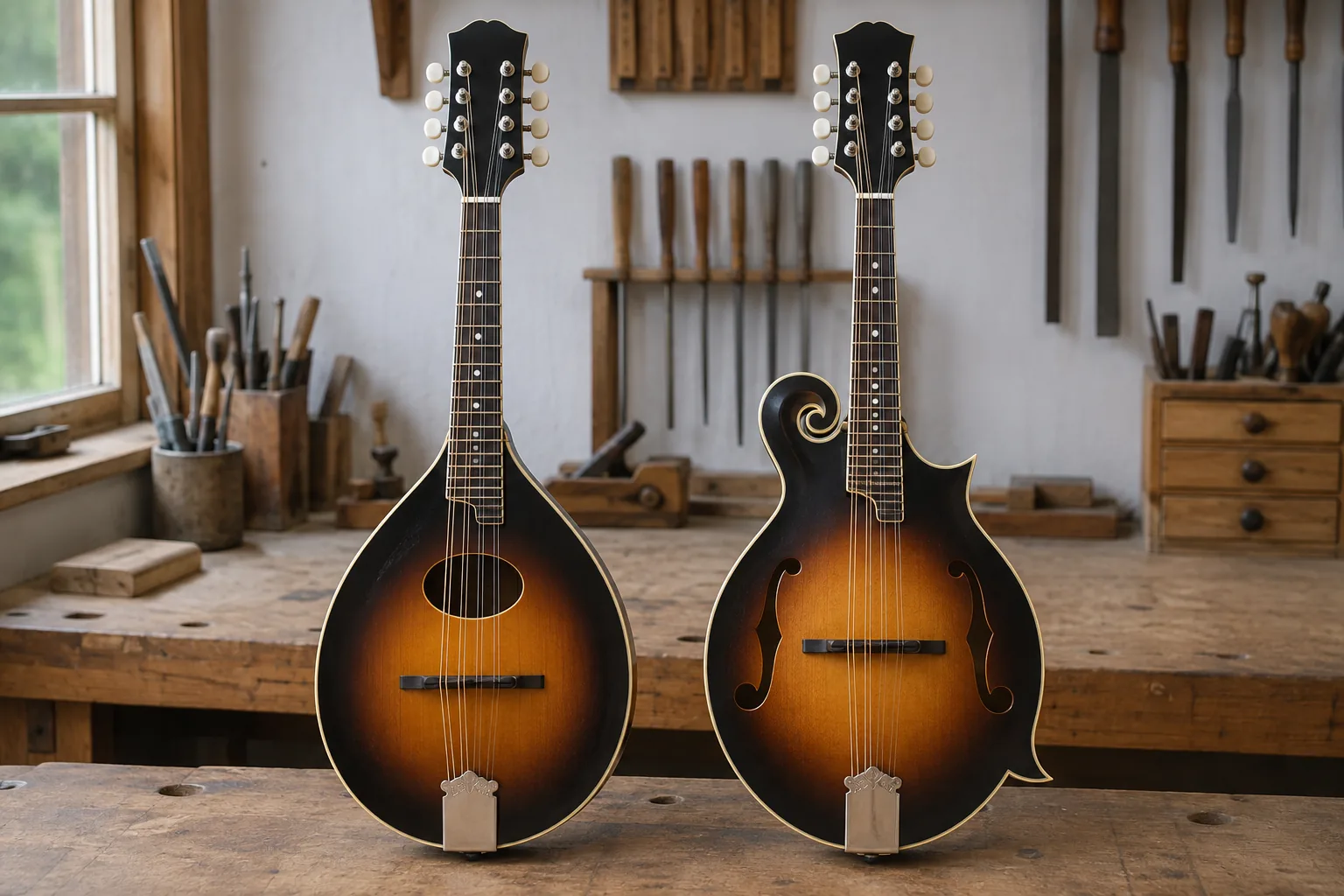
Choosing between an A-style and an F-style mandolin looks like a simple catalogue decision. It rarely stays simple once a buyer starts preparing a sample.
The two names describe recognizable body outlines. An A-style mandolin usually has a clean, rounded outline. An F-style instrument adds the scroll and body points associated with the American archtop tradition. Those visual differences matter in a shop display, but they do not tell a factory everything it needs to build the model. They do not confirm the top construction, soundhole design, scale, neck joint, bridge, hardware, finish or setup.
For a retailer, distributor or private-label brand, the practical question is not which letter is better. The question is which specification gives the customer a clear reason to choose the instrument, while remaining repeatable from the approved sample to later orders.
The short answer: start with the target player and retail position. Then approve the body outline, soundhole, construction and setup as separate items. Do not assume that the words “A-style” or “F-style” settle the complete design.
What A-style and F-style actually describe
An A-style mandolin is normally identified by its simpler, symmetrical or near-symmetrical body outline. It can still carry a wide range of construction choices. A-style models may use f-holes or an oval soundhole, a carved or flatter top concept, different neck profiles and different levels of decoration.
An F-style mandolin is recognized by a more elaborate outline with a scroll on the bass side and points on the treble side. The Metropolitan Museum of Art describes the traditional F-model form in those terms in its record of a 1916 Gibson F-2. Modern models continue to use the F-style name, but their materials, scale, fret count, finish and hardware are not automatically identical.
That distinction matters in an OEM discussion. Body style is one field in the specification, not a shortcut for the rest of the product.
Retail buyers often receive quotations in which one supplier treats “F-style” as an outline only, while another includes carved plates, multi-ply binding or a particular hardware package. Comparing the prices without aligning the specifications gives a false comparison. The same problem occurs when two A-style models look similar in a small catalogue photo but use different top constructions or setup targets.
Begin with the customer, not the scroll
An F-style silhouette has strong recognition in bluegrass and American roots-music retail. It also creates more visual presence on a wall display. That can be useful when the customer expects the traditional look or when the store needs a visually distinctive step-up model.
An A-style instrument is often easier to position when the range needs a clean appearance, a more restrained design or a straightforward entry point. It can also give a brand more freedom to build visual identity through color, soundhole treatment, pickguard, headstock and logo rather than through an ornate body outline.
These are merchandising considerations, not rules about sound or player level. An expensive A-style instrument and a modest F-style instrument can both exist. A body outline does not create a price tier by itself.
Before asking for a sample, write one sentence that describes the intended customer. For example:
- A first-time mandolin buyer comparing instruments in a general music store.
- A bluegrass player who expects a traditional F-style visual language.
- A folk-instrument retailer building a small range with two clearly different price positions.
- A private-label brand that wants a clean A-style platform with a distinctive finish and headstock treatment.
That sentence helps the supplier understand why the model exists. It also makes later choices easier. If an added binding detail or hardware change does not help the target customer understand the product, it may be unnecessary.
Do not use body shape as a tone claim
It is tempting to write that an F-style mandolin has one sound and an A-style mandolin has another. That is too broad for a purchasing specification.
The result depends on the whole instrument: the top and back construction, plate graduation, bracing, soundhole design, body dimensions, bridge fit, scale, strings and setup. Two instruments with the same outline can feel and sound different. Two different outlines can be closer than expected if their other construction choices are similar.
For buyers, the safer approach is to define the intended response in language that can be checked during sampling. Record what the reference instrument does well. Note whether the store wants a dry, direct attack, a fuller sustain, a particular balance between courses or simply a comfortable setup for the intended player. Then let the sample provide the evidence.
Do not put an unsupported tonal promise in the retail listing before the production sample has been evaluated. Descriptive copy should follow the approved product, not lead it.
Keep body shape separate from soundhole and construction
Three choices are often bundled together even though they should be recorded separately:
- Body outline: A-style or F-style, with a drawing or approved reference.
- Soundhole design: f-holes, oval hole or another approved pattern.
- Top and back construction: the materials and forming method agreed for the project.
An A-style mandolin can have f-holes. An F-style outline is not enough to confirm every arch, carve or internal detail. If a retailer wants an oval-hole A-style model, that should appear as a specific model definition rather than a note added after the quotation.
The same applies to the headstock. “F-style headstock” and “F-style body” are related visual ideas, but they should not be assumed to be one inseparable package. Logo position, tuner layout, headstock shape and inlay all need approval.
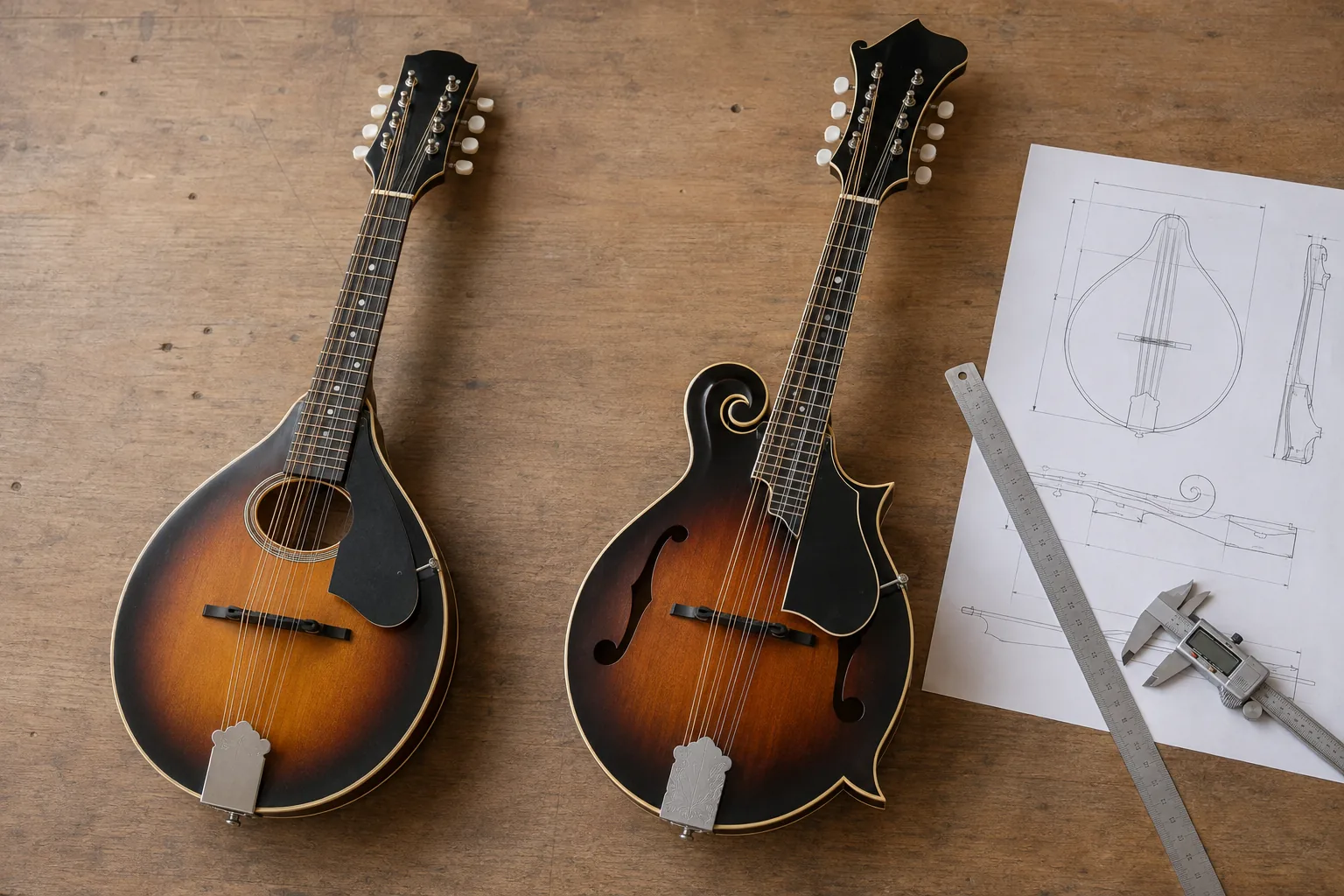
When a factory sends a drawing, check that the body outline and soundhole geometry are dimensioned. Reference photos are helpful for direction, but perspective can hide differences in waist, point length and scroll shape. A flat front-view drawing and a physical sample give a more reliable basis for approval.
Why an F-style quotation may need more detail
An elaborate outline can introduce more work around forming, routing, binding, sanding and finish inspection. The exact effect depends on the design and the production method. It should not be converted into a fixed price assumption.
Instead, ask the supplier what the quotation includes:
- Is the body based on existing tooling or a new outline?
- Which parts of the scroll and points require hand finishing?
- What binding layout is included?
- Is the finish solid, transparent, sunburst or another approved treatment?
- Which decorative details are included in the sample?
- Does the quoted case or bag fit the actual F-style outline?
These questions reveal the work behind the appearance. They also reduce late changes. A buyer who approves only a front photograph may discover during sampling that the binding route, scroll depth or case fit was never agreed.
An A-style model also needs a complete specification. Its simpler outline should not be treated as permission to leave the top construction, neck angle or bridge location undefined.
The specification sheet should identify one real model
A useful specification sheet allows someone who did not join the first sales call to understand the intended instrument. Avoid a document that says only “F-style, spruce top, sunburst.”
At minimum, record:
- Model code and revision date.
- Target market and retail position.
- Body outline with drawing reference.
- Body dimensions and depth.
- Soundhole type and approved shape.
- Top, back and side construction.
- Neck material, profile and joint.
- Scale length, fret count and nut width.
- Fingerboard material, radius if applicable and inlay.
- Bridge, tailpiece and tuner references.
- String/course arrangement and approved string set.
- Action and setup measurement points.
- Finish color, sheen and approved color reference.
- Binding, pickguard, logo and label details.
- Pickup and output requirements, if the model is amplified.
- Bag, case, carton and accessory contents.
The OEM specification sheet guide explains how to organize model information before the first sample. The same discipline applies here: one version, clear owners and a dated approval record.
Planning a new mandolin range?
Send Vinesmusical the intended market, A-style or F-style direction, construction brief, finish reference, branding files and packaging needs. We can review the brief and identify which points still need clarification before sampling. Send your project requirements.
Build a small range with visible differences
Retailers do not always need many mandolin models at launch. A small range is easier to explain if each model has a clear job.
One possible structure is an accessible A-style model and a more visually detailed F-style model. Another is two A-style instruments with different construction or pickup options. A bluegrass-focused store may make the F-style silhouette central to the range. A general folk-instrument retailer may prefer the simpler A-style as the first test.
The correct mix depends on existing customers, local music scenes and the store’s ability to explain the differences. It should not be copied from another market without evidence.
Before adding a second model, ask whether the customer can see and understand the difference in a product grid. If the answer depends on a hidden internal specification, the listing will need stronger comparison content. If the models differ only by a small decoration, they may compete with each other rather than expand the range.
Use the sample stage to prepare retail information as well as to inspect the instrument. Record accurate front, back, side and detail photographs. Confirm the model name. Write specifications from the approved sample. Do not let an early quotation description become the final catalogue by accident.
Evaluate fretwork, bridge fit and setup together
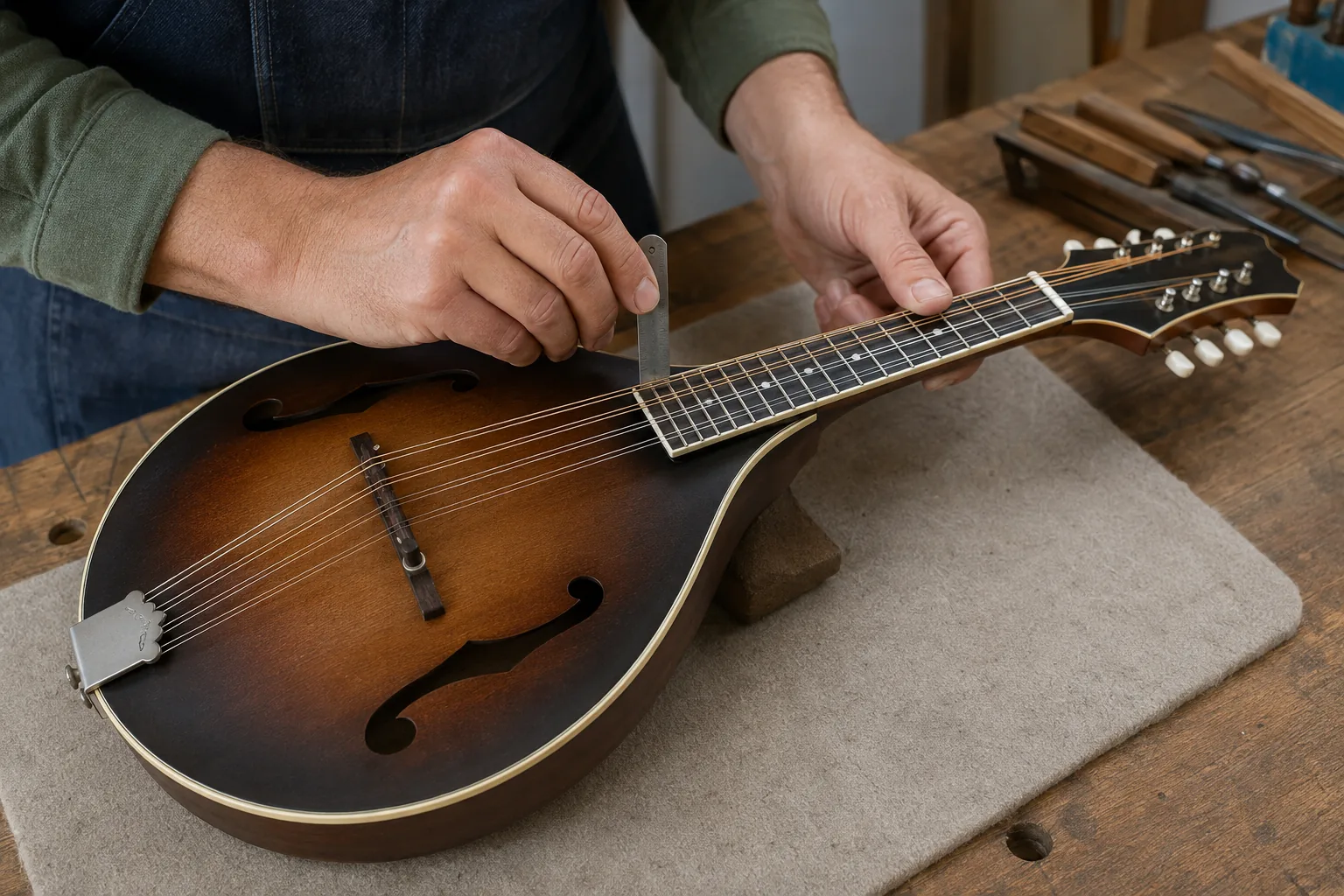
Mandolin setup is sensitive because the scale is short, the strings are arranged in courses and the floating bridge must sit in the correct working position. A model can look good in photographs and still be difficult to sell if the nut, frets, bridge or intonation need correction.
Inspect the sample in a consistent order:
- Tune it with the approved string set.
- Check neck relief and action at the agreed measurement points.
- Play every fret on every course and listen for buzzing or choking.
- Check the nut-slot feel and tuning stability.
- Confirm that paired strings sit evenly and feel balanced under the pick.
- Check bridge contact, location and adjustment range.
- Compare intonation at the agreed reference points.
- Inspect fret ends and the neck-to-headstock transition by hand.
A good inspection record uses measurements and short observations. “Setup feels fine” is difficult to reproduce. “Treble action measured at the agreed fret after tuning and settling” gives the factory a repeatable check.
Mandolin sample checklist for wholesale buyers
Body and construction
- Compare the outline with the approved front-view drawing.
- Check scroll and point shape on an F-style model.
- Confirm body depth and symmetry.
- Inspect soundhole shape, position and edge finish.
- Check binding routes, joints and transitions.
- Look inside with suitable lighting for loose debris, excess glue or unfinished areas that affect the agreed standard.
Neck, fingerboard and setup
- Confirm scale, nut width, fret count and model revision.
- Check neck profile against the approved sample notes.
- Inspect fret ends, level and polish.
- Measure action and relief after tuning.
- Check course spacing at the nut and bridge.
- Test tuning stability and intonation.
Hardware and electronics
- Confirm tuner, bridge and tailpiece references.
- Check plating color and surface condition.
- Make sure the bridge has usable adjustment range.
- If a pickup is included, test the output, controls, jack fit and noise level using the agreed procedure.
Finish and branding
- Compare color and sheen under consistent light.
- Inspect scrolls, points, binding edges and neck joint for finish buildup or thin spots.
- Check logo size, position and orientation.
- Confirm label wording and country-of-origin marking.
Packaging
- Test the actual instrument in the approved bag or case.
- Make sure an F-style scroll and points do not carry pressure from an incorrect internal shape.
- Check headstock and bridge clearance.
- Photograph the complete packed arrangement before shipment testing.
The finish approval guide and packaging approval guide provide fuller checklists for those two stages.
Approve natural variation without losing consistency
Wood figure and color vary. That variation can be attractive, especially on transparent finishes, but the buyer and factory should agree on the acceptable range.
Use several approved examples rather than one perfect photograph. Record which areas matter most to the visible grade. Decide how obvious mineral marks, color variation or figure differences may be. If a sunburst is used, specify what part of the grain remains visible and how the fade should look.
This is particularly important when the retail range places an F-style model above an A-style model partly because of appearance. The higher visual tier needs a clear inspection standard. Otherwise, the difference may disappear from one shipment to the next.
The natural wood variation guide explains how approval samples and boundary photos can make a subjective finish easier to manage.
Common purchasing mistakes
Assuming every F-style model has the same construction
F-style identifies an outline family. Ask for the complete construction specification and drawing.
Treating A-style as an entry-level specification
A-style describes shape, not quality or price. Materials, construction, setup and decoration establish the product tier.
Choosing the soundhole from a thumbnail
Ask for a front drawing and close photographs. Soundhole design should be a named, approved field.
Approving appearance before setup
The sample must pass both visual and playing checks. Do not let a strong finish hide fret, bridge or intonation issues.
Using one generic case for both styles
Test the actual model. Scrolls and body points change the contact areas and required clearance.
Changing the drawing without changing the revision
Put the revision code on the drawing, specification sheet and approval record. Tooling cannot protect a project from an outdated file.
Frequently asked questions
Should a new retailer start with A-style or F-style mandolins?
Start with the customer profile. An A-style model may offer a clean, easy-to-explain first position. An F-style model may be important for buyers who expect the traditional bluegrass-associated silhouette. A small mixed range can work when the two models have clear differences beyond decoration.
Does an F-style mandolin always cost more?
Not automatically. Its more complex outline can add forming, routing, binding, sanding or finishing work, but the quotation depends on the complete construction and decoration. Compare aligned specifications rather than body names alone.
Do A-style and F-style mandolins sound different?
The outline is only one influence. Top and back construction, soundhole design, plate work, body dimensions, bridge fit, strings and setup all affect the result. Compare approved samples built to controlled specifications.
Can an A-style mandolin have f-holes?
Yes. Body outline and soundhole design are separate specification fields. Record both in the drawing and model sheet.
What should a buyer inspect first on a mandolin sample?
Confirm the model revision, body outline and construction, then tune the approved string set and inspect fretwork, action, bridge fit and intonation. Finish, branding and packaging should follow the same dated sample record.
Is a reference photo enough for an OEM quotation?
It is useful for the first discussion but not for final approval. Add a drawing, construction details, setup targets, hardware references, finish standard and packaging requirements.
Final takeaway
A-style and F-style are useful retail labels because customers recognize the difference. They are incomplete production instructions.
Define the customer first. Keep body outline, soundhole and construction separate. Put dimensions and references into one revision-controlled specification. Then use a physical sample to approve setup, finish, branding and packaging.
If your company is preparing a mandolin range, send the target market, reference model or drawing, intended construction, branding files and packaging needs to Vinesmusical. Contact us to review the project brief before sampling.