 EN
EN Español
 Português do Brasil
“Solid top” and “laminated” are useful construction terms, but they are not complete buying decisions. A wholesale buyer still needs to know which part of the mandolin the term describes, how the construction will be verified, what the sample must demonstrate, and whether the proposed model fits the intended price position and sales channel.
The short answer is to compare complete models rather than material labels. A solid top may support a different product position, while laminated construction may be appropriate for another range. Neither label replaces a controlled specification, a representative sample, consistent setup or an inspection method. The buyer should approve the actual construction, response, appearance, stability and commercial role together.
This guide is for importers, distributors, music-store chains and private-label brands comparing mandolin proposals before sampling or bulk production. It focuses on evidence and purchasing decisions, not on declaring one construction universally superior.
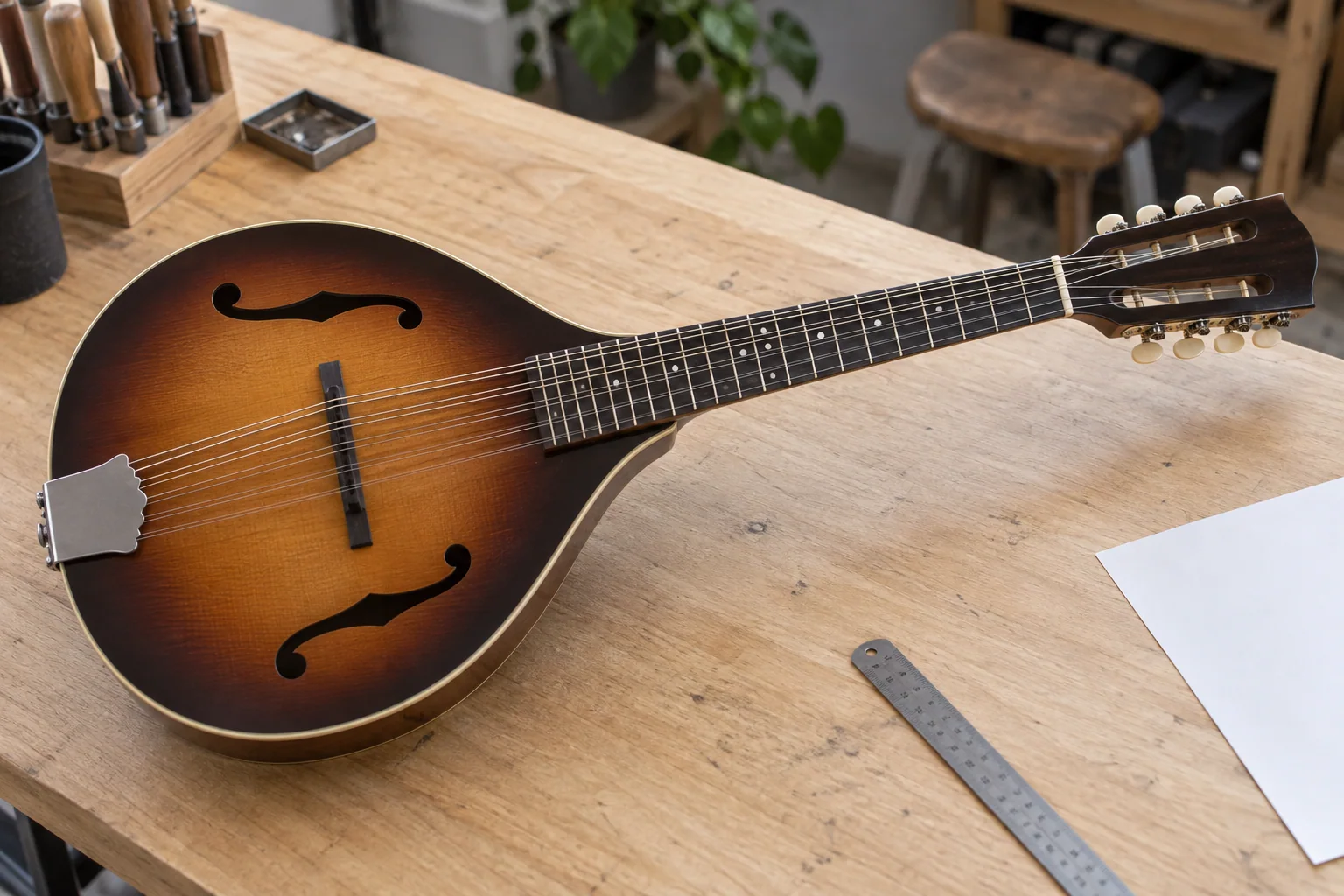
Define the construction before comparing it
The first risk is ambiguous language. “Solid wood mandolin,” “solid-top mandolin” and “laminated mandolin” do not necessarily describe the same scope.
A buyer should identify the construction of each body part separately:
- Top or soundboard.
- Back.
- Sides or rim.
- Neck.
- Fingerboard and bridge.
- Decorative veneer, if used.
A solid-top model can still use laminated back and sides. An all-solid model normally means that the top, back and sides are solid wood, but the specification should state that directly. A decorative outer veneer does not automatically make the full component solid.
For quotation purposes, use a table with one row for every part. Ask the supplier to mark each row as solid wood, laminated construction, veneer over another substrate, or another clearly described method. If the supplier proposes an alternative, keep the original and the alternative in separate quotation columns.
This simple step prevents a common comparison error: one supplier quotes a solid top with laminated back and sides, while another quotes an all-solid body, and the buyer treats both as the same “solid wood” offer.
What solid and laminated mean in practical terms
Solid wood is a natural wood component rather than a multi-layer panel. A solid mandolin top may be formed from joined pieces selected and worked for that component. Laminated material is made from layers bonded together. The visible outer layer may show the named wood species while the internal layers use a different material.
These definitions explain construction; they do not predict the quality of a finished mandolin by themselves. Plate thickness, forming method, glue joints, bridge fit, fretwork, strings and setup all affect the instrument the buyer evaluates.
Yamaha’s public explanation of acoustic-instrument construction notes that solid and laminated woods behave differently and also cautions that solid wood is not automatically better in every completed instrument. Although that explanation is written for acoustic guitars, the purchasing lesson is relevant here: compare the actual design and sample rather than converting one material term into a guaranteed result.
For a wholesale programme, material language should lead to three follow-up questions:
- What exactly is included in the quoted construction?
- How will the construction be verified on the sample and in production?
- What customer and price position is the model intended to serve?
Choose a retail role before choosing a material label
A construction decision is easier when the buyer has already defined the model’s job in the range.
An entry or education-focused mandolin may prioritise a controlled retail price, straightforward presentation, durable handling and repeatable setup. A step-up model may require a more specific construction story, closer appearance grading and a sample that demonstrates a clear difference from the entry model. A specialist folk or bluegrass retailer may expect construction details that a general music store does not need to lead with.
Write a one-sentence product role before requesting the quotation. For example:
- Accessible A-style mandolin for first-time buyers in general music stores.
- Solid-top step-up model positioned above the entry range.
- All-solid specialist model that requires tighter material and appearance documentation.
- Two-model assortment designed to show a visible and playable progression.
The sentence is not marketing copy. It is a purchasing control. It helps the buyer decide which differences must be real and which decorative additions are unnecessary.
If the proposed solid-top model looks, feels and performs almost the same as the laminated entry model, the store may struggle to explain the price step. If the laminated model has weak fretwork or inconsistent setup, changing the top material will not fix the range. Construction and execution must be evaluated separately.
Do not treat “solid top” as a tonal guarantee
Retail copy often turns construction into an absolute sound claim. That is risky before the production sample has been approved.
The top is an important vibrating part of an acoustic instrument, but the final response depends on the complete design. A buyer should not promise that every solid-top mandolin will be louder, richer, more responsive or more professional than every laminated model. Those conclusions need evidence from the actual product.
During sampling, use comparative language that can be evaluated. Ask whether the proposed model delivers the attack, balance, projection, sustain and playing response intended for the range. Compare it with the buyer’s approved reference under the same room, pick, string and setup conditions where practical.
Record observations without converting them into universal rules. “Sample B had a clearer course-to-course balance than Sample A under the agreed setup” is useful. “Solid wood always sounds better” is not an inspection result.
The final retail description should be written from the approved construction and evaluated sample. Material facts may be stated precisely. Broad tonal promises should be used only when the buyer can support them for the shipped model.
Ask for construction evidence, not only a catalogue label
Photographs can support a review, but a finished exterior may not reveal whether a component is solid or laminated. The buyer should agree in advance what evidence is reasonable for the project.
Possible evidence can include:
- A signed specification naming the construction of top, back and sides.
- Supplier photographs of the relevant component before assembly.
- Edge or opening details where the construction can be observed without damaging the instrument.
- Material purchase or batch records where appropriate to the project.
- A sample record that links the physical unit to the current specification revision.
- Incoming-material and production checks defined for the order.
The appropriate evidence depends on the model, value and supplier relationship. Keep model identity attached to it: a material photograph does not prove that the parts belong to the quoted mandolin unless the project, model, revision and date are clear.
Compare top, back and side choices separately
Buyers often focus on the top and leave the rest of the body ambiguous. That may be acceptable if it is deliberate, but it should not happen by accident.
Solid top with laminated back and sides
This combination can create a clear step between an entry model and an all-solid model. The buyer can lead with the top construction while controlling cost and appearance through the rest of the body. The exact result still depends on the design and sample.
The specification should state the face and internal construction of the back and sides. If a figured outer veneer is used, approve its expected appearance range and make sure retail wording does not describe the full component as solid.
All-solid body
An all-solid proposal usually requires more complete material documentation and a deliberate plan for natural variation. Color, figure and grain will not be identical from unit to unit. The buyer should decide which variations are acceptable and how they will be represented in product photography.
All-solid construction may also raise the importance of storage and climate instructions. That does not mean the model is unsuitable for wholesale distribution. It means the buyer should include environment, conditioning and inspection in the project plan rather than treating them as after-sales details.
Fully laminated body
A laminated construction can be a valid commercial choice when it fits the intended customer, price and distribution conditions. It still needs correct geometry, reliable glue joints, clean finishing, accurate fretwork and a controlled setup. “Laminated” is not permission to lower every other standard.
The buyer should also check whether the visible wood description refers to the outer veneer or the complete laminated component. Product listings need to be accurate about that distinction.
Include moisture and climate in the approval plan
Wood responds to changes in moisture. The U.S. Forest Products Laboratory explains that wood changes dimension as it gains or loses moisture below the fibre-saturation range. Instrument buyers do not need to turn the article into an engineering calculation, but they should recognise the operational consequence: conditioning, storage and inspection environment can affect what the sample and shipment reveal.
Ask how the sample will be conditioned before final setup and measurement. If goods will travel between very different climates, discuss packaging, storage and acclimatisation with the supplier and logistics team. Avoid claims that one construction is “humidity proof”; the buyer must assess the whole product and route.
A practical wholesale plan can include:
- Agreed storage guidance for samples and retained references.
- A consistent conditioning period before setup measurements.
- Packaging and desiccant decisions based on the real distribution route.
- Arrival inspection after a representative shipment or transport test.
- Clear dealer or customer care information when the model requires it.
Normalise quotations before comparing price
Material names are one of the easiest ways for two quotations to look comparable when they are not.
Create a comparison sheet that aligns the following fields:
- Body style and outline.
- Top construction and named outer wood.
- Back and side construction.
- Forming or carved direction where relevant.
- Neck, fingerboard and bridge materials.
- Binding, finish and decoration.
- Hardware and string set.
- Setup targets.
- Bag, case, carton and accessories.
- Sample cost and what revisions are included.
- Inspection, documentation and test scope.
Mark unanswered fields as open. Do not fill them with assumptions from another supplier’s offer.
A lower quotation may reflect laminated back and sides, simpler grading, a different finish process, existing tooling, a different hardware package or less inspection work. Those differences may be suitable for the buyer’s model. The point is to see them before choosing the quotation.
Commercial terms such as minimum quantity, sample timing and lead time should be confirmed against the completed proposal. Do not publish a generic figure as if it applies to every mandolin construction and finish.
Build one controlled sample plan
The best material discussion still needs a representative sample.
Give the sample a model code and revision. Link it to the construction table, drawing, component list, finish reference and packaging brief. If two constructions are being compared, keep the setup and other major variables as consistent as practical. Otherwise, the buyer may attribute a difference caused by strings or action to the body material.
Review the sample in stages:
- Confirm identity and document revision.
- Verify the stated top, back and side construction using the agreed evidence.
- Measure body, scale, neck and other controlled dimensions.
- Inspect joints, soundholes, binding and finish.
- Tune with the approved string set and allow the instrument to settle.
- Check relief, action, nut slots, course spacing and bridge position.
- Play every fret on every course and check tuning stability and intonation.
- Compare response with the intended product role and approved reference.
- Review labels, retail description and country-of-origin wording.
- Inspect the complete packed sample.
Consolidate comments into one revision request. A material change can affect finish, setup, weight, packaging and price. It should not be managed through disconnected messages.
For the connected specification fields, use the 8-string mandolin specification guide. Buyers comparing body platforms can also review the A-style vs F-style mandolin guide.
Define production quality checkpoints
Sample approval is not the end of material control. The purchase specification should state how the approved construction will be maintained during production.
Useful checkpoints may include:
- Verification of the current material and component specification before production starts.
- Identification of material batches where traceability is required.
- Visual checks before body closure when later verification is difficult.
- Control of glue joints, plate or panel condition and visible defects.
- In-process checks for body and neck geometry.
- Finish and branding approval against the current reference.
- Final setup, playability and appearance inspection.
- Packaging and carton review using the approved pack-out.
The buyer does not need to prescribe the factory’s complete internal process. It does need evidence that the construction named in the order is the construction being produced.
If a material becomes unavailable, use formal change control. The supplier should identify the affected model, explain the proposed substitution, provide updated documents and obtain approval before bulk use. A similar-looking veneer or species name should not be treated as an automatic equivalent.
Mandolin construction checklist for wholesale buyers
Before approving a quotation or sample, confirm that the project answers these questions:
- Which parts are solid, laminated or veneered?
- Does “solid top” refer only to the top, and is that clear in the retail copy?
- What evidence links the stated construction to the proposed sample?
- What customer and price position does the model serve?
- Are body style, plate construction, soundholes and finish defined separately?
- Are strings, bridge, fretwork and setup controlled so the sample comparison is fair?
- How will natural wood and veneer variation be approved?
- Which climate, storage and transport conditions are relevant?
- What production checkpoint verifies the construction before it becomes hidden?
- How will any material substitution be proposed and approved?
- Does the packaging protect the actual approved model?
- Can a dealer explain the difference between this model and the next tier accurately?
Frequently asked questions
Is a solid-top mandolin the same as an all-solid mandolin?
No. “Solid top” describes the top. The back and sides may be laminated or use another specified construction. “All solid” should be confirmed in writing for the top, back and sides rather than inferred from a product name.
Is a solid-top mandolin always better than a laminated mandolin?
Not automatically. Construction is one part of the finished product. Design, workmanship, fretwork, bridge fit, strings and setup also matter. Compare the actual samples against the intended customer and price position.
How can a buyer verify that a mandolin top is solid?
Agree the evidence before sampling. Use a signed construction specification and model-linked production evidence, and inspect appropriate component details where the construction can be observed. A catalogue photograph alone is not reliable proof.
What should happen if the approved wood is unavailable during production?
The supplier should raise a documented change request identifying the affected model and proposed substitute. The buyer should review updated evidence and, when necessary, a new sample before approving the change.
Use the material claim as the start of approval
Solid-top and laminated construction should help a buyer organise a mandolin range, not replace the work of specification and sampling.
Define the construction of every body part. Connect the label to evidence. Compare quotations on the same scope. Evaluate the actual sample with controlled strings and setup. Then carry the approved material, appearance and quality checkpoints into production and retail copy.
If your company is preparing a mandolin range, send the target market, body style, proposed construction, reference model, price position, branding and packaging requirements to Vinesmusical. Contact us to review the project brief before sampling.
Sources consulted
- Yamaha: Acoustic Guitar Anatomy — Solid vs Laminate
- USDA Forest Products Laboratory: Wood Handbook, Physical Properties and Moisture Relations of Wood