 EN
ENIntroduction
A music store does not need the largest possible guitar catalog. It needs a range that customers can understand, sales staff can explain, and the purchasing team can reorder with confidence.
That sounds simple until a buyer opens a guitar wholesale catalog. Each category branches into body shapes, sizes, finishes and electronics choices. Too many variations make the first order difficult to manage; too few can leave obvious customer needs uncovered.
Plan the assortment before asking a factory for prices. Decide which customer needs it must cover, assign a job to each SKU, and write a consistent specification brief before comparing quotations or requesting samples.
This guide explains how to build that framework for a mixed guitar program. It is written for music retailers, regional distributors and private-label buyers sourcing finished instruments—not strings, accessories or teaching products.
Answer First: What Should a First Wholesale Guitar Assortment Include?
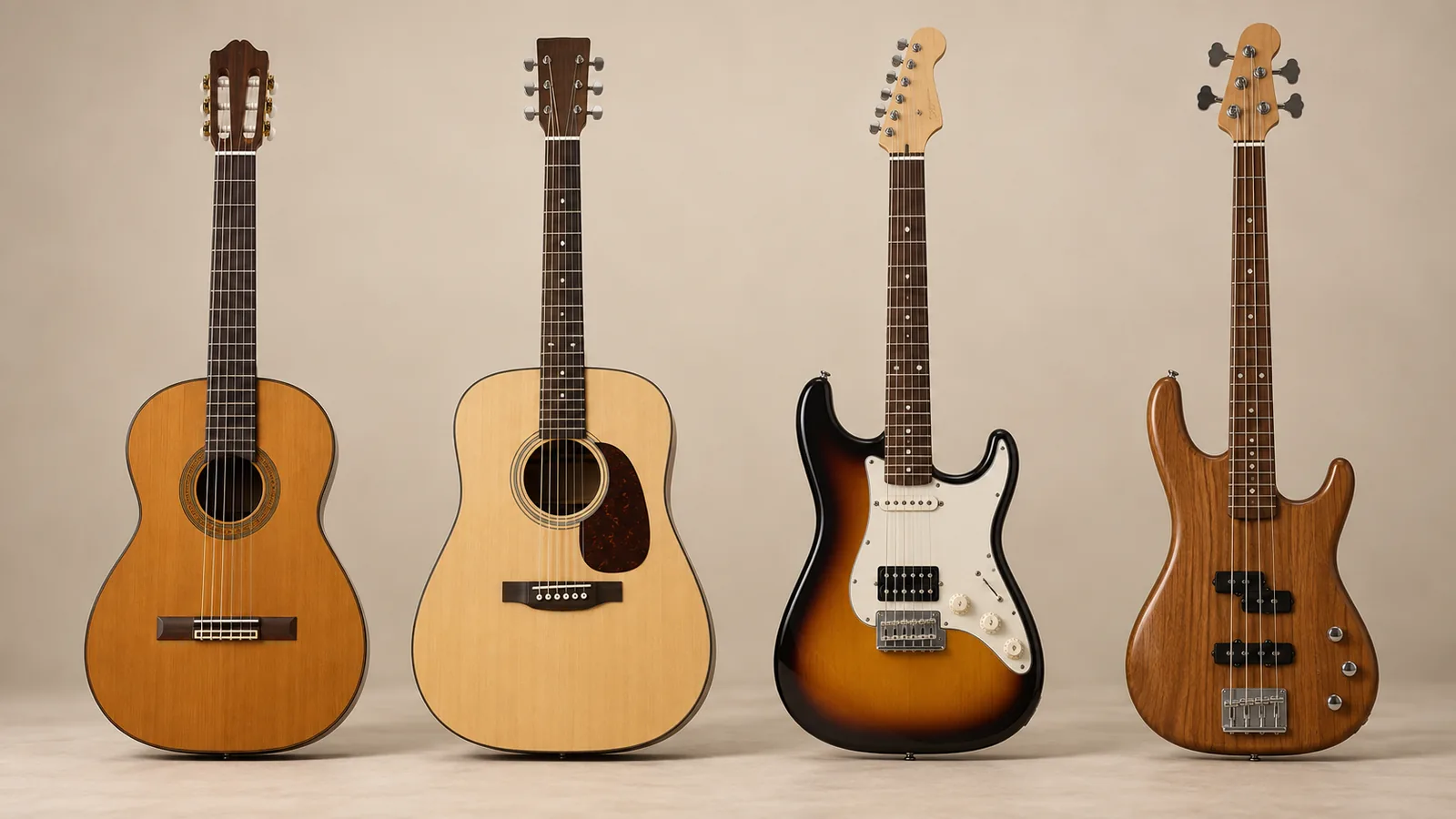
A workable first assortment usually begins with a small number of clearly differentiated models across the categories the store can support. The right mix depends on the local customer base, but the buying logic is consistent:
- cover distinct playing needs rather than small cosmetic variations;
- give each model a defined target player and retail position;
- separate essential specifications from optional decoration;
- test samples against the same written acceptance points;
- expand only after real sell-through and service feedback are available.
For a general music store, the four core groups are classical guitars, acoustic guitars, electric guitars and electric basses. A specialist retailer may place more weight on one group, but the same planning method still applies.
The objective is to make the first order readable, testable and useful enough to improve the next one.
Start with Store Demand, Not a Factory Catalog
Factories organize products around construction, materials and production routes. Stores organize products around customers. Those are different views of the same instrument, and the buyer has to translate between them.
Before contacting a guitar wholesale supplier, write down the customer situations the range must serve. Useful questions include:
- Are most buyers complete beginners, returning players or experienced musicians?
- Does the store serve schools, private teachers, working bands, worship groups or home-recording customers?
- Which body sizes are comfortable for the local customer base?
- Do customers regularly ask for amplified acoustic use?
- Is the local electric market driven by familiar shapes or more specialized configurations?
- Does the store have staff who can explain and service bass and electric models?
- Which products are expected to be repeat sellers, and which are display-led choices?
A useful exercise is to write one sentence for every proposed SKU: “This model exists for ___.” If two models receive the same answer, they may be competing for the same shelf space. If no model covers an important customer need, the range has a gap.
Give Every SKU a Clear Role
The word “entry-level” is too vague to guide manufacturing. Two buyers can use it while expecting different body sizes, materials, setup targets and presentation standards. Replace broad labels with a defined role.
For example, a store might describe a model as:
- a nylon-string instrument for first-time learners who need comfortable playability;
- a full-size acoustic for general strumming and singer-songwriter use;
- an acoustic-electric model for customers who need stage or rehearsal amplification;
- a solid-body electric built around a familiar pickup layout;
- a four-string bass intended as the standard starting point for new bass players.
These statements are purchasing decisions rather than product specifications. Once the role is clear, the buyer can discuss specifications that support it and reject options that merely add complexity. The result is also easier for sales staff to explain.
Plan the Classical Guitar Group
Classical guitars often enter a store through beginner demand, lessons and nylon-string preference. The first decision is the player and size requirement, not finish color.
Consider whether the store needs full-size only or a sequence of smaller sizes. A smaller instrument is not simply a full-size guitar reduced visually. Comfort, scale, string spacing, action and setup expectations still need to be reviewed as a complete playing system.
For each classical model, define:
- intended player and size position;
- body and neck dimensions to be confirmed on the specification sheet;
- top, back and side construction terminology;
- finish type and acceptable visual range;
- bridge, fingerboard and nut information;
- setup and playability checkpoints;
- packaging and labeling requirements.
If the store wants a basic model and a step-up option, make the construction difference easy to explain. The product page, sales team and factory brief should describe it consistently.
Plan the Acoustic Guitar Group
Acoustic assortments expand quickly because body shape, cutaway, construction, finish and electronics create visible variations. Begin with use cases.
A general-purpose acoustic may cover the broadest demand. A second model might add a different body feel or an amplified application. A third should earn its place by serving a customer the first two do not serve—not merely by changing color.
When comparing acoustic models, keep these decisions separate:
- Body format: The outline affects handling, presentation and the way buyers understand the instrument.
- Construction: Terms such as laminated, solid top and all-solid must be written accurately and used consistently.
- Cutaway: Treat it as an application decision, not automatic decoration.
- Electronics: Define the control layout, installation expectations and functional inspection points if amplification is required.
- Finish: A finish choice affects appearance and production approval, but it should not hide an unclear core specification.
For more detail, see the acoustic guitar body-shape guide. Avoid ordering several silhouettes before deciding why the store needs each one.
Mid-Article CTA: Send the Assortment Brief Before Asking for a Quote
If you are planning a private-label range, send the target customer, product categories, model roles, reference specifications, expected quantity structure, finish direction and packaging requirements in one brief.
Contact Vinesmusical to discuss a mixed classical, acoustic, electric or bass project. A clear brief makes it easier to identify missing decisions before samples are prepared.
Plan the Electric Guitar Group
Electric guitars are highly visual, but body, neck, scale, frets, hardware, pickups, controls and finish still have to work as a system.
For a first wholesale range, familiar and explainable configurations are usually easier to manage than many small variations. A store may choose one broadly recognizable configuration and add a second only when it answers a real demand difference—for example, a different pickup layout or playing application.
The specification brief should identify at least:
- body and neck construction;
- neck profile and dimensional references;
- fret count and fingerboard information;
- bridge and tuner type;
- pickup layout;
- control layout and switching;
- output and functional test expectations;
- finish reference and acceptable visual tolerance;
- setup and final inspection points.
A reference photo can communicate direction, but it cannot define hidden construction, measurements, electronics or acceptance criteria. Pair it with written specifications.
Plan the Electric Bass Group
Electric bass should receive the same planning attention as electric guitar. It is not an accessory category, and it should not be added as a single unexplained SKU at the end of a catalog.
Start with the store’s actual bass customer. A standard four-string model may serve the broadest first position. Additional string counts, active electronics or more specialized configurations should be added because the market asks for them, not because they are available in a factory catalog.
For each bass model, define:
- string count and intended use;
- scale and neck references;
- body and neck construction;
- pickup and control system;
- bridge and tuner requirements;
- balance, setup and functional inspection points;
- packaging appropriate to the finished instrument.
Shared visual language can connect the bass and electric guitar ranges, but their specifications still require separate review.
Build a Simple Assortment Matrix

Once the categories are chosen, place every proposed model in a matrix. A spreadsheet is often enough. Use one row per SKU and include columns for:
- category;
- model role;
- target customer;
- key construction distinction;
- body or size position;
- electronics requirement;
- finish direction;
- sample status;
- packaging version;
- planned retail position;
- reason the SKU belongs in the range.
The last column is especially useful. If the purchasing team cannot explain why a model is included, it may be premature.
Then look across the matrix for three problems.
1. Unnecessary duplication
Two models may differ in color or a minor feature while serving the same customer.
2. Missing steps
A step-up model should offer a difference the customer can see, feel or use.
3. Operational overload
Every SKU creates specification, sampling, labeling, photography, website and reorder work. A smaller, well-documented range is usually easier to inspect and improve.
Separate the Core Specification from Options
One common sourcing problem is mixing mandatory requirements with ideas that are still under discussion. A factory quotation becomes difficult to compare if one supplier prices the core model while another includes optional electronics, upgraded hardware or different packaging.
Divide each brief into three sections:
- Required specification — the version every quotation must address.
- Optional alternatives — choices to be priced or evaluated separately.
- Open questions — decisions that still require technical discussion or sample review.
This reduces the risk that a lower-looking quotation is simply based on a different product.
For quotation preparation, use the site’s guitar factory quotation guide. The most useful comparison is not supplier A versus supplier B on one number. It is the same defined model, packaging basis and inspection expectation compared line by line.
Use Samples to Test the Assortment, Not Just the Instrument
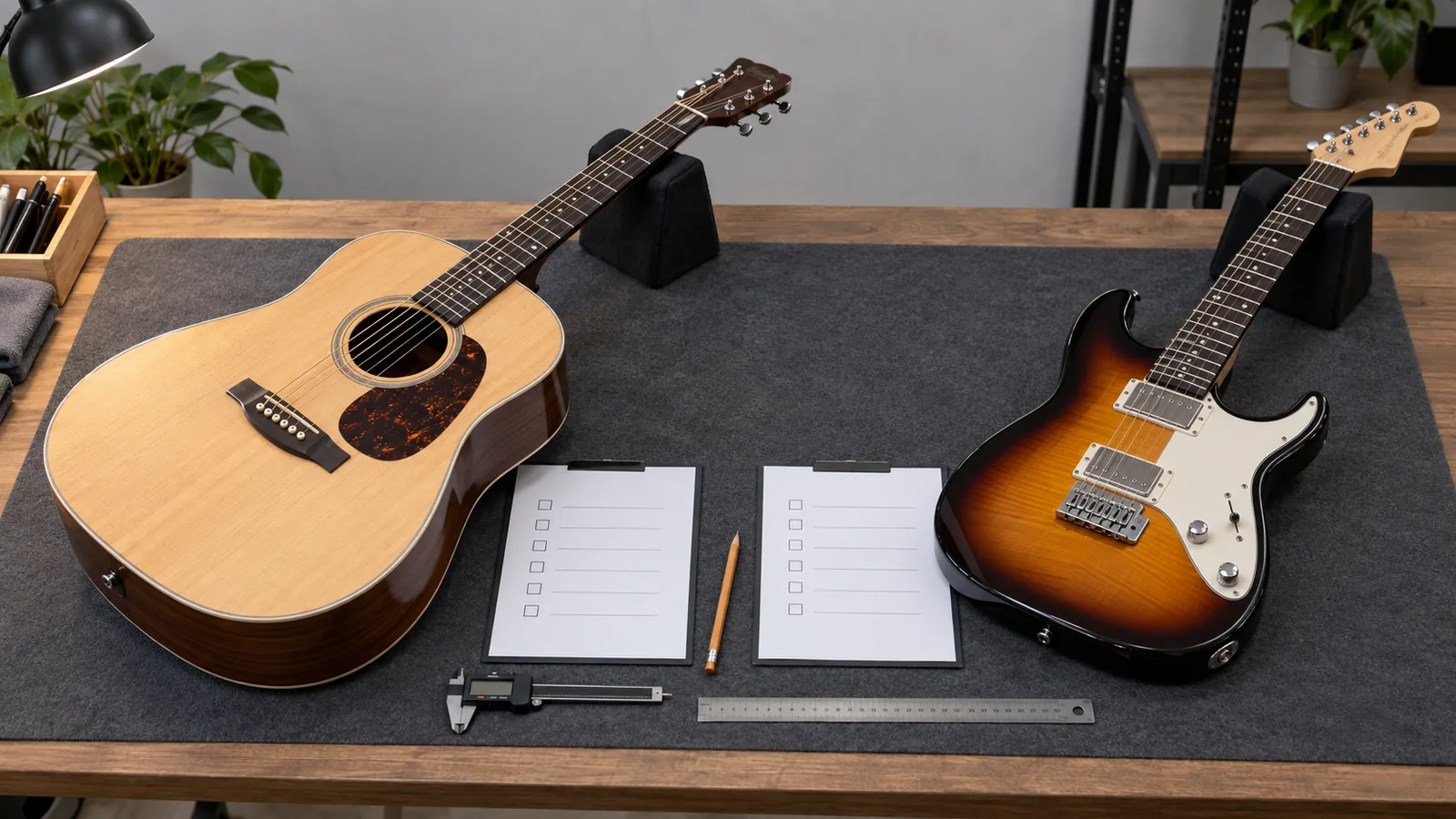
A sample review should answer two questions. First: does the instrument meet the written requirements? Second: does the model still make sense inside the planned range?
Review the sample against the approved specification, including construction, dimensions, appearance, hardware or electronics, playability, labeling and packaging. Record observations rather than relying on memory. Photograph relevant details and identify any requested changes in writing.
Then compare samples side by side. If two models feel too similar, the assortment may contain duplication. If a step-up model does not communicate a clear difference, its role may need to be simplified.
The sample-development guide explains how to move from a brief to a controlled approval process. An approved sample is most useful when the buyer also preserves the matching written specification and change record.
Connect Assortment Planning to Quality Control
Quality control should follow the product brief. A generic statement such as “good quality” is not an inspection standard.
For each SKU, convert important customer expectations into checkpoints. Depending on the model, these may cover:
- correct construction and components;
- dimensions that match the approved specification;
- finish appearance within the agreed reference;
- neck, fret and setup condition;
- hardware installation;
- electronics function;
- label, carton and packaging accuracy;
- consistency across inspected units.
The inspection plan should identify what evidence is recorded and how findings are handled. For broader context, see the guitar factory quality-control guide.
By shipment inspection, the product definition should already exist in the specification, approved sample and change record. Inspection checks whether the production lot follows those references.
Review Packaging and Sales Preparation Early
Packaging is part of the wholesale program, not an afterthought. The buyer should clarify the carton, protective materials, labels, barcodes, manuals or inserts, and any market-specific information needed for the finished product.
This work connects directly to receiving and sales. Ask:
- Can warehouse staff identify each SKU without opening every carton?
- Do model codes match the purchase order and website?
- Are product name and specification consistent across carton, label and online listing?
- Will staff need additional setup or inspection before the instrument reaches the floor?
Installation or setup preparation should also be planned. Instruments may require receiving inspection and store-level preparation according to the retailer’s own process. That responsibility should be understood before the assortment is launched.
Expand from Evidence, Not from Catalog Size
After the first range is in market, collect evidence by SKU. Sell-through is important, but it is not the only signal. Also review returns, setup time, repeated customer questions, staff feedback, warranty patterns and the reasons customers choose one model over another.
A slow model may be poorly explained, incorrectly positioned or too close to another SKU. A fast model is not automatically ready for many variations. Confirm why it works before expanding it.
Useful expansion decisions include:
- adding a size that customers repeatedly request;
- adding an amplified version for a documented use case;
- introducing a genuine step-up construction;
- extending a successful visual family into another core category;
- removing a model whose role is already covered more clearly elsewhere.
This is how a guitar dealer program becomes a controlled product system rather than an accumulating list of SKUs.
Frequently Asked Questions
How many guitar models should a music store order first?
There is no universal number. Start with the smallest group that covers the main customer needs and can be sampled, documented, inspected and explained properly.
Should the first range include classical, acoustic, electric and bass guitars?
Only if the store serves those customers and can support the categories. A general retailer may need all four; a specialist may go deeper in fewer categories. The framework works in either case.
Is a wholesale catalog enough to request a factory quotation?
No. A catalog helps identify directions, but a comparable quotation needs a written specification, quantity structure, finish and branding requirements, packaging basis and any inspection expectations.
Can several finish colors be treated as one SKU?
That depends on the store’s inventory system and purchasing plan, but the factory and buyer should still identify each approved finish clearly. Color variations create separate approval, labeling, photography and stock-control work even when the construction is shared.
What should be approved before bulk production?
The buyer should have a controlled written specification, an approved sample or documented reference, confirmed branding and packaging details, and a record of any changes. The exact approval process depends on the project.
How should a buyer compare two guitar wholesale suppliers?
Compare the same product definition, sample expectations, packaging basis and quality-control requirements. Review factory evidence and communication quality as well as the commercial quotation. Do not treat unlike specifications as a direct price comparison.
Conclusion
The best wholesale guitar assortment is not the one with the most models. It is the one in which each model has a job, every specification can be explained, samples can be compared against written requirements, and the store can learn from real sales and service feedback.
Begin with customer situations. Assign a role to every SKU. Build a simple matrix across classical, acoustic, electric and bass categories. Separate mandatory specifications from options, and use samples to test both the instrument and the logic of the range.
That preparation makes supplier discussions more productive because the question changes from “What guitars do you have?” to “Can you build and document this range for these customers?”
Final CTA: Send Your Requirements
Vinesmusical supports OEM/ODM finished-guitar projects across classical, acoustic, electric and electric bass categories. The company was established in 2014, has about 80 employees, reports monthly capacity of about 7,000 guitars, has 13 years of OEM/ODM experience, and operates from a self-owned 10,000-square-metre, five-storey facility. Vinesmusical also holds third-party BSCI certification and has a third-party in-depth factory audit report.
Review the current finished-instrument range and send your requirements. Include your target customer, planned categories, reference specifications, quantity structure, finish direction, branding and packaging needs. You can also contact info@vinesmusic.com.