 EN
EN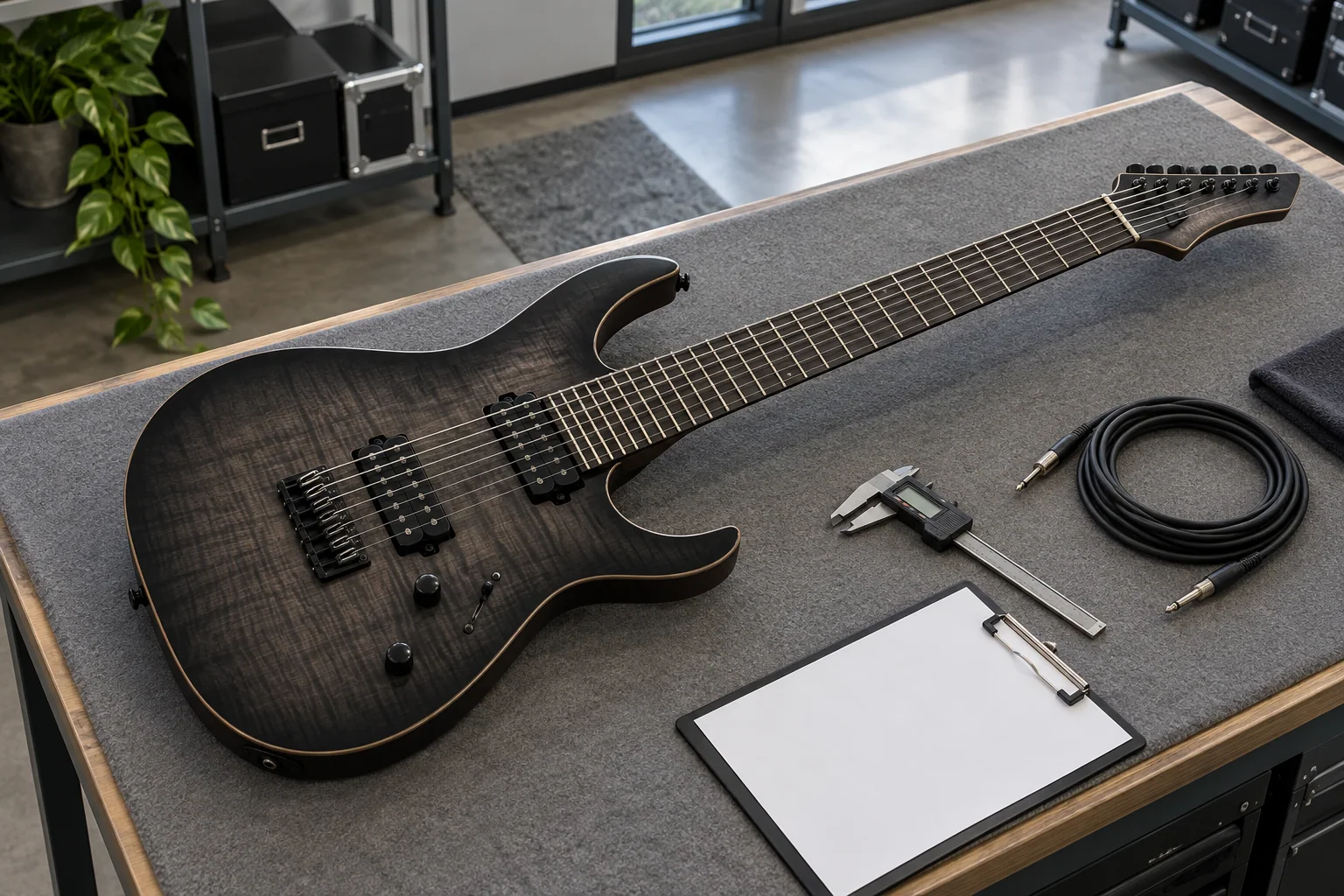
A seven-string electric guitar is not simply a six-string body with one extra tuner. The additional low string changes the neck, nut, bridge, pickup width, string tension and setup. It also changes what a retailer must explain to the player.
That makes the category attractive and demanding at the same time. A well-planned model can extend a store's metal, progressive, modern rock or recording range. A weak brief can produce a guitar that looks right in photographs but feels crowded at the nut, sounds unclear on the lowest string or arrives with a setup that does not match the intended tuning.
Wholesale buyers do not need to design every workshop detail. They do need to connect the commercial idea to a complete technical baseline. The factory should know the target player, tuning, scale direction, neck feel, pickup layout, bridge system, finish, setup and approval method before the sample starts.
In brief: define tuning and string set before scale; treat the neck, nut and bridge as one seven-string system; select pickups and electronics for the intended response rather than appearance alone; approve setup under the real tuning; and compare quotations only after every supplier is pricing the same specification.
Give the model a clear job in the retail range
The first question is commercial: why should this seven-string model exist in the buyer's assortment?
Some retailers need an accessible first seven-string for players moving from standard electric guitar. Others want a more demanding model for lower tunings, longer scale preferences or stage use. An online brand may prioritize a distinctive finish and specification story. A specialist shop may care more about neck profile, pickup response and serviceable hardware.
Write a short positioning note that covers:
- Intended player level and main musical use.
- Target tuning or tuning range.
- Retail channel and target market.
- Product position within the buyer's existing electric-guitar line.
- Fixed features and features open to proposal.
- Reference models and the exact qualities being referenced.
- Estimated quantity by model and finish.
- Branding, accessories and packaging direction.
Avoid asking a factory to “make it like” a reference product. A reference may help explain neck feel, balance or pickup response, but the buyer should identify those points specifically and avoid copying protected branding or design details.
Set tuning and string direction first
Tuning is the foundation of the seven-string specification. It affects scale choice, string gauges, nut slots, bridge adjustment, pickup response and the final setup. If tuning remains open, several other decisions remain open too.
Record the intended tuning and whether the guitar should support alternatives. Then identify the string set used for sample approval. If the buyer allows equivalent strings, define the acceptable gauge and construction direction rather than leaving the sample team to use whatever is available.
This matters because a sample can behave well with one set and feel loose, stiff or poorly balanced with another. The lowest string may need particular attention to clarity, intonation and nut fit. A late string change can require another setup review and may alter the customer's impression of the pickups.
For a model intended for several tunings, decide which tuning controls the factory setup and how other tunings will be described to dealers. It is better to approve one honest baseline than to claim broad flexibility without testing it.
Match scale length to the playing brief
Scale length is often treated as a single feature line, but buyers should review it as part of the whole instrument.
A familiar scale may make the transition from six-string guitar easier. A longer direction may provide a firmer low string for some tunings, but it also changes reach, fret spacing and overall feel. A multi-scale platform introduces additional choices around fan layout, bridge, pickup geometry, player expectations and case fit.
The right answer depends on the target user. Ask:
- Which tuning and string set must the sample support?
- Is familiar six-string feel more important than maximum low-string firmness?
- Will the main customer play rhythm, lead or both?
- Does the market already understand multi-scale guitars?
- Does the buyer need one general-purpose model or a clearly specialized instrument?
Once the direction is selected, state the measurement method and keep the drawing, sample sheet and product page consistent. Do not rely on terms such as standard scale or extended scale without a number and method in the controlled specification.
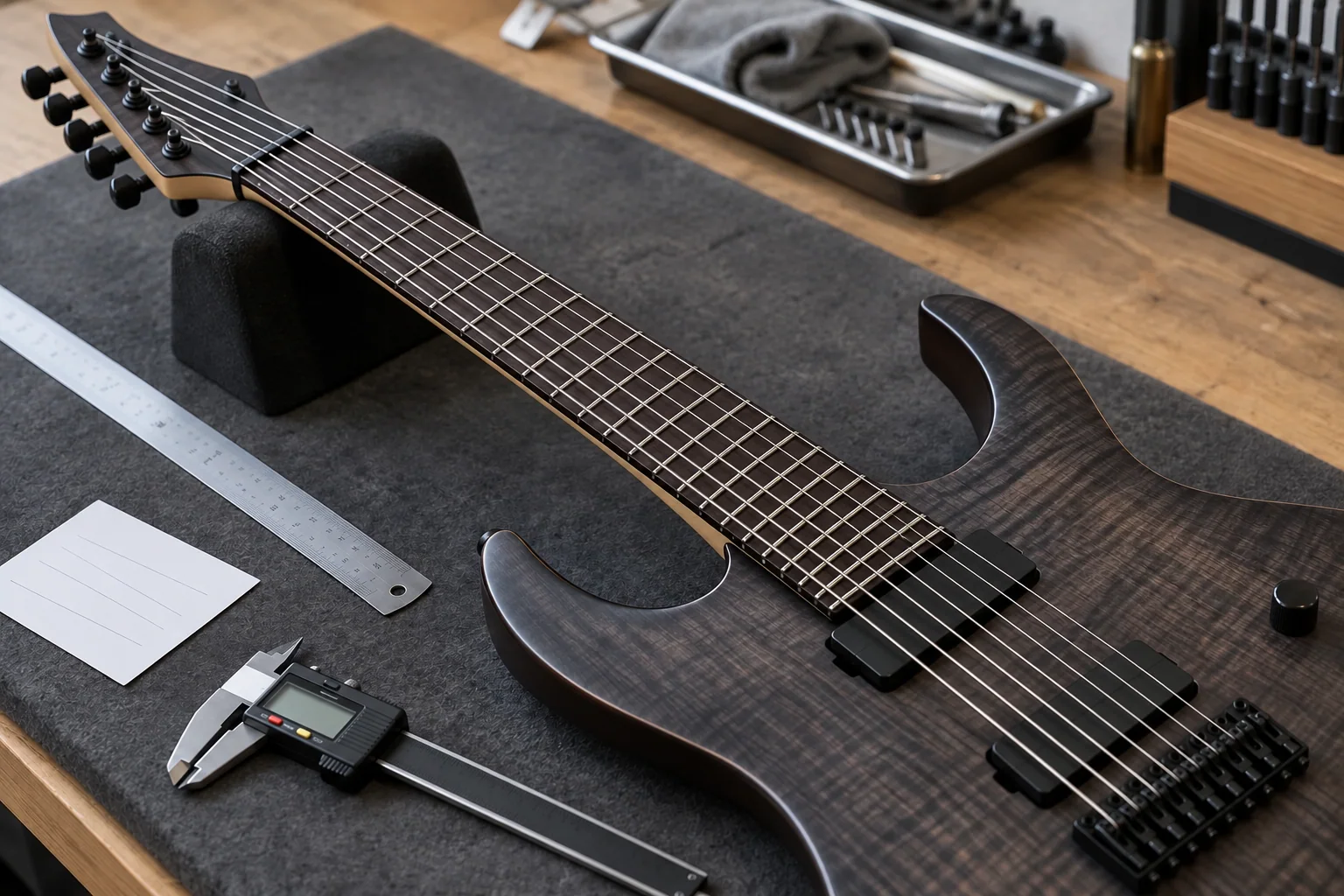
Illustrative visual: scale, nut and neck dimensions reviewed on a seven-string electric-guitar sample.
Give the neck enough attention
Players notice neck problems before they notice most hidden material choices. Seven strings require more room, but a wider neck is not automatically a comfortable neck.
The specification should connect:
- Nut width.
- String spread at the nut and bridge.
- Spacing between strings.
- Outside-string distance from the fingerboard edges.
- Fingerboard width at agreed fret positions.
- Neck thickness or profile references.
- Fingerboard radius direction.
- Fret count, fret size and fret material where required.
- Neck-joint and heel design.
If the buyer wants a familiar feel, provide a measured reference rather than the word slim. A neck can be relatively thin and still feel large because of its shoulder shape, width or radius. A sample review should combine measurements with real playing evaluation.
Fretwork deserves the same discipline. Inspect level, crown, polish and fret ends. Play every string across the fingerboard, including bends where relevant. The seventh string should not pull too close to the fingerboard edge, and the first string should not be pushed inward simply to create space on the bass side.
Our Fretboard and Neck Finishing guide explains the checks that apply across OEM guitar projects.
Choose the bridge as part of the tuning system
Fixed and tremolo bridges can both work in a seven-string range, but they create different approval and service questions.
A fixed bridge may simplify setup and appeal to players who value tuning stability under lower tunings. A tremolo system may be essential to the model's role, but the buyer then needs to confirm spring setup, travel direction, return-to-pitch expectations, routing, back-cover details and the practical string-change process.
Whatever the choice, check:
- Compatibility with seven-string spacing.
- Adjustment range for action and intonation.
- Saddle finish and string path.
- Bridge alignment with the neck and pickups.
- Hardware finish and acceptable cosmetic variation.
- Availability of replacement or service parts.
- Packaging protection around protruding components.
The sample should reach the approved setup without saddles or height adjustment sitting at an unusable limit. Intonation must be reviewed with the intended string set and tuning, not with a temporary factory setup.
Specify pickups by response and layout
Seven-string buyers often begin with pickup type—HH, active, passive or a named reference. That is only the beginning.
The low string must be heard clearly without making the rest of the guitar harsh or unbalanced. The result depends on the pickup, distance to the strings, electronics, scale, strings and amplifier signal path. A pickup that performs well in one platform may not produce the same result in another.
For the quotation and sample, define:
- Pickup configuration and format.
- Active or passive system.
- Control functions and their order.
- Switching positions and intended combinations.
- Potentiometer and capacitor specifications where controlled.
- Output-jack type and location.
- Battery type, compartment and access if active.
- Pickup mounting and adjustment method.
- Buyer-supplied, factory-proposed or branded components.
Draw a simple control map. “One volume, one tone and a switch” can still lead to different wiring logic if the switch positions are not described. The final product page, dealer sheet and inspection procedure should all use the same control sequence.
Developing a seven-string range? Send the target player, tuning, scale direction, pickup layout, bridge, estimated quantity, finish and packaging requirements through the Vinesmusical contact page. We can identify which points are ready for quotation and which still need a technical proposal.
Test electronics like a buyer, not only with a meter
Continuity and output checks are necessary, but they do not describe the whole customer experience. Plug the sample into a clean reference signal path and operate every control.
Listen and look for:
- Output from every pickup and selected combination.
- Correct control direction and switching order.
- Noise, crackle or intermittent output while controls are moved.
- Jack security and cable fit.
- Pickup balance across all seven strings.
- Unwanted mechanical noise from loose hardware or cavities.
- Battery access and power behaviour for active systems.
- Shielding and grounding performance under the agreed test conditions.
Keep the test conditions consistent. An undefined amplifier setting makes comments such as muddy, weak or bright difficult to reproduce. A short reference recording can support the review, but the wiring map and functional checklist remain the production record.
See our Electric Guitar and Bass Electronics QC guide for a broader inspection framework.
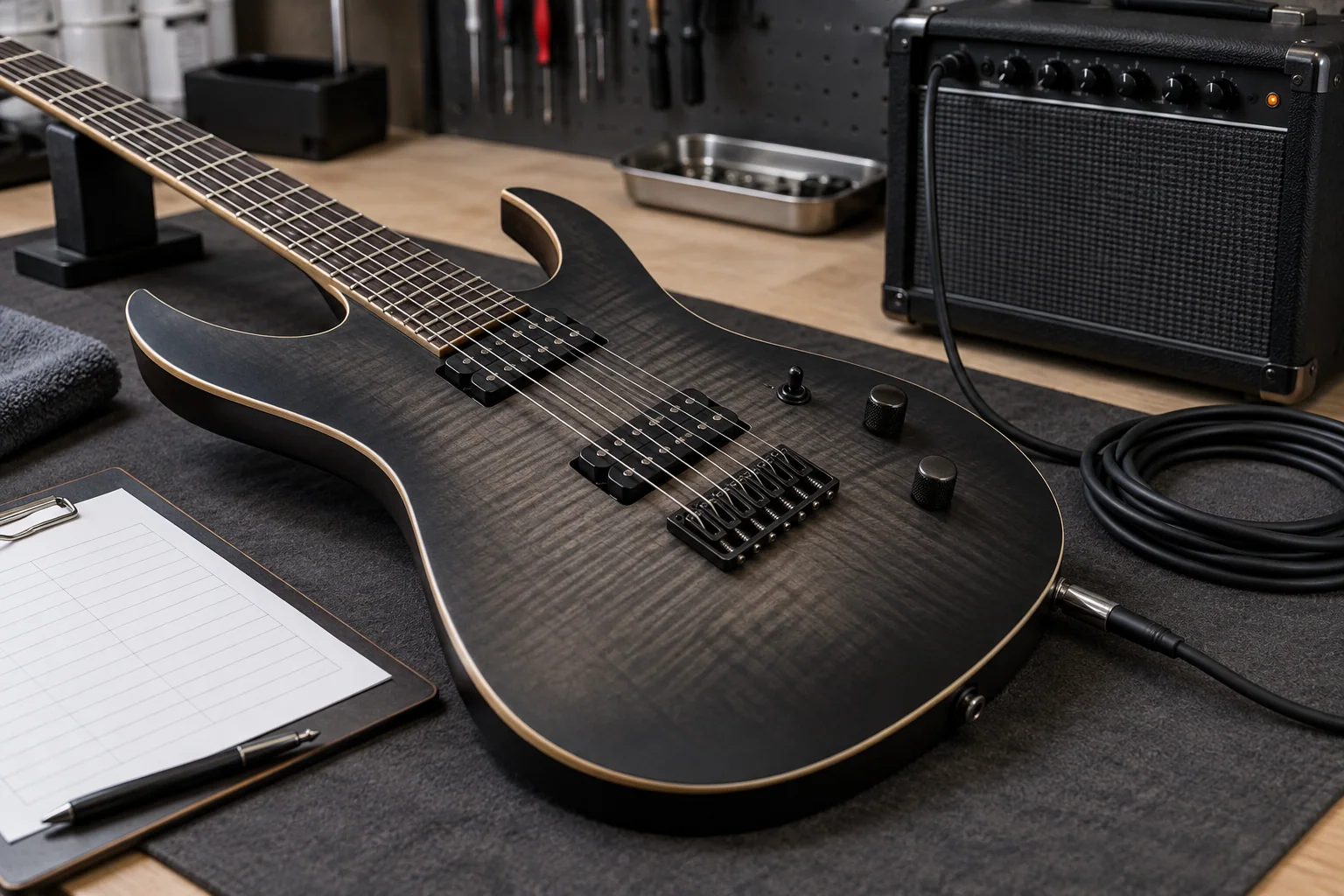
Illustrative visual: pickup balance, controls and setup reviewed before a seven-string sample is approved.
Balance body design, weight and access
The body must support the extra neck width and intended hardware without becoming uncomfortable. Review balance with a strap and in a seated position. Check upper-fret access, forearm comfort, control reach and whether the output cable interferes with the player.
If the body shape comes from an existing platform, confirm that the neck pocket, pickup routes and bridge position are engineered for the seven-string version. A scaled or widened component should not be inserted into a six-string drawing without reviewing alignment and structure.
Weight targets should be realistic for the selected wood and hardware. Natural materials vary. If weight is important, approve a practical range and agree how it will be measured. Do not promise one unusually light sample as the standard for every production unit.
Finish and colour also affect the commercial role. Extended-range guitars are often sold with bold visual language, but finish complexity should have a reason. A demanding burst, metallic colour or graphic can add sample rounds and inspection points. Approve colour using physical or controlled references, not a phone image alone.
The Guitar Finish Approval guide explains how to record colour, gloss, edge treatment and acceptable variation.
Decide how the model fits the assortment
A retailer adding seven-string guitars should avoid treating the category as one isolated experiment. Consider the path a customer follows through the range.
A practical assortment may distinguish models by:
- Entry versus step-up positioning.
- Fixed bridge versus tremolo.
- Familiar scale versus extended or multi-scale direction.
- Passive versus active electronics.
- Standard versus distinctive finish.
- Right-handed and left-handed demand.
The first order does not need every combination. Too many variations can hide which feature actually drives demand. A focused model with a clear technical story gives sales staff better language and gives the buyer cleaner feedback for the next revision.
Product information should answer the questions seven-string customers genuinely ask: tuning baseline, scale, string set, neck dimensions, pickup/control layout, bridge, setup and included accessories. General phrases such as professional hardware or powerful tone do not help a dealer compare models.
Build sample approval around the real use case
Approve the sample with the intended tuning, strings and signal path. A presentation sample prepared differently from the production brief cannot control the order.
Use a consistent sequence:
- Confirm model code, drawing and specification revision.
- Measure scale, nut, neck and string spread.
- Check neck joint, bridge and pickup alignment.
- Inspect fret level, ends, crown and polish.
- Fit the approved string set and tune to the target.
- Measure relief and action at agreed points.
- Play every string and fret; check bends and upper-register access.
- Review intonation and bridge adjustment range.
- Test pickups, controls, jack and battery system if fitted.
- Inspect finish, logo, accessories, labels and packaging.
Consolidate comments into one dated revision. Avoid sending separate requests that work against each other. A change in string gauge may affect the nut and setup. A pickup change may affect routing, mounting or electronics. A bridge change may alter alignment and packaging.
Our Electric Guitar OEM Options guide helps buyers organize the broader body, neck, hardware and electronics decisions before sampling.
Protect the instrument during shipping
Seven-string guitars may have a wider headstock, heavier hardware or longer overall dimensions than a nearby six-string model. Do not assume the same foam positions, bag or carton will fit.
Check:
- Headstock and tuner clearance.
- Neck and body support points.
- Protection around switches, knobs and bridge parts.
- Accessory placement away from the finish.
- Bag or case dimensions.
- Retail and master-carton labels.
- Model, string count and finish identification.
- Carton strength and movement under the agreed packing method.
If the guitar is shipped with a tremolo arm, tools, cable or spare parts, give each item a secure position. A loose metal accessory can damage a finish that passed inspection before packing.
Seven-string wholesale specification checklist
Before requesting a final quotation or sample, confirm:
- Target player, musical use and retail position.
- Tuning baseline and approved string set.
- Scale direction and measurement method.
- Nut width, string spread, neck profile and radius.
- Fret count, fretwork and setup requirements.
- Body platform, balance and upper-fret access.
- Bridge system and adjustment range.
- Pickup configuration, control map and electronics test.
- Finish, logo and acceptable natural variation.
- Accessories, labels, bag or case and carton.
- Sample approval method and document owner.
Frequently asked questions
Is a longer scale always better for a seven-string guitar?
No. It may support a firmer low string for some tunings, but it also changes reach and feel. Choose the scale with the intended tuning, strings and player in mind, then test the complete system.
Should the first wholesale model use active or passive pickups?
Either can work. The choice should follow the target sound, price position, control requirements, service expectations and battery considerations. Approve the real electronics system on the sample rather than relying only on the pickup label.
Can a six-string body design be converted directly to seven strings?
It requires review. Neck pocket, bridge, pickup routes, body balance, hardware alignment and packaging may all change. An existing platform can be a useful starting point, but the seven-string version needs its own drawing and sample approval.
What should a retailer publish on the product page?
State tuning, scale, string set, neck and fingerboard details, fret count, bridge, pickups, control layout, construction, finish, included accessories and measured dimensions. Clear facts reduce comparison questions and returns.
What information helps a factory quote accurately?
Send the target player and market, tuning, scale, neck direction, body platform, bridge, pickups, electronics, finish, branding, estimated quantity and packaging. Separate fixed requirements from items open to proposal.
A seven-string model succeeds as a complete system
The extra string changes more than the product name. It changes how the neck feels, how the bridge adjusts, how the pickups respond and how the factory prepares the final setup.
For a dependable 7 string electric guitar wholesale project, close the connected decisions in the right order: player and tuning first, then scale and strings, neck and bridge, pickups and electronics, body and finish, setup and packaging. Review the sample under the real use case and keep every approved change in one revision.
Vinesmusical supports B2B OEM/ODM projects for guitar brands, importers, distributors and private-label buyers. The company was established in 2014 and operates a company-owned factory of approximately 10,000 square metres across five floors. Its 80-person team has monthly production capacity of approximately 7,000 guitars, supported by 13 years of OEM/ODM experience, third-party BSCI certification and an independent in-depth factory audit report.
Review the Electric Guitar category and send your seven-string project requirements. Include the target tuning, scale direction, pickup and bridge requirements, finish, estimated quantity, branding and packaging so the sample brief can be reviewed on one consistent basis.