 EN
EN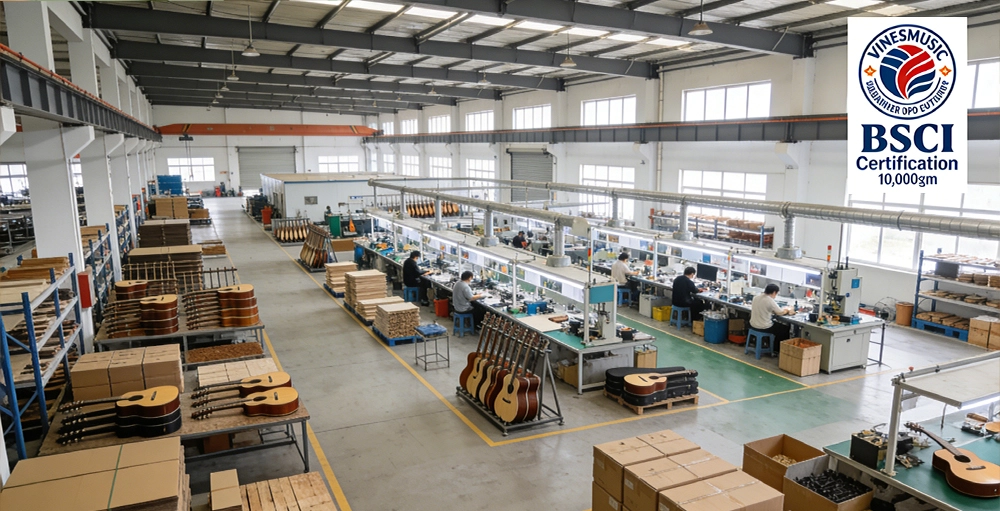
Guitar buyers hear the same supplier claims repeatedly: strong capacity, strict quality, fast delivery and many customers. Those phrases are difficult to use in a supplier decision unless the factory can connect them to verifiable information and a workable project process.
Vinesmusical is a B2B guitar manufacturer established in 2014. We operate a company-owned factory of approximately 10,000 square metres across five floors. Our 80-person team manufactures classical, acoustic and electric guitars, with monthly capacity of approximately 7,000 instruments and 13 years of OEM/ODM experience.
Verified factory information
- Established: 2014
- Facility: company-owned, approximately 10,000㎡ across five floors
- Employees: 80
- Monthly capacity: approximately 7,000 guitars
- Products: classical, acoustic and electric guitars
- OEM/ODM experience: 13 years
- Social compliance: third-party BSCI certification
- Factory verification: an independent company has completed an in-depth factory audit report
Buyers may request current certificate information and relevant audit-report details as part of supplier approval. The scope and validity should be reviewed against the buyer’s own compliance requirements. A certificate supports due diligence; it does not replace product sampling and order-specific quality control.
A company-owned facility supports long-term planning
Owning the factory gives Vinesmusical a stable base for production and buyer visits. The five-floor layout provides approximately 10,000 square metres for the functions needed to support guitar manufacturing.
For a buyer, floor area is useful context rather than a quality score. During a visit or remote walkthrough, follow one model through the relevant areas and ask how work in progress is identified. The value of the facility comes from how people, materials, documents and checkpoints are organized inside it.
BSCI and the third-party audit report serve different purposes
BSCI certification concerns social-compliance due diligence. A factory audit report can examine broader supplier information according to the auditor’s scope. Product quality still requires a model specification, approved sample, production checks and final inspection.
Professional buyers should avoid treating these documents as interchangeable. Ask for the current BSCI information, understand who completed the factory audit and when, and identify which sections are relevant to your approval process. If your company has its own audit checklist, send it before the review.
OEM and ODM support starts with the product brief
Vinesmusical works with buyers who arrive at different stages. Some have full drawings and a bill of materials; others have a target market, price position and reference model.
For OEM projects, the buyer generally controls more of the design and specification. For ODM projects, development begins from an existing factory platform and applies agreed changes. Many projects combine both approaches.
A useful first inquiry includes:
- Target country, retail channel and customer.
- Classical, acoustic or electric guitar.
- Reference model, drawing or specification.
- Expected quantity and model mix.
- Finish, logo and packaging requirements.
- Target sample and shipment dates.
- Items that are fixed and items open to recommendation.
Read our OEM vs ODM guitar manufacturing guide if you are deciding which route fits the project.
Product range without a one-size-fits-all promise
Classical, acoustic and electric guitars share some manufacturing skills, but their key risks differ. A classical model may emphasize nut width, body construction and student playability. An acoustic project connects body, bracing, neck geometry, fretwork and finish. An electric guitar adds routing, hardware compatibility, electronics and intonation requirements.
We discuss capacity and lead time at model level. The factory-wide capacity of approximately 7,000 guitars per month is not a promise that every custom configuration can be produced immediately at that volume. Sample status, materials, finish, component supply and the current schedule all matter.
What buyers can verify before placing an order
- Company and factory information.
- Current BSCI certificate information.
- Relevant information from the third-party deep factory audit report.
- A live or recorded walkthrough of areas connected to the proposed model.
- The factory’s response to a written specification.
- A sample produced to the agreed requirements.
- Examples of order-specific inspection evidence with customer information protected.
- The packing method and shipping marks before release.
Our remote guitar factory audit checklist helps buyers structure this review.
Sample development tests the working relationship
A sample is not only a guitar for approval. It shows whether the factory can identify unclear requirements, record revisions and respond to feedback.
During sample review, separate defects from preferences. Number each comment, attach a photo or measurement where useful and ask the factory to reply with the proposed action. After approval, issue one current specification and retain the sample as a physical reference.
Late changes should be reviewed for material, price and schedule impact. Our production change-control guide provides a simple method.
Quality evidence should be connected to the order
Certificates and audit reports describe the supplier at a particular time and within a particular scope. They do not show whether a specific guitar meets the approved standard.
For production, ask for evidence tied to your model: approved components, selected work-in-progress checkpoints, early-production comparison, setup or electronics checks and a final inspection summary. The request should protect other buyers’ confidential information.
See what guitar factory quality evidence buyers should request.
Why buyers consider Vinesmusical
The reason to continue a supplier discussion should be clear and testable: the product category fits, the factory has appropriate scale, the technical response is useful, the sample meets the brief, compliance information is available and communication remains consistent from quotation to production.
Vinesmusical provides a company-owned manufacturing base, an 80-person team, approximately 7,000-guitar monthly capacity, third-party BSCI certification and a third-party in-depth factory audit report. The final decision should still be based on your project, sample and supplier-approval requirements.
Start a supplier review
Send your project brief to info@vinesmusic.com or use the contact page. If your company uses a supplier questionnaire or audit checklist, include it with the product information so the relevant teams can prepare a complete response.