Address
D308, Mingzhu Business Park, Baiyun District, Guangzhou, China
Work Hours
Monday to Friday: 7AM - 7PM
Weekend: 10AM - 5PM
Address
D308, Mingzhu Business Park, Baiyun District, Guangzhou, China
Work Hours
Monday to Friday: 7AM - 7PM
Weekend: 10AM - 5PM

If you’re running a guitar brand—whether a physical instrument label, an independent musician’s signature line, or a cross-border e-commerce store—one of the most consequential decisions you’ll make is where to manufacture your guitars.
This decision impacts far more than just your procurement costs. The expertise of your guitar OEM factory directly determines your products’ tonal consistency, playability, craftsmanship, and on-time delivery performance. An unprofessional guitar manufacturer might offer rock-bottom prices initially, but they’ll create massive risks in quality control, lead times, and product uniformity—risks that will ultimately damage your brand reputation and erode customer loyalty.
This systematic guide is designed specifically for instrument brand owners, musical instrument distributors, and guitar cross-border e-commerce sellers. We break down how to assess the true capabilities of any guitar OEM/ODM manufacturer across seven core dimensions, empowering you to make informed decisions during inquiries, factory inspections, and business negotiations.
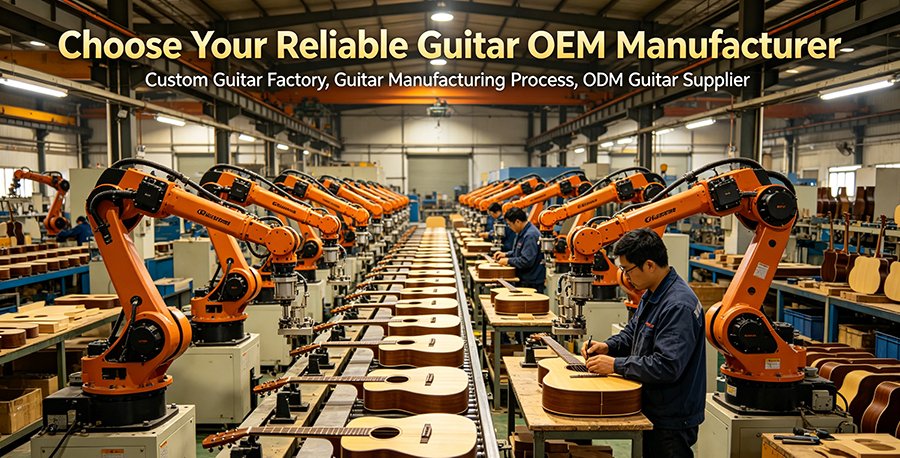
Before approaching any China guitar factory, you need to clearly define your expected order volumes. A reputable guitar OEM manufacturer will transparently provide you with:
Beyond production numbers, the equipment inventory is far more critical. A professional guitar manufacturing process relies on the following core equipment:
| Equipment Type | Precision Standard | Primary Application |
|---|---|---|
| 3-5 Axis CNC Machining Centers | ±0.05mm | Precision finishing of guitar bodies, necks, and headstocks |
| Large Vacuum Presses | ≥100 tons pressure | Laminating plywood and solid wood guitar tops |
| Robotic Spraying Systems/Automatic Painting Lines | ≤5μm thickness variation | Primer and topcoat application |
| CNC Drilling Equipment | ±0.1mm | Pickup cavities, electronics compartments, and bridge holes |
| Neck Slotting Machines | — | Truss rod channel fabrication |
| Fret Forming and Installation Machines | — | Precise fret positioning and installation |
If a factory claims a monthly capacity of 2,000 guitars but only has two outdated CNC machines, their production figures are almost certainly inflated. Guitar production capacity must always align with the equipment inventory.
If your guitar brand targets North America, Europe, or Japan, factory certifications are not “nice-to-haves”—they’re mandatory entry requirements.
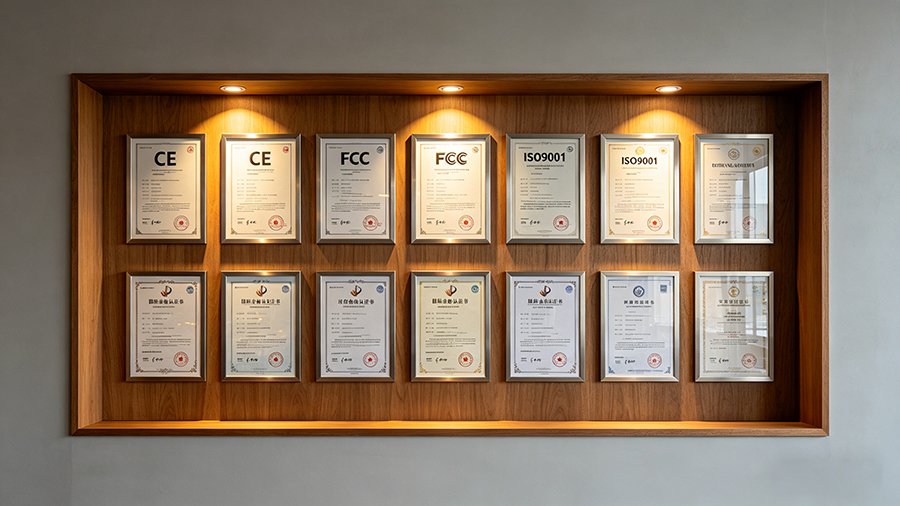
Many factories display “certificates” that are either purchased or expired. Use these verification methods:
Guitar quality control is the defining factor that separates professional factories from backyard workshops. A trustworthy guitar OEM factory must implement a three-tier inspection system:
Guitar factories source numerous materials: wood, paints, metal hardware, plastic components, electronics, pickups, knobs, and jacks. Each category requires specific inspection standards and documentation.
Core inspection items include:
Inspection checkpoints must be established at critical production stages to prevent defective products from moving to the next process. Key control points in the guitar manufacturing process include:
Comprehensive pre-shipment inspection includes:
Always ask what Acceptable Quality Limit (AQL) standard the factory follows. Professional facilities typically implement AQL 2.5 or stricter. Any factory that cannot answer this question either lacks a formal quality management system or follows extremely low standards.
Guitar finishes are potential sources of heavy metals and VOCs (Volatile Organic Compounds). Guitars exported to Europe must comply with:
If your guitars use mahogany, rosewood, or other endangered wood species, you must ensure:
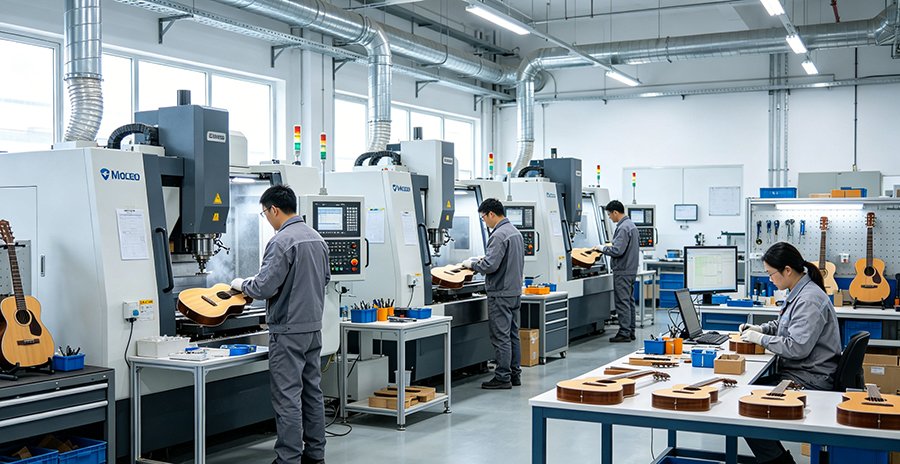
A hallmark of a professional ODM guitar supplier is having an in-house technical team, not just assembly line workers.
Your technical team should provide:
Before placing formal orders, ask the factory these critical questions:
Lead times depend on more than just production scheduling:
A reputable guitar OEM manufacturer will provide quotes with clear cost breakdowns:
| Cost Component | Description |
|---|---|
| Raw Material Costs | Wood, paints, metal parts, electronic components |
| Labor and Processing Costs | CNC machining, painting, assembly, hand finishing |
| Quality Inspection Costs | IQC, in-process inspection, final inspection |
| Packaging Materials | Inner boxes, outer cartons, protective padding |
| Overhead and Profit | Factory operating costs and reasonable profit margin |
| Certification and Testing Fees | Certification maintenance and product testing (if required) |
Be wary of excessively low quotes. Guitar manufacturing has a minimum material cost floor. Below-cost pricing almost always indicates material downgrades (lower-grade wood substitutes, reduced design specifications) or a non-existent quality control system.
Common payment terms for guitar OEM/ODM manufacturing:
Any factory requiring 100% prepayment or cash-only terms is a significant red flag.
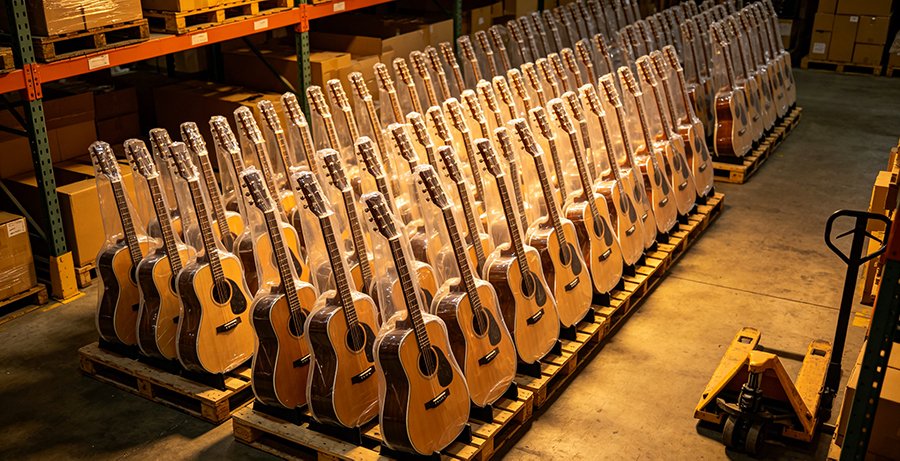
Use this weighted checklist to systematically evaluate potential guitar manufacturing partners:
| Evaluation Dimension | Weight | Key Assessment Questions |
|---|---|---|
| Production Capacity & Equipment | 20% | Does monthly/annual capacity meet your needs? Does equipment support your product types? |
| Certification System | 15% | Do they hold all required certifications for your target markets? Can they provide authentic test reports? |
| Quality Control Process | 20% | Do they implement IQC/IPQC/FQC three-tier inspection? What AQL standard do they follow? |
| Environmental Compliance | 10% | Do paints, coatings, and electronics meet target country environmental regulations? |
| Technical Team | 15% | Can they provide DFM reviews, custom development support, and tonal testing? |
| Delivery Capability | 10% | What are standard and peak season lead times? Do they support partial shipments? |
| Cost Transparency | 10% | Is the quote clearly broken down by cost component? Are payment terms industry-standard? |
Q: Can I find a suitable guitar OEM factory without prior musical instrument industry experience?
A: Absolutely. The key is to clearly define your product positioning (product type, target market, price range, required certifications) and come prepared with detailed product specifications. Lack of experience isn’t a barrier—lack of preparation is. Many new brands successfully start by working with an experienced musical instrument trading intermediary or independent QC inspector.
Q: What is the typical Minimum Order Quantity (MOQ)?
A: Professional guitar OEM factory facilities typically have a single-model MOQ of 50-200 units. Some factories accept small trial orders (20-50 units) at a higher unit price. A growing number of manufacturers offer flexible OEM production models that allow mixed-model production to reduce per-model MOQs.
Q: What are typical prototyping timelines and costs?
A: Electric guitar prototyping usually takes 4-6 weeks, while acoustic guitars require 6-8 weeks (including acoustic testing). Prototyping costs are typically 3-5 times the unit production cost (covering engineering programming, tooling, and labor). Most factories will credit prototype costs against confirmed bulk orders.
Q: How can I ensure consistent tone across production runs?
A: Tonal consistency depends on: ① Strict adherence to material specifications (moisture content, density grades, wood origins); ② Standardized CNC machining programs (identical code for all batches); ③ Fixed finishing parameters (film thickness, curing times); ④ Pre-shipment whole-instrument audio testing (intonation measurement, output level verification). Specify these process control points in your manufacturing agreement and require the factory to provide process parameter records for each batch.
This guide is designed to help instrument brands, musical instrument distributors, and cross-border e-commerce guitar sellers systematically evaluate and select reliable guitar OEM/ODM manufacturing partners. For a complete factory capability assessment form, product specification template, or certification checklist, please contact our manufacturing team.
