Address
304 North Cardinal
St. Dorchester Center, MA 02124
Work Hours
Monday to Friday: 7AM - 7PM
Weekend: 10AM - 5PM
Address
304 North Cardinal
St. Dorchester Center, MA 02124
Work Hours
Monday to Friday: 7AM - 7PM
Weekend: 10AM - 5PM

Selecting the right guitar factory is one of the most consequential decisions a professional buyer, brand manager, or luthier can make. The difference between a factory capable of producing instruments with genuine acoustic character and one that merely assembles parts often comes down to deep technical understanding—particularly the mastery of guitar body shape acoustics.
This guide walks buyers through the critical dimensions of factory evaluation, using proven acoustic physics principles as the ultimate benchmark of manufacturing capability. Whether you’re sourcing 50 units for a startup brand or 10,000 units for a global retail chain, this framework will help you identify partners who can deliver consistent, spec-driven tonal quality on time and on budget.
The global acoustic guitar market was valued at $3.8 billion in 2025 (Statista) and is projected to grow at 4.2% CAGR through 2030, with production concentrated in three key regions:
Each region operates under different philosophies: some optimize for volume, others for tonal precision. A professional buyer must understand that not all factories can produce every body shape with equivalent quality. The acoustic performance gap between a factory that understands Helmholtz resonance and one that does not can be substantial—often the difference between a 1% warranty rate and a 10% warranty rate.
When evaluating a factory, the question is not simply “Can you build a guitar?” The more precise and revealing question is:
“Do you understand why a Dreadnought sounds different from a Jumbo, and can you manufacture both to their specific acoustic specifications?”
Factories that can answer this question with technical depth are the ones worth partnering with. Those that cannot will always struggle to deliver consistent tone across production batches.
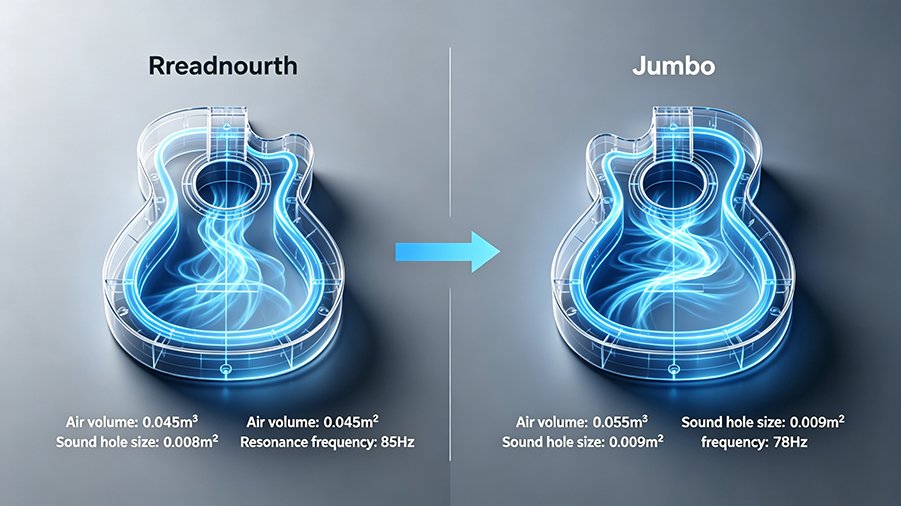
Before assessing any factory, a professional buyer must first understand the fundamental physics that govern guitar tone. Every guitar acts as a complex resonating system:
According to Helmholtz resonance principles—the cornerstone of acoustic guitar design—the frequency at which a guitar body resonates depends on two non-negotiable physical properties:
Two additional design elements directly shape tonal character:
A factory that understands these principles can make deliberate, data-driven choices about bracing patterns, wood thickness, and arching that directly serve the target sound profile. Factories that do not will simply copy existing designs without understanding why they work—resulting in inconsistent, lifeless instruments.
Commercial Insight: Factories that understand acoustic physics can offer true custom tone engineering, while copycat factories can only replicate existing designs. This is the single biggest differentiator between $200 and $2,000 OEM guitars.
Each guitar body shape represents a unique engineering solution to specific tonal requirements. A factory’s ability to produce these shapes correctly is the most objective measure of its technical expertise.
Introduced by C.F. Martin & Company in 1916, the Dreadnought is the most widely produced acoustic guitar shape in history. Its design was revolutionary: a large, deep body (approximately 20″ long, 4-5″ deep) with a relatively straight waist curve.
Acoustic Physics:
Factory Capability Test:
A competent Dreadnought manufacturer must have:
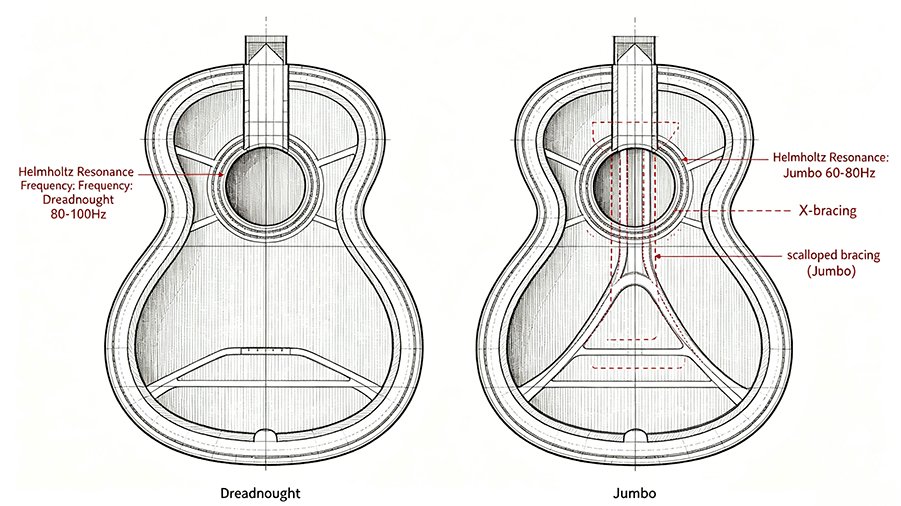
Industry Benchmark: The best Dreadnought factories achieve a Helmholtz resonance frequency of 95-105 Hz, consistent within ±3 Hz across production batches. VINESMUSIC Standard: ±2 Hz consistency.
The Gibson J-200, introduced in 1937, represents a different acoustic philosophy. It features an even larger body than the Dreadnought with a deeply curved waist, designed to maximize soundboard surface area while maintaining structural integrity.
Acoustic Physics:
Factory Capability Test:
Jumbo production requires advanced engineering:
| Body Shape | Key Acoustic Characteristics | Primary Use Case | Minimum Factory Requirement | Typical OEM Price Point |
|---|---|---|---|---|
| Grand Auditorium (GA) | Balanced tone, excellent note separation | Fingerstyle, recording | 5-axis CNC for complex bracing | $300-$800 |
| Orchestra Model (OM) | Enhanced midrange clarity | Fingerstyle, folk | Tight neck angle tolerance control | $250-$700 |
| Parlor | Warm, intimate tone | Travel, vintage styles | Small-body resonance optimization | $200-$600 |
Taylor Guitars pioneered the Grand Auditorium shape in the 1990s, investing heavily in CNC technology to achieve the precise bracing tolerances required for its balanced tone. Today, only factories with equivalent equipment and engineering expertise can produce high-quality GA guitars consistently.
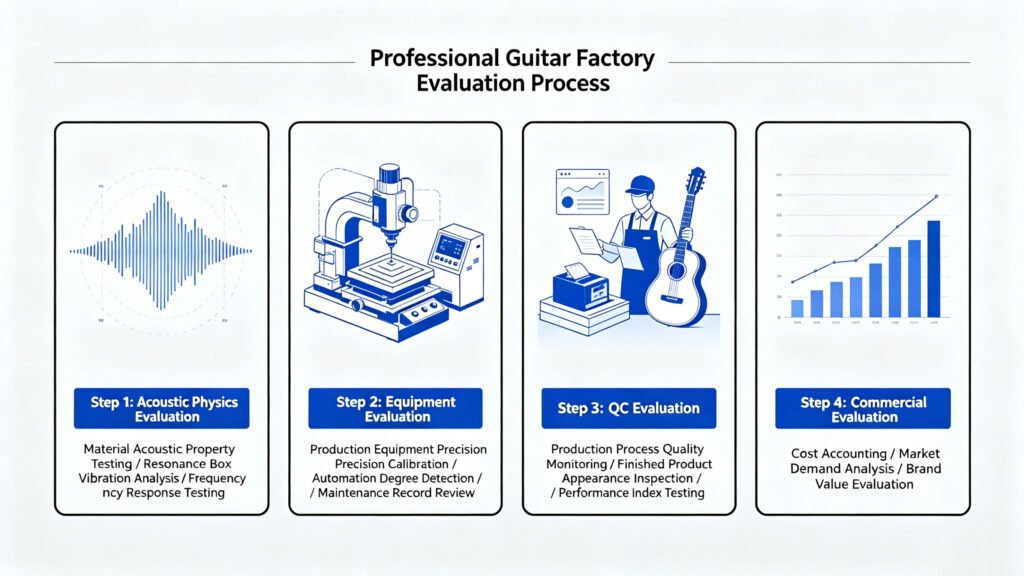
Now that you understand the acoustic fundamentals, you can evaluate factories objectively using these three critical dimensions.
Equipment alone does not make a great factory, but it is impossible to produce professional-grade instruments without it. Professional buyers should assess three categories of equipment:
Industry Red Flag: Many factories claim to have 5-axis CNC machines but only use them for rough cutting, relying on manual labor for finishing. Always ask to see the CNC program output and finished bracing samples.
Critical Note: Excessive finish weight dampens top panel vibration—a well-documented acoustic principle. Reputable factories control finish thickness to within ±5μm to preserve resonance.
Download our free Guitar Factory Equipment Verification Checklist (PDF) → Contact us now
Equipment is only as good as the people operating it. The human factor remains critical in three key areas:
What to Look For:
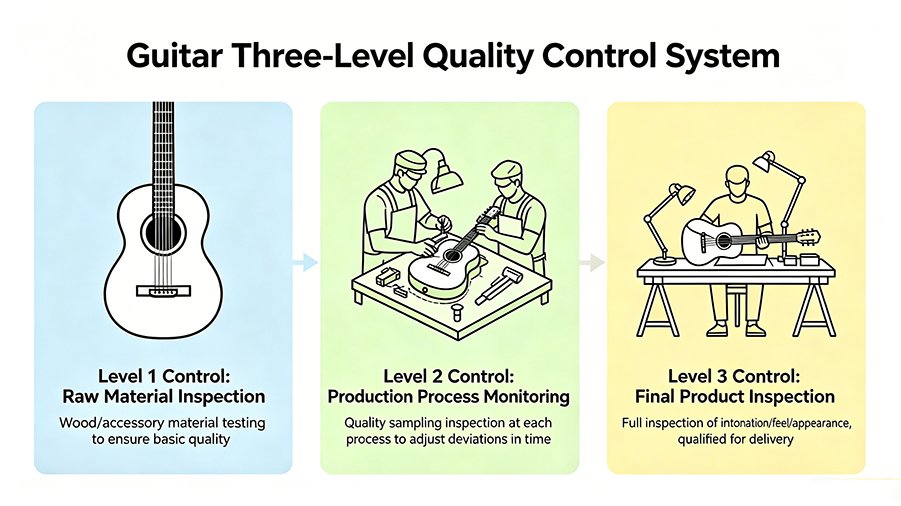
A mature guitar factory implements a 3-stage quality control system with documented records for every batch:
Contract Tip: Always require factories to provide batch inspection reports with every shipment. Include penalty clauses for failure to meet specified QC standards.
Request our sample QC Inspection Report Template (Excel) → Consult our team
Technical capability is meaningless if the factory cannot meet your commercial requirements. Below are the non-negotiable commercial terms to evaluate:
| Term | Entry-Level Factories | Mid-Range Professional Factories | High-End Boutique Factories | VINESMUSIC Standard |
|---|---|---|---|---|
| MOQ | 500+ units per model | 120 units per model | 20-50 units per model | 50 units for startups, 120 units for standard orders |
| Lead Time | 45-60 days | 25-35 days | 60-90 days | 25 days standard, 15 days expedited |
| Payment Terms | 50% deposit + 50% before shipping | 30% deposit + 70% against B/L | 50% deposit + 50% before shipping | 30% deposit + 70% against B/L; OA 30 days for established clients |
| Warranty | 90 days | 1 year | 2 years | 1 year on workmanship |
| Certifications | Basic CE | CE, FCC, RoHS, BSCI | All global certifications | CE, FCC, RoHS, BSCI, ISO 9001 |
When visiting a factory, focus on these critical areas:
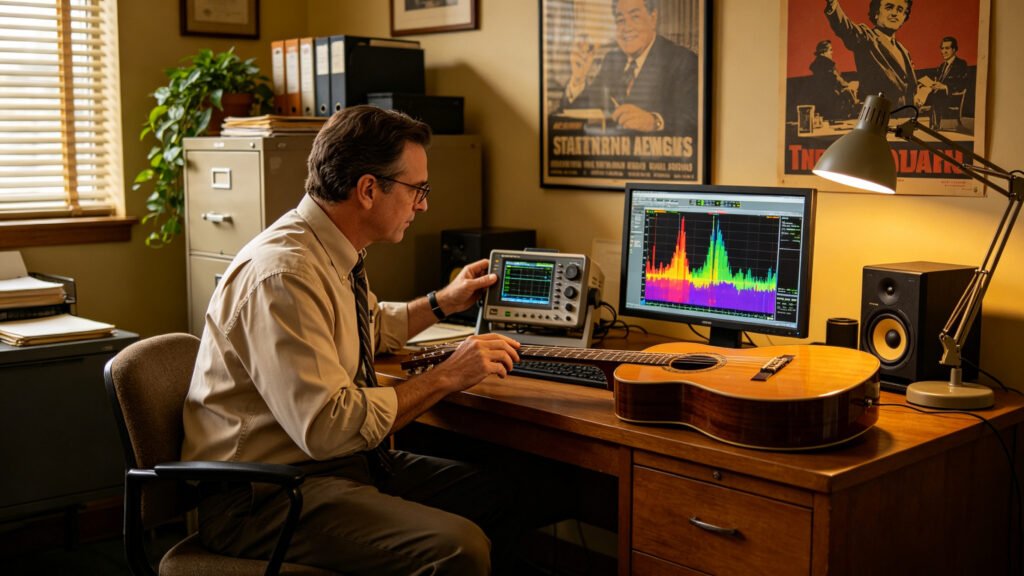
The most effective way to verify a factory’s technical expertise is to conduct a structured interview with their engineering team. Ask these specific questions:
Factories that can answer these questions with reference to acoustic physics principles have likely invested in the engineering expertise necessary for professional-grade production. Those that respond with vague assurances about “quality materials” or “experienced workers” should be evaluated with extreme caution.
A: The most important factor is the factory’s understanding of acoustic physics and body shape engineering. A factory that can explain why different guitar shapes sound different and how they manufacture to those acoustic specifications will deliver far more consistent tone than one that merely copies designs.
A: Standard MOQ for mid-range acoustic guitar OEM is 120 units per model. Many professional factories accept small trial orders of 50-100 units for startup brands at a slightly higher unit cost. Entry-level factories typically require 500+ units per model.
A: OEM (Original Equipment Manufacturing) means you provide the complete design and specifications, and the factory produces to your requirements. ODM (Original Design Manufacturing) means the factory provides pre-designed models that you can brand with your logo and minor customizations.
A: Request to see sample inspection records from previous batches, including incoming material test reports, in-process inspection checklists, and final inspection certificates. A reputable factory will have no problem providing these documents.
A: A PLEK machine is a computer-controlled fret leveling and nut slotting system that achieves precision of ±0.001mm. It ensures perfectly level frets and accurate intonation, resulting in superior playability. Factories with PLEK machines produce instruments with far more consistent setup quality than those relying solely on manual methods.
A: Chinese factories (particularly in Huizhou) offer superior technical expertise, more advanced equipment, and better supply chain integration. They can produce a wider range of guitar types and handle more complex custom designs. Indonesian and Vietnamese factories typically offer lower labor costs but have limited technical capability for mid-range to high-end instruments.
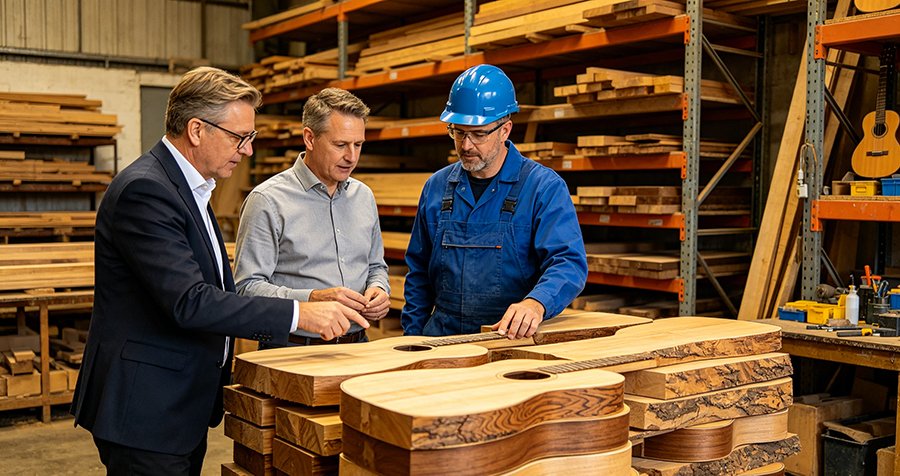
Choosing a guitar factory requires moving beyond surface-level evaluations of price and lead time. Professional buyers who invest time in understanding acoustic physics, evaluating equipment specifications, and assessing quality control systems position themselves to establish partnerships with factories capable of producing instruments with genuine tonal integrity.
The body shape acoustic principles outlined in this guide—Dreadnought, Jumbo, GA, OM, and Parlor—serve as an objective benchmark against which any factory’s technical capability can be measured. By using these principles as your evaluation framework, you can avoid the common pitfalls of guitar sourcing and build a supply chain that grows with your brand.
VINESMUSIC has been a trusted OEM/ODM partner for 300+ global guitar brands for 18 years. Located in Zhaoqing—our team of acoustic engineers and master luthiers combines traditional craftsmanship with cutting-edge technology to produce instruments that meet the highest tonal standards.
Ready to Find Your Ideal Manufacturing Partner?
Try our free interactive Guitar OEM Cost Calculator to estimate your production costs instantly
Copyright © 2026 VINESMUSIC. All rights reserved. Reproduction must indicate the source | Official Website: www.vinesmusical.com
