Address
304 North Cardinal
St. Dorchester Center, MA 02124
Work Hours
Monday to Friday: 7AM - 7PM
Weekend: 10AM - 5PM
Address
304 North Cardinal
St. Dorchester Center, MA 02124
Work Hours
Monday to Friday: 7AM - 7PM
Weekend: 10AM - 5PM

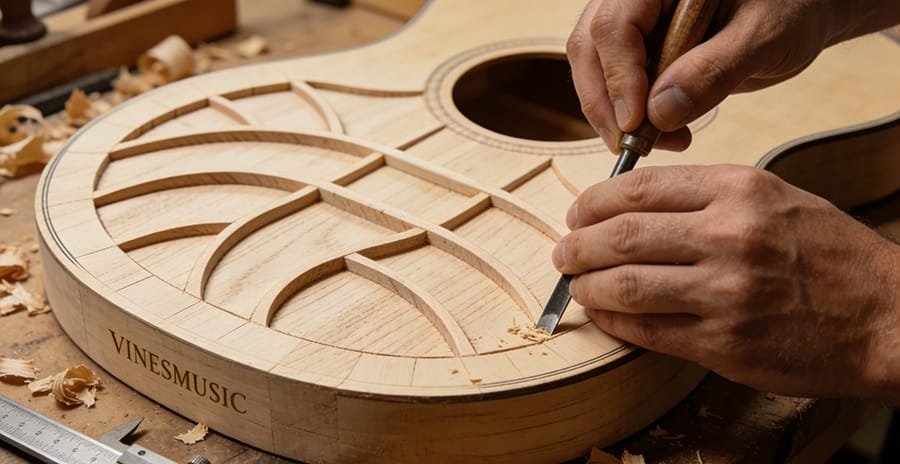
As a professional BSCI-certified guitar factory with 18 years of OEM/ODM experience, VINESMUSIC completes the entire component machining process in-house at our 10,000 sqm factory, with no core processes outsourced. In 2026, we added 2 new high-precision 5-axis CNC machines, adopting a dual-track model of “CNC precision machining for standardization + handcrafted refinement for texture” to balance mass production consistency and the warmth of handcrafted instruments. We offer a standard component MOQ as low as 120 sets, with 4-day custom prototyping, making us the long-term partner of 300+ guitar brands worldwide. This article will walk you through the core logic of guitar component machining from three dimensions: basic knowledge, in-depth process analysis, and practical guidelines, providing professional reference for your brand selection and cooperation decisions.
Component machining is the critical stage after tonewood processing, which converts stabilized tonewood into core guitar components through forming, carving and refinement. The 90 processes are divided into three core modules, each with clear execution standards and quality control requirements, fully compliant with global market regulations including EU REACH and US FDA standards.
Component machining is the core turning point for a guitar “from wood planks to a musical instrument”. Its core goal is to process standardized tonewood into components that meet acoustic design parameters, while preserving the wood’s vibration performance without damaging its internal fibers. Unlike ordinary woodworking, guitar component machining requires a precision of ±0.05mm; even a 0.1mm deviation will directly affect the guitar’s intonation, playability and resonance. This is the core reason why VINESMUSIC has developed standardized SOPs for every single process.
VINESMUSIC abandons the extreme models of “machine-only mass production” or “handmade-only low-efficiency production”, adopting an integrated dual-track process to balance precision, efficiency and acoustic performance:

Want to get the complete SOP manual for the 90 processes? Contact us for free access
The 90 component machining processes are not simple cutting and sanding, but a systematic project integrating material mechanics, acoustic principles, CNC technology and handmade experience. Below we analyze the core logic of this stage from three dimensions: technical principles, full process breakdown, and process optimization.
The core technical principle of component machining is “balancing machining precision with the natural vibration characteristics of tonewood within the acoustic design framework”. On one hand, CNC technology ensures the accuracy of component size, radian and thickness to achieve standardized implementation of acoustic design; on the other hand, handcraft adapts to the grain and density differences of each piece of tonewood, avoiding fiber damage from machine processing, and maximizing the wood’s acoustic potential. Only when the two complement each other can we produce guitar components that meet mass production standards and deliver excellent acoustic performance.
VINESMUSIC scientifically divides the 90 component machining processes into three core modules, which are interlocked. Each module must pass quality control inspection before moving to the next stage, and unqualified components will never enter the next process:
To improve machining efficiency and product yield while ensuring precision, we continuously optimize our processing technology through three core directions, achieving a stable component machining yield of 99.2%, far exceeding the industry average of 90%:

Want to learn more about our component machining quality control standards? Consult our professional team for detailed documentation
For global guitar brands, importers and retailers, understanding the core logic of component machining is the key to selecting a reliable manufacturing partner, controlling product quality, and creating differentiated products. Based on 18 years of industry experience, we have compiled a practical guide that can be implemented directly.
To achieve the optimal balance between quality and cost, you should match the corresponding processing technology and standards according to your product positioning and target market:
To achieve smooth mass production of custom components, there are three key nodes to control: First, provide accurate acoustic design drawings and parameter standards, and communicate with the factory’s technical team in advance to confirm the feasibility of process implementation. Second, confirm the machining accuracy and acoustic performance of core components during the prototyping stage, and lock the SOP standards. Third, clarify the quality control acceptance standards between processes to avoid quality deviations during mass production. VINESMUSIC assigns an exclusive technical contact to each custom client, following up the entire process from prototyping to mass production, with custom sample delivery completed in 4 days.
| Common Problems | Core Causes | VINESMUSIC Standardized Solutions |
|---|---|---|
| Neck size deviation in mass production | CNC equipment wear, lack of inter-process inspection | Daily equipment calibration, full inspection of the first piece of each batch, 100% dimensional inspection between processes, and immediate rework of unqualified products |
| Soundboard bracing bonding failure | Poor glue compatibility, non-standard pressing process | Custom instrument-specific eco-friendly glue, standardized constant temperature and pressure bonding process, 100% full bonding inspection, glue failure rate controlled within 0.1% |
| Fret buzz on fingerboard | Inaccurate fret slotting, non-standard fret inlay | CNC precision slotting, hand inlay + three-level leveling and sanding, 100% fret buzz test on finished products, zero defects before delivery |
| Wood deformation after machining | Unstable moisture content, insufficient environmental control | Secondary moisture content inspection before machining, full production in constant temperature and humidity workshop, 7-day standing stabilization after machining, qualified products enter the next link |
VINESMUSIC offers a standard MOQ as low as 120 sets for regular guitar components, 300 sets for custom components, and supports small-batch trial production of 10-50 sets, adapting to the different needs of startup brands and established brands.
CNC machining offers high precision and strong mass production consistency, suitable for efficient production of standardized components; handcrafted machining can adapt to the characteristics of each piece of tonewood to optimize acoustic performance, suitable for high-end customized products. VINESMUSIC adopts an integrated process of the two, balancing precision, efficiency and acoustic performance.
The mass production lead time for standard components is 15-20 days; for custom components, we offer 4-day rapid prototyping, with a mass production lead time of 25-30 days, and expedited production available according to customer needs.
Yes. We support full-dimensional non-standard customization from headstock shape, bracing structure, neck profile to fingerboard parameters, with 18 years of experience in custom component machining, perfectly implementing customers’ personalized design requirements.
We are BSCI certified, with 28 key control points set throughout the process. Our component machining precision tolerance is ≤0.05mm, fret flatness tolerance ≤0.01mm, 100% inspection between processes, and a stable finished product yield of 99.2%, far exceeding the industry average.
90 component machining processes, each step is the integration of precision and ingenuity, every detail determines the final performance of the guitar. With 18 years of industry experience, BSCI-certified standardized system, and mature technology integrating CNC and handcraft, VINESMUSIC provides stable and high-quality component machining and full-process OEM/ODM services for 300+ guitar brands worldwide.

Want to Learn More?
Welcome to visit VINESMUSIC official website to view the full real-shot video of component machining, or contact our professional team to get a customized machining solution and free prototyping consultation.
