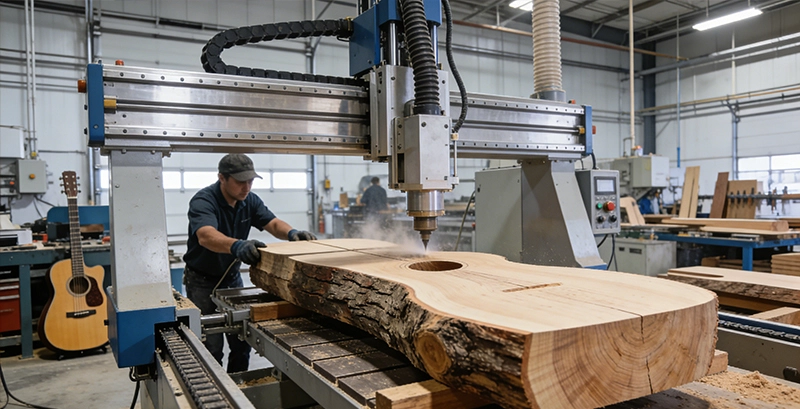
Tonewood processing is the core link in guitar manufacturing, directly determining the instrument’s quality, tone, and service life. As a BSCI-certified professional guitar factory with 18 years of experience, VINESMUSIC has refined 30 rigorous processes to transform raw logs into high-performance usable tonewood—each step adhering to strict standards to lay a solid foundation for premium guitars. In this article, we will deeply analyze the technical principles, practical applications, and selection skills of guitar tonewood processing from a professional perspective, helping you unlock the secrets of high-quality tonewood.
I. Basic Concepts of Guitar Tonewood Processing
Guitar tonewood processing refers to the series of refined operations that convert raw logs into stable, defect-free, and tone-friendly wood materials suitable for guitar component manufacturing. Unlike ordinary wood processing, guitar tonewood processing focuses on retaining the natural texture of the wood while optimizing its physical properties to ensure it can transmit vibration effectively and produce a pure, full tone. The 30-step process covers log selection, cutting, drying, stabilization, and defect treatment, with each link interlocking to avoid quality hazards.
1. Key Point 1: Tonewood Quality Criteria
The quality of tonewood directly affects the guitar’s tone potential, so strict criteria must be followed in processing. In practical operation, attention should be paid to the following three aspects to maximize the wood’s performance. Contact us for detailed tonewood identification guidelines to ensure you select the best raw materials.
Correct Identification Methods: Master the skills to identify high-quality tonewood—such as observing the grain (uniform and dense grain for better resonance), checking for defects (no cracks, insect infestations, or dead knots), and judging the wood’s density (moderate density for balanced tone transmission). For example, Sitka spruce, commonly used for guitar soundboards, is valued for its clear grain and excellent dynamic range, while mahogany offers a balanced tone with distinct midrange performance.
Regular Inspection and Maintenance: During processing, regularly inspect the wood’s state (such as moisture content and surface flatness) and maintain processing equipment (such as cutting tools and drying rooms) to avoid equipment wear affecting processing precision. For instance, keeping cutting tools sharp ensures smooth cuts without damaging the wood fibers, which is crucial for maintaining the wood’s vibration performance.
Timely Defect Treatment: Once defects (such as small cracks or uneven grain) are found during processing, take immediate measures to repair or discard the affected parts. Ignoring minor defects will lead to greater quality problems in subsequent processing, such as deformation or tone distortion after the guitar is assembled.
2. Key Point 2: Core Requirements of Tonewood Processing
Guitar tonewood processing requires a balance between “retaining natural properties” and “optimizing performance”. In practical operation, the following points must be noted to ensure the processed wood meets guitar manufacturing standards:
Precise Parameter Control: Strictly control key processing parameters, such as cutting size (error ≤0.1mm), drying temperature, and moisture content (6%-8% for guitar tonewood, error ≤0.5%). Unlike ordinary wood processing, even a small parameter deviation can affect the wood’s stability and tone performance.
Gentle Processing Methods: Adopt gentle processing techniques to avoid damaging the wood’s internal fibers. For example, when sanding, use fine-grained sandpaper (240-400 mesh) for gradual polishing to ensure the wood surface is smooth without burrs, which helps improve the subsequent painting effect and vibration transmission.
Real-Time Environmental Control: Maintain a stable processing environment (temperature 20±2℃, humidity 55%±5%) to prevent the wood from absorbing or losing moisture too quickly, which can cause deformation. This is especially important for sensitive tonewoods like cedar and rosewood, which are prone to shrinkage or expansion in extreme environments.
3. Key Point 3: Selection Principles of Processing Materials
Selecting suitable raw logs is the premise of high-quality tonewood processing. When choosing raw materials, three core factors must be considered to ensure the processed wood meets guitar manufacturing needs:
Quality Factor: Prioritize FSC-certified high-quality logs with uniform grain, no defects, and appropriate density. High-quality tonewood (such as Hawaiian Koa, Indian Rosewood, and Western Red Cedar) has better texture and vibration performance, which can significantly improve the guitar’s tone. For example, Western Red Cedar offers a warm, soft tone ideal for fingerstyle playing, while Sitka spruce provides a bright, dynamic sound suitable for rhythmic styles.
Applicability Factor: Select tonewood according to the guitar type and usage scenario. For example, acoustic guitar soundboards often use spruce (bright tone, strong resonance), while classical guitar soundboards prefer cedar (warm tone, gentle overtones); neck wood usually chooses hard, stable wood like mahogany or ash to ensure playability and durability. Ash is divided into hard and soft types—hard ash offers a bright tone with long sustain, while soft ash provides a balanced sound with moderate warmth.
Sustainability Factor: Choose sustainably sourced tonewood to comply with global environmental standards and BSCI certification requirements. VINESMUSIC only selects FSC-certified logs to ensure responsible sourcing, protecting forest resources while guaranteeing product quality.
II. In-Depth Analysis of Tonewood Processing
Guitar tonewood processing is not a simple “cutting and drying” process, but a systematic project integrating technology, experience, and precision. Below, we will analyze the technical principles, practical applications, and optimization methods of tonewood processing in detail, helping you deeply understand the core of this link. Interested in the specific technical parameters of our drying process? Contact our team for a free SOP manual.
1. Technical Principles
The core technical principle of tonewood processing is to “stabilize the wood’s physical properties while retaining its natural vibration performance”. Wood is a porous material with high water content and poor stability in its natural state; processing it through scientific methods can reduce internal stress, stabilize moisture content, and optimize texture, making it suitable for guitar manufacturing. The key technical principles include three aspects:
Moisture Balance Principle: The moisture content of tonewood directly affects its stability and tone. The goal of drying and stabilization is to reduce the wood’s moisture content to the golden range (6%-8%) and make the internal moisture distribution uniform. This prevents the wood from deforming, cracking, or warping due to moisture changes during subsequent processing or use. Unlike the industry’s conventional 1-2 month drying cycle, VINESMUSIC adopts a 3-year dual drying process (natural air-drying + constant temperature and humidity drying) to achieve optimal moisture balance. Learn more about our tonewood drying technology for detailed parameters.
Fiber Protection Principle: The wood’s internal fibers are the key to transmitting vibration and producing tone. During processing, all operations (cutting, sanding, polishing) must avoid damaging the fiber structure. For example, precision cutting with high-speed CNC equipment ensures smooth cuts without fiber tearing, while gentle sanding preserves the fiber’s integrity, allowing the wood to vibrate freely and produce a pure tone.
Defect Elimination Principle: Through strict inspection and targeted treatment, eliminate internal and external defects of the wood (such as cracks, knots, and insect holes) to avoid affecting the guitar’s structural strength and tone. For example, using professional equipment to detect internal defects (invisible to the naked eye) and cutting off the defective parts ensures the processed tonewood is intact and stable.
2. Practical Applications
From a technical perspective, the practical application of tonewood processing involves multiple levels of knowledge, including raw material preparation, processing operation, and quality inspection. Mastering these links can significantly improve processing efficiency and product quality. According to industry research data, scientific and standardized tonewood processing can improve the guitar’s tone and stability by more than 30%.
VINESMUSIC’s 30-step practical processing process is as follows (core links):
Log Selection (Step 1-5): Select FSC-certified logs, inspect for defects, and judge the wood’s quality based on grain, density, and moisture content.
Log Cutting (Step 6-10): Use precision cutting equipment to cut logs into slabs of appropriate size (according to guitar component requirements), ensuring smooth cuts and no fiber damage.
Preliminary Drying (Step 11-15): Naturally air-dry the slabs for 2-3 months to remove surface moisture and reduce initial internal stress.
Constant Temperature & Humidity Stabilization (Step 16-22): Place the wood in a constant temperature and humidity drying room (20±2℃, 55%±5%) for phased slow drying, stabilizing the moisture content at 6%-8%.
Defect Treatment (Step 23-27): Inspect the dried wood for surface and internal defects, repair small defects (such as minor scratches) by sanding, and discard severely defective parts.
Finishing (Step 28-30): Polish the wood surface with fine sandpaper (400-800 mesh) to ensure smoothness, and perform a final moisture content test to confirm it meets standards.
In practical application, it is crucial to flexibly adjust parameters according to the wood type. As mentioned earlier, the golden moisture content range for tonewood is 6%-8%, and the optimal processing environment is 20±2℃ with 55%±5% humidity—hard tonewoods (such as mahogany and ash) require longer drying time to ensure internal moisture balance, while soft tonewoods (such as cedar) need gentler processing to avoid fiber damage.
3. Optimization Methods
Optimization methods are an important part of tonewood processing, directly affecting the quality of the final product and the efficiency of the processing process. Understanding these methods is crucial for in-depth mastery of tonewood processing. In practical applications, optimization methods are diverse and need to be selected and adjusted according to different needs and scenarios. VINESMUSIC’s core optimization methods include three aspects:
Processing Parameter Optimization: Adjust drying temperature, time, and cutting precision according to the wood type and thickness. For example, for thick slabs (such as guitar backboards), extend the drying time and reduce the heating rate to avoid internal cracks; for thin slabs (such as soundboards), increase the cutting precision to ensure uniform thickness (error ≤0.05mm).
Equipment Upgrade Optimization: Use advanced processing equipment to improve efficiency and quality. VINESMUSIC is equipped with 5 high-precision CNC cutting machines and intelligent constant temperature and humidity drying rooms, which can automatically monitor and adjust processing parameters, reducing human errors and improving processing consistency.
Process Improvement Optimization: Continuously optimize the processing process based on customer feedback and technological upgrades. For example, adding a “7-day standing stabilization” link after drying to allow the wood to adapt to the processing environment, further reducing internal stress and improving stability.
III. Practical Guide to Tonewood Processing
For guitar manufacturers, importers, and retailers, mastering the selection, use, and common problem-solving skills of tonewood is crucial for improving product quality and reducing costs. Below, we provide a practical guide to help you better apply tonewood processing technology. Need personalized advice for your specific guitar type? Consult our professional team for tailored solutions.
1. Selection Suggestions
When selecting processed tonewood, focus on three core factors to ensure it meets guitar manufacturing needs and cost requirements:
Quality Inspection: Check the wood’s moisture content (6%-8% is optimal), grain uniformity, and surface flatness; use professional equipment to detect internal defects (such as hidden cracks). For单板 guitars, the tonewood should be a single piece of wood with natural, irregular grain—unlike plywood, which has regular, artificial grain patterns.
Applicability Matching: Select tonewood according to the guitar’s positioning and use scenario. For high-end acoustic guitars, choose high-quality solid wood (such as Indian Rosewood or Hawaiian Koa) for better tone; for entry-level guitars, select cost-effective tonewood (such as Sapele) that balances quality and price. Additionally, consider regional adaptability—for example, in humid areas, choose wood with strong moisture resistance (such as ash) to avoid deformation.
Supplier Certification: Choose suppliers with BSCI certification and FSC certification (such as VINESMUSIC) to ensure the tonewood is sustainably sourced and processed in accordance with international standards. Certified suppliers can provide traceable processing records, ensuring product quality and compliance with environmental requirements.
2. Usage Skills
Proper use of processed tonewood can extend the guitar’s service life and maintain its tone stability. The following usage skills are recommended:
Storage Environment Control: Store processed tonewood in a constant temperature and humidity environment (temperature 20±2℃, humidity 55%±5%) to avoid moisture absorption or loss. Do not place the wood in direct sunlight or near air conditioners/heaters, as this can cause deformation or cracking.
Pre-Processing Preparation: Before using the tonewood for guitar assembly, perform a secondary moisture content test to ensure it is within the standard range. For wood that has been stored for a long time, lightly sand the surface to remove dust and ensure good adhesion with glue or paint.
Post-Assembly Maintenance: After the guitar is assembled, remind users to maintain a stable environment to avoid the tonewood deforming due to extreme temperature or humidity changes. For example, in dry environments, use a humidifier to maintain appropriate humidity; in humid environments, use a dehumidifier to prevent wood expansion.
3. Common Problems & Solutions
In the process of tonewood processing and use, some common problems may occur. Mastering the corresponding solutions can avoid quality losses. According to industry data, timely handling of common problems can reduce product scrap rates by more than 30%.
Common Problems
Causes
Solutions
Wood deformation after drying
Uneven moisture distribution, too fast drying speed
Re-dry the wood in a constant temperature and humidity room, extend the drying time, and perform secondary stabilization; cut off severely deformed parts if necessary.
Surface scratches or burrs
Dull cutting tools, improper sanding methods
Sharpen cutting tools, use fine-grained sandpaper for gradual polishing; avoid excessive sanding to prevent fiber damage.
Moisture content exceeding the standard
Insufficient drying time, unstable drying environment
Return the wood to the drying room for supplementary drying, adjust the temperature and humidity parameters, and test again after drying.
Internal cracks (invisible to the naked eye)
Excessive internal stress, improper cutting
Use professional detection equipment to identify cracked parts and cut them off; optimize the cutting and drying process to reduce internal stress.
Through the introduction of this article, we have comprehensively understood the relevant knowledge of the guitar tonewood processing stage—from basic concepts to advanced applications, from selection suggestions to usage skills. As the core link of guitar manufacturing, tonewood processing requires both scientific technology and rigorous attitude. VINESMUSIC’s 30-step refined processing process, combined with 18 years of manufacturing experience and BSCI certification, ensures that every piece of tonewood meets high-quality standards.
VINESMUSIC Provides Professional Products and Services!
👉 Contact us now to get a quote for high-quality processed tonewood
💬 Consult our professional team to obtain personalized tonewood customization solutions