 EN
EN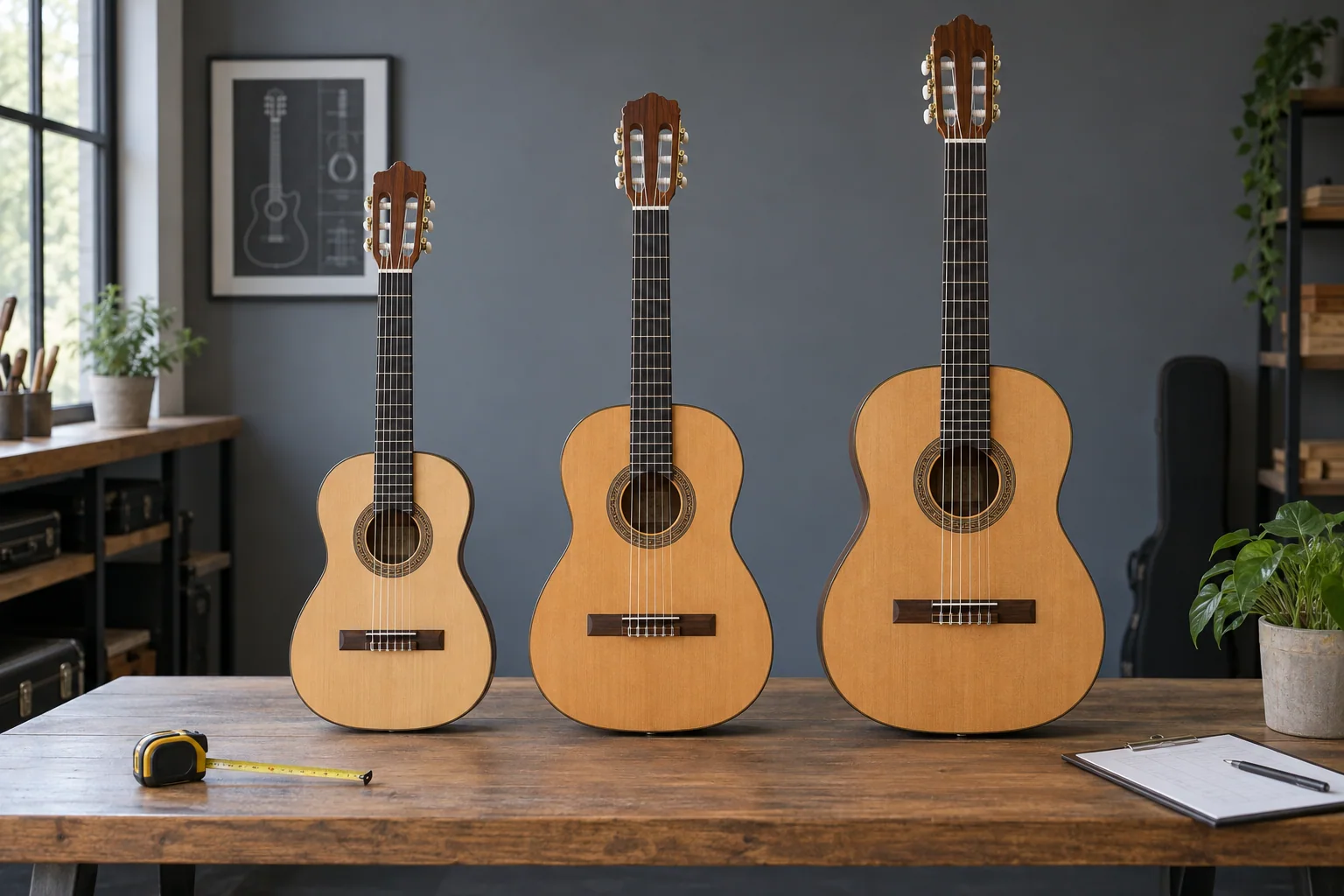
A school or retailer asking for “small classical guitars” has not yet written a workable product brief. The familiar labels—1/2, 3/4 and 4/4—help buyers organize an assortment, but they do not guarantee one universal set of dimensions. Two suppliers may use the same size name while offering different scale lengths, body depths, neck widths and overall proportions.
That is why size selection should start with the player and the sales channel, then move to measured specifications. A buyer needs to know who will use each model, how the instruments will be set up, how the size will be shown on the carton and product page, and what will be checked on the sample. Otherwise, the first shipment can contain technically acceptable guitars that do not fit the intended students or retail positioning.
For a wholesale programme, the practical approach is straightforward: use size labels for merchandising, use measurements for manufacturing, and use an approved sample plus a dated specification for quality control.
In brief: choose the assortment by player group and channel; define scale, body, neck and string setup for every size; avoid assuming that 1/2, 3/4 or 4/4 means the same thing at every factory; approve labels and packaging with the instrument; and keep each size as a separate controlled model.
Why size labels alone are not enough
Size names are convenient because customers recognize them. They are less useful on a production floor unless they are supported by measurements.
A 3/4 classical guitar, for example, may be designed as a proportionally reduced student instrument, a compact travel-friendly model or a shorter-scale guitar with a body that remains relatively full. Those interpretations can all be sold honestly as three-quarter size, yet they will not feel the same to the player.
The label also says nothing about neck profile, string spacing, action or string tension. These details often matter more than a small difference in body outline. A child may be able to hold the body comfortably but still struggle if the neck is too wide or the strings feel unnecessarily stiff. An adult looking for a compact guitar may want a shorter reach without the visual character of a school instrument.
For that reason, a useful factory brief should separate two ideas:
- Commercial size name: the wording used in the catalogue, product page and carton.
- Manufacturing dimensions: the measured scale, overall length, body dimensions, neck width and other controlled points.
Once those two layers are clear, the buyer can market the instrument in familiar language without asking the factory to work from an ambiguous label.
Start with the player, not the fraction
Before deciding how many sizes to order, describe the main user for each model. Age can be a useful clue, but it should not be the only criterion. Hand size, arm reach, playing posture, teaching method and local expectations all affect the choice.
For each proposed size, record:
- Intended player group.
- Main use: school programme, private lessons, general retail, travel or another purpose.
- Target market and language.
- Expected retail position within the buyer's range.
- Whether a teacher, dealer or end customer will make the final size decision.
- Whether the instrument will be sold alone or in a pack.
This short commercial note prevents a common sourcing mistake. A factory may suggest its most familiar small-body model, while the buyer expects a guitar that matches a local education programme. Both sides can be acting reasonably and still be discussing different products.
Retailers should also consider how customers choose a size in practice. If most purchases are made in-store with staff guidance, the range can support several closely spaced options. If most sales are online, the product page needs clearer measurement guidance, and too many similar choices may increase returns or customer confusion.
Build one measurement sheet for every model
The safest way to compare suppliers is to use the same measurement list for every quotation and sample. The list does not need to be complicated, but it should define the points that affect fit, setup, packaging and product-page accuracy.
Scale length
Scale length influences fret spacing, reach, string feel and bridge position. State the measurement method rather than copying a number from a supplier's catalogue. The approved drawing, sample report and online listing should use the same definition.
Scale also works together with tuning and string choice. If a shorter-scale instrument is fitted with a different string set to achieve the intended feel, that decision belongs in the specification. Changing the string set after approval can change action, intonation and playing response.
Overall and body dimensions
Record overall length, body length, upper- and lower-bout widths, waist and body depth at agreed points. These measurements help the buyer evaluate player fit, case compatibility, inner-carton design and shelf space.
Body depth deserves particular attention. A guitar can have a short scale but still feel large if the body is deep. Conversely, a shallow body may be comfortable for a smaller player but provide a different acoustic response from the model the buyer used as a reference. The brief should make the intended compromise clear.
Neck and nut dimensions
Nut width is important, but it is not the complete neck specification. Include fingerboard width at agreed fret positions, neck thickness or profile references, string spacing and the distance from the outside strings to the fingerboard edges.
If the buyer has a preferred reference instrument, measure it. Words such as slim, standard and comfortable are helpful in conversation, but they are not strong approval criteria.
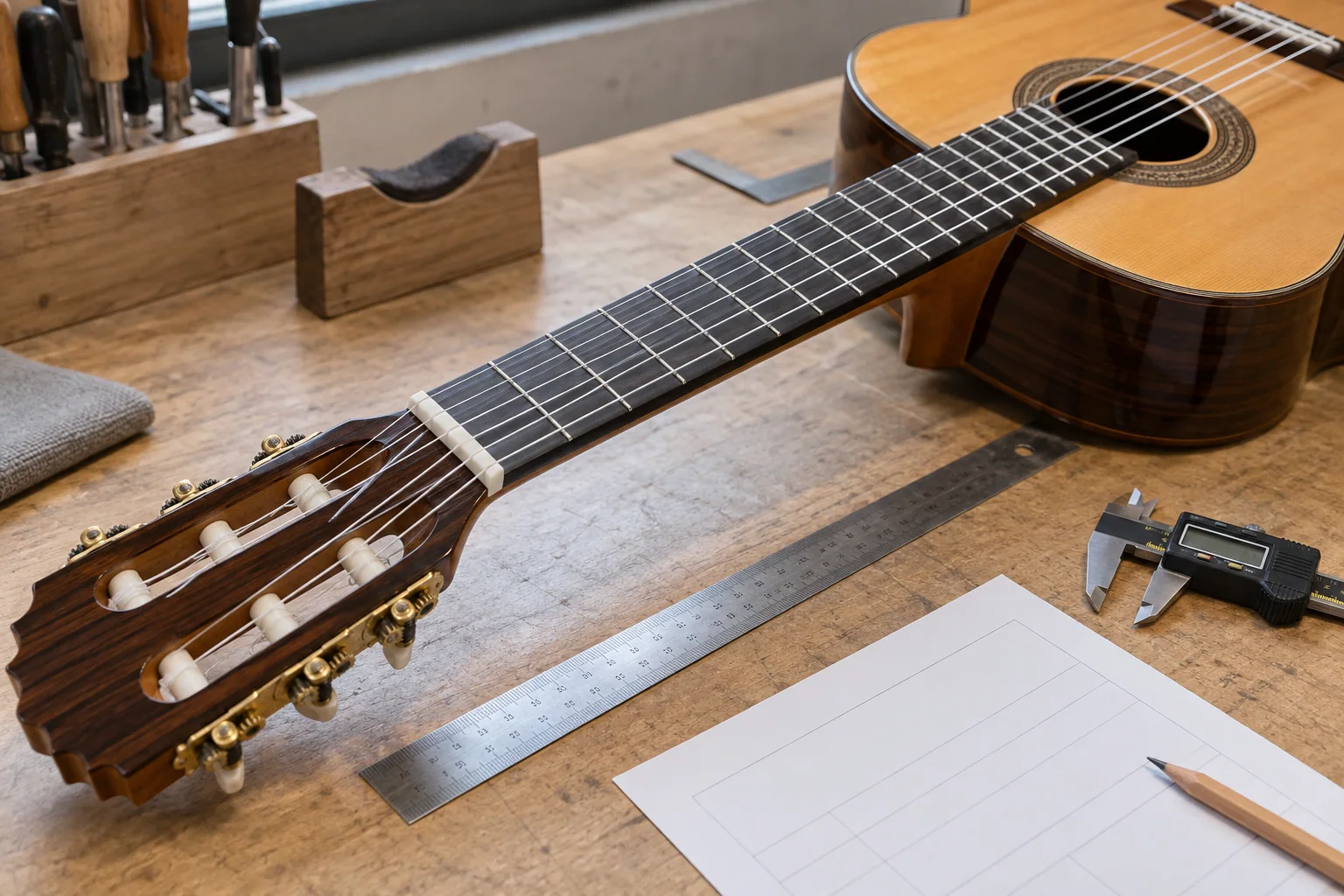
Illustrative visual: scale, nut and neck measurements checked against a buyer's specification sheet.
What each size usually contributes to a wholesale range
The size mix should reflect real customers rather than a desire to show every possible option. A small retailer may need only two carefully differentiated models. A school distributor may need several sizes because teachers are fitting students across a broad age range.
1/2-size classical guitars
A half-size model is commonly considered for younger students or programmes that need a clearly smaller instrument. Comfort, manageable reach and durable everyday handling are usually more important than decorative upgrades.
For this model, buyers should pay close attention to neck feel, action, fret ends, tuner operation and the way the body sits in a student's playing position. The carton and product label should make the size easy to identify in a classroom stockroom.
Do not assume that a smaller guitar is automatically easier to play. Poor fretwork, high action or an unsuitable string setup can make a compact instrument harder for a beginner than a well-prepared larger one.
3/4-size classical guitars
Three-quarter size often has the broadest role. It may serve older children, smaller adults, travel customers or players who simply prefer a compact nylon-string guitar. That flexibility makes it commercially useful, but it also creates specification risk.
A 3/4 model for a school programme may prioritize robust construction and easy identification. A compact adult model may need a more refined finish, different neck feel or a product name that does not sound juvenile. The factory cannot infer that distinction from the fraction alone.
When sourcing a 3/4 size classical guitar wholesale programme, define the intended user and product position before discussing colour or decoration. Then compare scale, body depth, nut width, setup and packaging on the same sheet.
4/4-size classical guitars
Full-size models usually form the main adult or general-purpose classical-guitar offer. They may range from accessible student instruments to more demanding solid-top or all-solid products. “Full size” still does not replace dimensions, construction details or setup targets.
If the 4/4 model is the reference point for the smaller sizes, decide which features should remain consistent across the family. Logo position, finish direction, rosette language, tuner appearance and packaging graphics can create a recognizable range. Scale, neck and body proportions, however, should be approved for each size rather than reduced automatically.
Keep construction language precise
Size selection and construction selection are related but separate decisions. A buyer may choose laminated construction for a high-use school programme, a solid top for a step-up retail model or another structure that fits the project. Whatever the choice, the description must be accurate.
Record the top, back and side construction clearly. Avoid using “solid” as a general quality adjective. If the top is solid and the back and sides are laminated, say so. If natural wood variation will be visible, approve an acceptable range rather than treating one highly figured sample as the bulk standard.
The same discipline applies to fingerboard, bridge, neck and decorative veneers. A specification should distinguish required materials from factory-proposed alternatives. This allows quotations to be compared fairly and reduces late substitutions.
For a deeper look at sample control, see our Classical Guitar OEM Sample Approval guide.
Treat strings, action and setup as one decision
Player comfort is not determined by size alone. String set, scale, nut slots, neck relief, fret condition, saddle height and action work as a system.
For every size, agree on:
- Intended tuning.
- String brand or approved string specification.
- Measurement points for action.
- Neck-relief inspection method.
- Nut-slot finish and first-position comfort.
- Fret-end, level and polish expectations.
- Acceptable bridge and saddle adjustment range.
A setup target should be realistic for the construction, string set and transport conditions. The goal is not to force one number onto every guitar. It is to define how the factory will prepare the sample and how the buyer will judge consistency.
In school orders, repeatability often matters more than an unusually low action on one presentation sample. Teachers need a group of instruments that feel broadly consistent. A sample approved only by one player's personal preference may not represent the classroom requirement.
Planning a multi-size classical-guitar range? Send the intended player groups, target market, size mix, estimated quantity, branding and packaging requirements through the Vinesmusical contact page. We can separate confirmed requirements from measurements that still need a factory proposal.
Plan the assortment before setting quantities
The right ratio of 1/2, 3/4 and 4/4 models depends on channel evidence. Past sales, teacher feedback, return reasons and regional customer questions are more useful than a generic size chart.
A buyer can start with four practical questions:
- Which size sells most often without staff assistance?
- Which size receives the most fit-related returns or exchanges?
- Do schools request mixed packs or separate cartons by size?
- Does the market treat 3/4 as a student model, a compact adult model or both?
If the data is limited, keep the first assortment understandable. A clear entry model in two or three sizes is easier to evaluate than many overlapping models with small cosmetic differences. The sample stage should test whether each size has a distinct job.
Buyers should also decide whether colours and finishes are shared across all sizes. A consistent family is easier to present, but every additional size-and-finish combination creates another stock-keeping unit, carton label and forecast. Range planning is as much an inventory decision as a product decision.
Approve the sample as a complete retail product
Each size should have its own sample record. A 4/4 approval does not automatically approve the 3/4 neck, setup or packaging.
Use a consistent review sequence:
- Confirm model code, size label and specification revision.
- Measure scale, overall length, body and neck points.
- Inspect construction, joints, binding, rosette and finish.
- Tune with the intended string set.
- Check first-position comfort, fret condition and action.
- Play across the fingerboard and listen for unwanted buzzes or dead notes.
- Check tuner operation, bridge condition and intonation.
- Review logo, labels, warnings and accessories.
- Fit the instrument into its bag, case or carton.
- Record changes in one consolidated approval document.
Photographs are useful evidence, especially when a scale or template is visible. They should support the specification rather than replace it. Perspective can make a neck or body appear larger or smaller, and colour can change under different lighting.
Our OEM Guitar Specification Sheet guide explains how to keep dimensions, materials, components and approval notes in one controlled record.
Packaging has to match the size
Smaller instruments should not be placed in a larger carton with extra loose filler simply because it is convenient. Movement inside the pack can damage the headstock, tuners, bridge area or finish. It can also make a carefully designed compact product look improvised when the customer opens it.
For each size, confirm:
- Inner support points around the neck, headstock and body.
- Protection from hard accessories.
- Bag or case fit.
- Product label and barcode wording.
- Size identification on retail and master cartons.
- Packing quantity and carton orientation.
- Any classroom, care or tuning information included in the pack.
If schools receive mixed-size shipments, make the outer labels easy to read from a storeroom shelf. A small operational detail can save teachers and distributors a surprising amount of time.
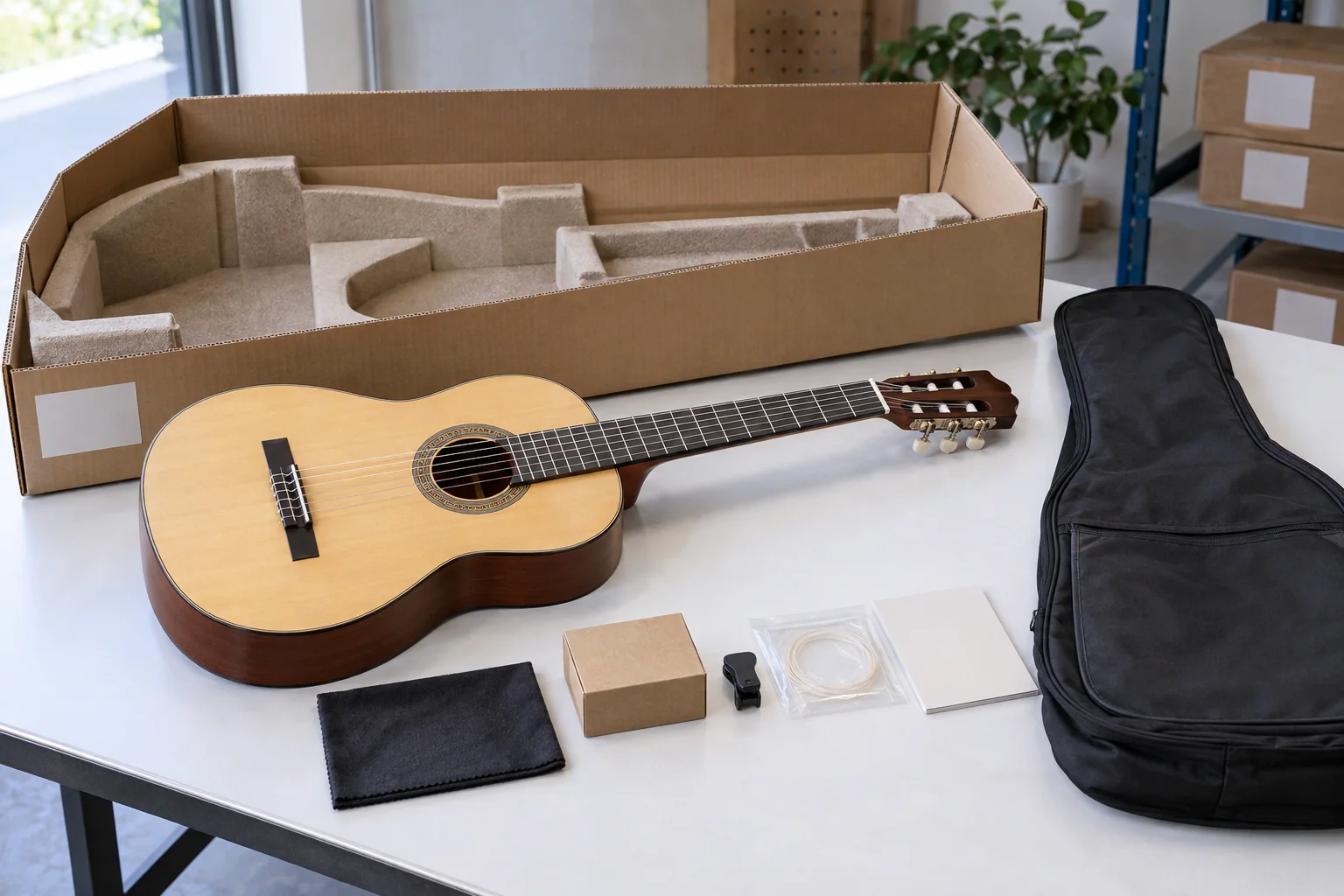
Illustrative visual: size labels, carton support and accessories reviewed for a classical-guitar school pack.
The OEM Guitar Packaging Approval guide covers the wider transport and retail checks.
Classical-guitar size brief checklist
Before requesting a final quotation, make sure each model answers these questions:
- Who is the intended player and which channel will sell the guitar?
- What commercial size name will appear online and on the carton?
- Which measured scale, body and overall dimensions control production?
- Are nut width, string spacing and neck profile defined?
- Which construction and material descriptions are required?
- Which string set, tuning and setup checks will be used?
- Are finish, rosette, logo and label details approved?
- Does every size have its own packaging specification?
- Will the sample be approved by measurement, playing review or both?
- Who controls the final revision before bulk production?
Frequently asked questions
Is every 3/4 classical guitar the same size?
No. The label is a useful retail category, but dimensions vary between suppliers and model families. Compare the measured scale, body, neck and overall length, then approve one documented sample.
Which classical-guitar size is best for a school programme?
There is no universal answer. Student age, physical fit, teaching method, local expectations and the school's stock system all matter. Schools often need more than one size, but the final mix should follow teacher input and actual demand.
Can a buyer use one setup standard for all sizes?
The inspection method can be consistent, but the approved result should account for scale, string set and intended player. Review each size on its own sample rather than assuming the full-size setup will transfer unchanged.
Should a compact adult guitar be called 3/4 size?
It can be, but the product description should explain the intended user and publish real dimensions. Some markets may respond better to language such as compact or travel-friendly if the model is not designed primarily for children.
What should be sent to a factory for an accurate quotation?
Send the size mix, measured requirements or reference samples, construction direction, finish, setup, estimated quantity, branding, accessories and packaging. Mark which details are fixed and which are open to a factory proposal.
A clear size system is easier to sell and easier to inspect
The best wholesale range does not necessarily contain the most sizes. It contains models whose roles are easy to explain, whose measurements are controlled and whose packaging keeps them clearly identified.
Use 1/2, 3/4 and 4/4 as familiar customer-facing labels. Behind those labels, maintain a separate specification and sample record for every model. That combination gives retailers useful merchandising language and gives the factory a practical production standard.
Vinesmusical supports B2B OEM/ODM projects for brands, importers, distributors and private-label buyers. The company was established in 2014, operates a company-owned factory of approximately 10,000 square metres across five floors, and has an 80-person team with monthly production capacity of approximately 7,000 guitars. Vinesmusical has 13 years of OEM/ODM experience, third-party BSCI certification and an in-depth factory audit report completed by an independent company.
To discuss a classical-guitar size programme, review the Classical Guitar category and send your requirements. Include the intended players, target market, model sizes, estimated quantity, branding and packaging. We will review the brief before sample specifications are confirmed.