 EN
EN Español
 Português do Brasil
 Français
 Deutsch
 Русский
Acoustic guitar body shapes influence how an instrument feels against the player and how its design responds to different playing styles. A dreadnought, an OM-style guitar and a compact concert model can offer useful alternatives within a product range. The choice should begin with the intended player, then move to the actual dimensions and sound of the sample.
For a brand or importer, the practical question is which differences customers will notice. Can they hold the guitar comfortably? Does a light fingerpicked passage remain clear? Does a stronger strum support a singer without covering the voice? Those questions give a body-shape comparison a purpose.
Use the shape name to shortlist models. Approve the instrument through a drawing, a listening comparison and a physical sample. Body depth, bracing, materials and setup can change the result substantially, even when two guitars carry the same body-family label.
Start with the role of the guitar in your range
Consider a hypothetical retailer choosing between two samples with similar finishes. One is intended for customers who mainly accompany their singing; the other is meant to offer a compact alternative for seated playing. If both samples feel and sound almost identical, a different model name will do little to explain the distinction.
A useful brief describes the player and the situation in which the guitar will be used. Specify whether the customer mainly picks individual notes, uses a light strum, or plays with a stronger attack. Include any concern about reaching around the body. For an acoustic-electric model, explain whether the instrument will be judged unplugged, through a stage system, or both.
You can then ask a factory to propose suitable existing platforms or review a new outline. This keeps the discussion connected to an actual product need. It also gives the sample reviewer something more specific to assess than whether the instrument looks like a familiar guitar.
Read body names within the maker's own system
Body names are useful, but their meanings are not identical across brands. Martin's 0, 00, 000, OM and M designations belong to its own system. Taylor uses names such as Grand Concert and Grand Auditorium within a different design framework. A shared word does not establish matching dimensions.
For example, Martin identifies its M or 0000 family as Grand Auditorium. That does not make it the same body as a Taylor Grand Auditorium. Compare the actual lower-bout width, depth and outline before treating two designs as alternatives. Martin's body-size guide is useful for understanding Martin's terminology; Taylor's body-shape guide explains Taylor's own families.
OM and 000 also need care. The names do not necessarily describe different outlines. Martin's 000-28 and OM-28 both list a 000-14 Fret body, while their scale lengths differ. That is a reason to read the model specification rather than infer the whole design from its name.
In an OEM inquiry, attach a body name to a drawing or an identifiable reference model. State whether the reference is intended to communicate appearance, dimensions or a sound preference. These are different requests, and a photograph rarely communicates all of them.
Compare the main body families by use and trade-off
Dreadnought and slope-shoulder designs
Dreadnought-style guitars are a reasonable starting point when reviewing a larger-bodied instrument for rhythm accompaniment. Listen to the bass support, the definition of a full chord and the response when the player increases attack. Check whether the sound remains useful alongside a voice, rather than rewarding the sample that initially seems loudest.
Martin describes its dreadnought family in terms of strong bass and projection. That makes bass support a sensible listening priority, rather than a guaranteed result for every dreadnought-style guitar. A pronounced low end can support a rhythm part; it can also cover details that a singer wants to remain audible.
The body can also require a wider reach for the picking arm. Measure width and depth, then try the guitar seated. A familiar front outline can conceal a depth that makes a substantial difference to comfort.
Square shoulders and rounded or sloped shoulders should be described accurately. Shoulder shape alone does not guarantee a particular tone. If the two candidates also differ in scale length, bracing or materials, record those differences before attributing the sound to the shoulders.
OM, 000 and related mid-sized bodies
These are useful candidates for a range that needs a different balance of body feel and playing response. A buyer might compare them for mixed fingerpicking and strumming, or for a customer who finds a larger body awkward to hold.
Within Martin's own guide, the 000 and OM families are presented as a balance of projection and comfort. Use that as a starting point for comparison. Whether a particular sample feels balanced across the strings still depends on the completed design and the way it is played.
Listen for separation within a picked passage and for the way the bass supports the melody. Then strum at the force the intended player is likely to use. An instrument that responds well to a light touch still needs to be assessed at stronger attack if that is part of its intended role.
Keep the neck specification in view. A mid-sized body can have a longer scale, and a comfortable outline does not establish the right neck width or profile. The acoustic guitar size guide explains those separate measurements.
Grand Auditorium
Taylor presents its Grand Auditorium as a versatile body for both fingerstyle and strumming. That is a description of Taylor's design, not a promise attached to every guitar bearing the same name.
For an OEM program, inspect the waist and the way the body rests on the player's leg. A more pronounced waist may provide a useful contrast with another sample, but the resulting position depends on the complete proportions. Try both seated and standing before deciding that the outline solves a comfort problem.
Compare light and stronger playing, then check the actual depth. If an auditorium-style sample is intended as an all-purpose model, it should earn that description through its intended uses rather than through a label on the quotation.
Concert, parlor and other compact bodies
Compact models deserve a full sound review. They are not automatically children's guitars, and their body dimensions do not tell you whether they use a short scale.
Taylor's guide describes smaller air-volume designs as tending toward a more focused voice. For a buyer, that suggests listening for note definition in a quiet passage. It does not establish that every small guitar lacks bass or that every large guitar has less clarity.
Pay attention to how clearly a soft passage speaks and whether the low notes provide enough support for the intended music. For strumming, listen to the chord at the customer's normal attack. A small body may suit that role, or another design may be preferable; the physical sample settles the question.
Portability is a separate check. Inspect the packed guitar and its case or bag. A compact instrument with bulky packaging may not deliver the travel convenience expected from its product description.
Jumbo and other larger bodies
A larger body can be worth comparing when the product concept calls for a fuller physical presence and a substantial acoustic voice. It also demands a careful fit assessment. Check the player's shoulder position, the pressure of the rim against the forearm and whether the waist gives useful support.
For recording or accompaniment, more bass is not always the preferred result. Listen to the guitar in the arrangement for which it is being selected. A large body that sounds appealing alone may need a different microphone position or may compete with another instrument in a mix.
Hear more than bass and brightness
Tone descriptions become more useful when they identify something the reviewer can hear. Start with the balance between the bass notes and the upper strings. Does the low end support the part, or does it obscure the melody or voice?
Then listen to note separation. In a fingerpicked passage, can the reviewer follow the melody and accompaniment independently? In a chord, is the sound distinct enough for the intended rhythm? These observations need not produce a numerical score.
Touch response is the way the guitar reacts to a light attack. Dynamic headroom describes how the response behaves as playing force increases. For a buyer, both should be evaluated with the intended playing style. A sample chosen only through gentle picking may not have been assessed for a stronger rhythm part.
Finally, hear the decay of the notes. A ringing sound can suit one arrangement, while a more quickly decaying response can suit another. Avoid making sustain a universal ranking of quality. The relevant question is whether the sound helps the player perform the intended part.

Use plain listening notes: "the bass masks the vocal in this passage" is more actionable than "premium tone." Keep the recording conditions beside the observation so a later reviewer can understand what was compared.
Why the outline cannot predict the whole sound
The body's outline, depth and internal air space form part of the acoustic design. The soundboard, bridge and bracing also influence its response. Changing one of these while leaving the front silhouette unchanged can alter the result.
Martin's bracing explanation describes how brace shaping and placement influence its guitars. For a buyer, the useful lesson is to record the bracing reference when comparing samples. A body-family comparison becomes difficult if the samples also use different top construction or substantially different bracing.
The same care applies to materials. "Spruce top" does not establish whether the top is solid or laminated. A wood name does not describe thickness or the completed design. Use the acoustic guitar materials guide for that part of the selection, rather than repeating a full materials comparison in the body-shape brief.
A cutaway is another separate decision. Its main practical role is access to higher positions on the fingerboard. Evaluate that access and the actual sample's sound; there is no universal percentage of tonal loss that can be assigned to every cutaway.
Check comfort while the player is actually playing
Try the guitar seated before looking at the specification again. Observe the picking shoulder and the forearm resting over the rim. Ask the player to perform the passage they normally use, because a comfortable pose held briefly may change during a longer piece.
The waist affects where the body sits, while depth changes how far the arm reaches around it. Body edges and any armrest also matter. Do not assign shapes by gender or assume that a small body suits every smaller-framed player.
Repeat the comparison standing with an adjusted strap. A body that sits well on a chair can balance differently on a strap. Check access to the neck and, for an acoustic-electric model, whether the cable or controls interfere with the playing position.
Record what caused discomfort. "Forearm presses against the lower-bout edge when seated" gives the design team a clearer question than "make it more comfortable." It may point toward a depth or edge treatment discussion rather than a wholesale change of body family.
Send your body-shape requirements
Share your target player, reference outline and intended playing style with Vinesmusical. Include the dimensions already decided and the alternatives you want to compare. Send Your Requirements for an acoustic guitar OEM/ODM project review.
Compare samples under conditions you can repeat
Have the same player use the same passages, tuning and pick or finger technique. Keep string specification and condition as comparable as practical, and record any differences in setup. Changing these between samples weakens the explanation of why they sound different.
For recorded comparisons, maintain microphone position and recording gain. Automatic level adjustment can make a quiet performance seem as loud as a stronger one. Keep an unprocessed recording when the purpose is to compare response; a heavily equalized clip answers a different question.
Include a soft passage, a normal strum and a stronger passage appropriate to the product. Add a vocal comparison if accompaniment is part of the brief. An amplified test should be recorded separately from the unplugged comparison because the pickup and signal chain introduce additional variables.
This is a proposed review method, not a claim that a particular Vinesmusical model has passed a documented test. Buyers should agree on the method and keep the resulting sample notes with the specification.

Carry the choice into drawings and production
Once a sample is selected, connect it to the current drawing and model code. Record the body outline, width and depth at agreed points, cutaway version, scale length and neck joint. Identify the top construction and bracing reference so later changes can be recognized.
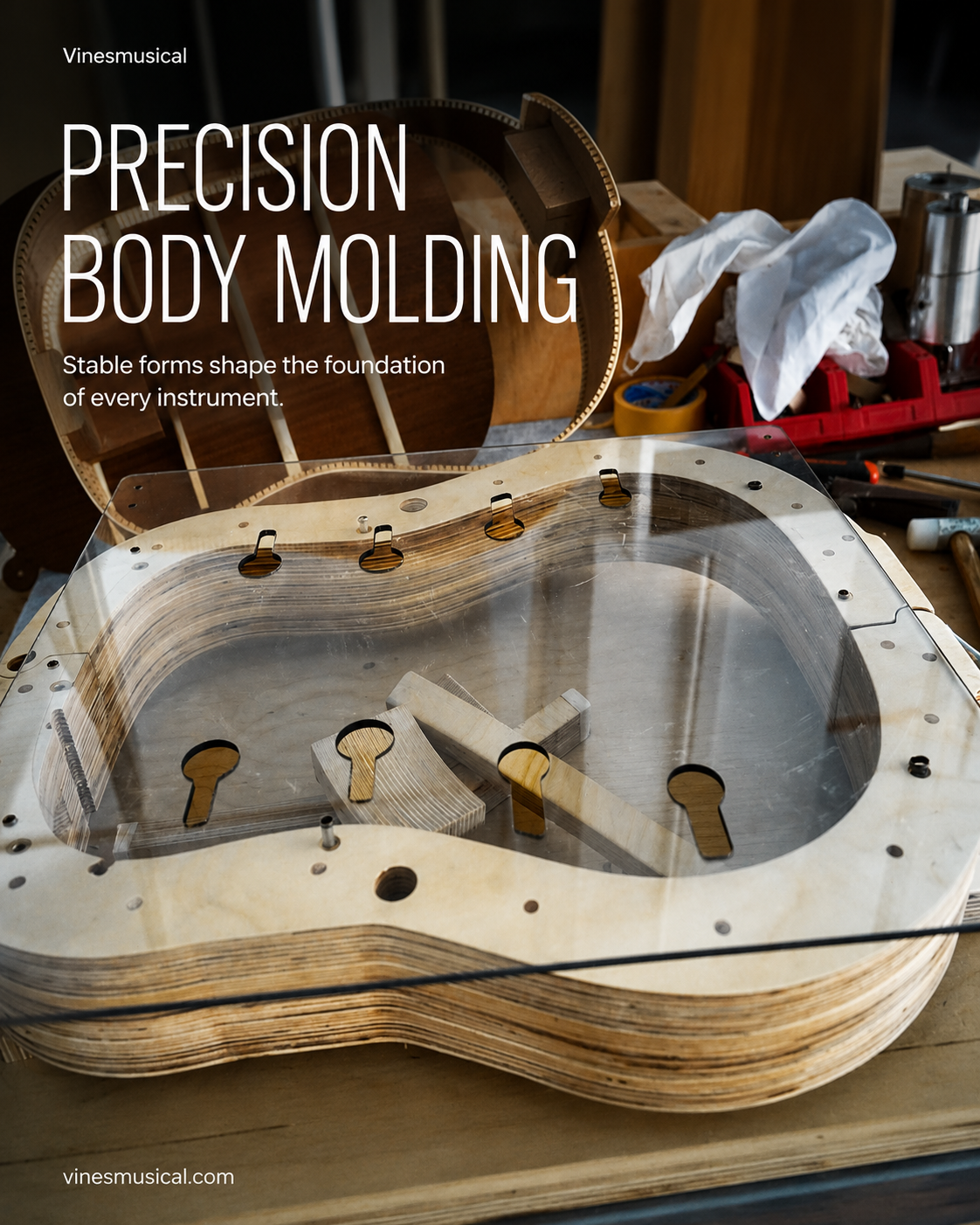
An existing factory platform can be a practical starting point when the brief mainly changes finish, branding or another approved detail. A new outline needs a drawing review and a discussion of molds, fixtures and packaging. Confirm which route is proposed before treating a reference picture as a manufacturing instruction.
Use the OEM guitar specification sheet guide to keep these decisions together. The Acoustic Guitar OEM Checklist covers the wider pre-quotation requirements.
Check the packed sample as well. A case that supports one outline may leave another free to move or press against a different part of the instrument. Approve the instrument and its packed configuration together, then use the same references during shipment inspection.
Frequently asked questions
Is a dreadnought always louder than an OM-style guitar?
No. The result depends on the specific instruments, their construction, setup and the comparison conditions. A larger body may be a useful candidate for a certain acoustic response, but its family name does not establish a measured volume advantage.
Are OM and 000 completely different shapes?
Not necessarily. Martin's 000-28 and OM-28 share the same listed body designation but have different scale lengths. Other makers may use these terms differently. Read the particular model's dimensions and construction.
Can a compact guitar be suitable for strumming?
Yes, if its response suits the intended playing force and musical use. Check chord clarity and bass support in the sample. Compact body size alone is not a reason to reject a rhythm model.
Does a cutaway automatically reduce sound quality?
There is no universal answer across all designs. Choose the required upper-fret access and evaluate the actual construction. Avoid assigning a fixed percentage of sound loss without a relevant controlled test.
Which body shapes should a retailer put in a first range?
Start with the store's customers and the roles each model needs to serve. Select alternatives with meaningful differences in fit, response or purpose. A shape chart cannot replace that local knowledge or a sample review.
Conclusion
A useful body-shape choice gives the customer a recognizable difference in sound or comfort and gives the factory a measurable design to follow. Shortlist a few suitable families, compare the actual instruments, and approve the sample with its drawing and packaging.
Review Vinesmusical's Acoustic Guitar reference products, then Contact Us with your target market, body preference and sample requirements. You can also email info@vinesmusic.com.