 EN
ENWhen a buyer asks for a factory audit report, the next question is usually more important: what should I actually look for?
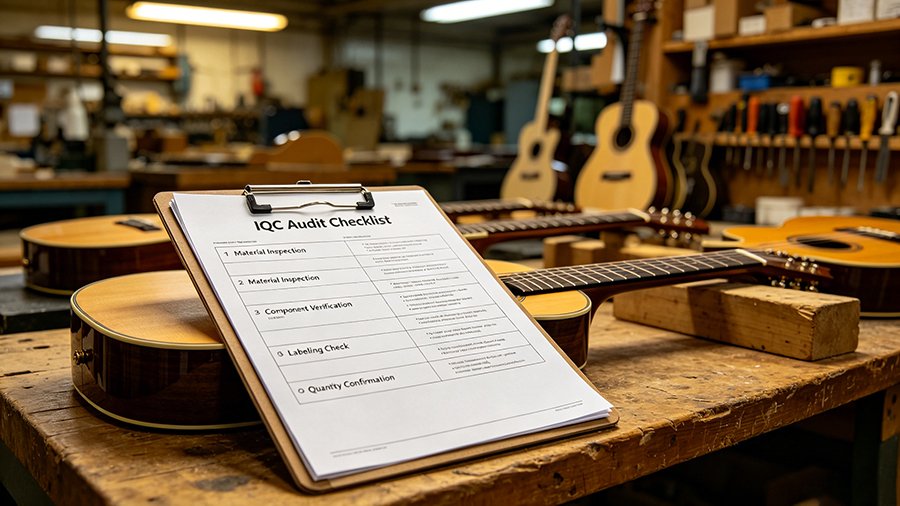
A report can run to dozens of pages. The cover may look reassuring, but the useful information is spread across business registration, site photographs, equipment lists, workforce records, quality procedures and production observations. Reading only the summary score can create a false sense of certainty.
For an OEM or ODM guitar project, the report should help you answer a practical question: can this supplier repeatedly build the model you approved, at the quantity and quality level you need?
Start with three checks
- Identity: Does the legal company in the report match the company signing the quotation, sample agreement and production order?
- Capability: Do the factory layout, people, equipment and records support the claimed product range and capacity?
- Consistency: Does the report agree with what you saw during a video audit, sample review or on-site visit?
If one of these three does not line up, ask for clarification before discussing a large deposit.
1. Confirm who was audited
Begin with the legal name, registration address, operating address and contact details. In guitar manufacturing, buyers sometimes communicate with an export company while production takes place at a related factory. That arrangement is not automatically a problem, but the relationship should be clear.
Check which entity owns or operates the production site, which entity employs the workers, and which entity will appear on the sales contract and commercial documents. If the report covers a different address or a different legal company, ask the supplier to explain the connection in writing.
Site tenure matters as well. A company-owned building and a short-term rented workshop create different continuity risks. The report may include ownership documents, lease terms or an auditor’s note on occupancy. Do not treat square metres as a marketing number; use it to understand whether the production flow described later in the report is physically possible.
2. Read the factory layout as a production flow
A guitar factory is not one open room with finished instruments appearing at the end. Wood storage, cutting, body and neck work, sanding, finishing, assembly, setup, inspection and packing need different spaces and controls.
Look at the floor plan and photographs in sequence. Can you follow the material from incoming inspection to finished-goods storage? Are unfinished wood parts separated from dusty sanding areas? Is finishing handled in a controlled area? Are completed guitars protected before packing?
A neat showroom tells you very little. Photographs of work-in-process, production boards, inspection stations and storage conditions tell you much more. Compare image dates and captions with the date of the audit. If several production stages are missing, request current photos or include them in a live video audit.
3. Check whether workforce and capacity agree
Capacity should never be read as a single number. Ask what that number includes: all guitar types, one shift or several shifts, standard models or highly customized orders, and normal months or peak months.
Then compare the claim with the number of production workers, lines, key machines and working days. A factory may have enough total space but still face a bottleneck in finishing, neck work, final setup or inspection. Those bottlenecks are often more relevant to delivery than the total headcount.
Vinesmusical was established in 2014 and operates from a company-owned five-story factory of about 10,000 square metres. The team is about 80 people and stated monthly capacity is around 7,000 guitars across classical, acoustic and electric guitars and electric basses. A buyer should still discuss how much of that capacity is available for the specific model, finish and delivery window in the quotation.
For a deeper look at this point, see our article on what a 7,000-unit monthly capacity figure means for an OEM order.
4. Separate an equipment list from real process capability
An equipment table is useful, but machine names alone do not prove stable output. Look for quantity, condition, maintenance records and the production step each machine supports. For guitar projects, ask which operations are done in-house and which are subcontracted.
Subcontracting is not necessarily a red flag. Many factories use approved outside specialists for particular components or processes. The important questions are whether those suppliers are controlled, whether incoming parts are inspected, and whether a material or process change requires buyer approval.
Pay attention to the operations that affect the sample you approved: neck profile, fretwork, bridge position, finish colour, hardware installation, electronics and final setup. These are the points where a generic equipment list must connect to your own specification sheet.
5. Look for records, not only procedure names
An audit report may state that incoming, in-process and final inspections exist. The next step is to see whether the factory keeps usable records.
Useful evidence can include incoming-material checks, first-piece approval, in-process inspection sheets, final inspection records, non-conformance handling, calibration logs and shipment traceability. The report does not need to disclose another customer’s confidential information, but it should show that the system is used in day-to-day production.
For a guitar order, translate the quality system into model-specific checkpoints. Neck relief, action, fret condition, intonation, electronics, appearance, accessories and packaging should have agreed tolerances or approval standards. A general statement such as “100% QC” is not a substitute for a documented inspection plan.
Our production QC verification guide explains how buyers can follow these checks after the purchase order is placed.
6. Keep social compliance in a separate column
Social-compliance evidence and production-capability evidence answer different questions. A BSCI assessment, for example, focuses on workplace and social-compliance conditions. It does not by itself prove that a factory can hold your neck tolerance, match a finish sample or deliver a complex order on time.
Both kinds of evidence matter, but they should not be mixed together. Review the scope, site name, assessment date and validity of the social-compliance document, then review technical capability through the factory audit, sample and quality records.
Vinesmusical has third-party BSCI evidence. Buyers can read our plain-language explanation of what BSCI does and does not tell a guitar OEM buyer.
7. Cross-check the report against the sample and quotation
This is where a report becomes part of a purchasing decision rather than a file saved for compliance.
If the quotation promises a certain wood, finish, pickup configuration, packaging method or lead time, ask where that process appears in the audit evidence. If the sample was made in a development room, confirm that the production line can reproduce it. If capacity is tight during peak months, agree on material booking and inspection dates before production starts.
A useful supplier-verification file should contain the report, current business documents, approved specifications, sample approval notes, packaging requirements, production schedule and inspection plan. When these documents agree with each other, risk becomes easier to manage.
Questions to send after reading the report
- Which legal entity and factory address will be responsible for our order?
- Which production steps for this model are completed in-house?
- What is the current available capacity for our model and finish?
- Which process is the main delivery bottleneck during our planned production month?
- Can you show a blank or redacted example of the inspection record used for a similar guitar?
- How are subcontracted parts and materials approved and inspected?
- What changes require written buyer approval after the sample is signed off?
- How will finished goods be identified and traced before shipment?
How Vinesmusical handles buyer verification
We do not expect a serious buyer to make a sourcing decision from a website claim alone. For qualified projects, Vinesmusical can support supplier verification with appropriate company, BSCI and third-party factory-audit materials, together with current factory information. Sensitive or third-party documents may need to be shared in an appropriate business context rather than posted publicly.
The report should then be connected to the actual project: target model, specifications, quantity, finish, branding, packaging, sample requirements and inspection plan. That conversation is more useful than simply asking whether a factory has “passed an audit.”
If you are reviewing a guitar OEM or ODM supplier and want to compare the report with a specific project, send the model, expected quantity and key requirements to info@vinesmusic.com. You can also use our contact page.