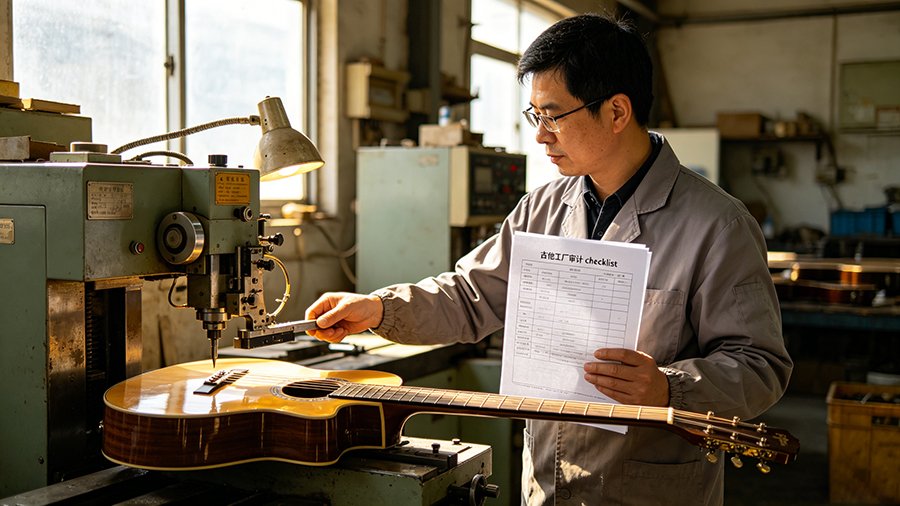
Guitar Factory Quality Control: Complete Guide to IQC, IPQC & OQC Systems | 2026 Professional OEM Guide

Table of Contents

  1. Why Quality Control Is the Core Competitiveness of Top Guitar Factories
  2. Three-Tier QC System for Guitar Manufacturing: IQC/IPQC/OQC Explained
  3. Tier 1: IQC Incoming Inspection — The First Line of Quality Defense
  4. Tier 2: IPQC In-Process Control — Real-Time Defect Interception
  5. Tier 3: OQC Outgoing Quality Control — The Final Check Before Shipment
  6. Four Supporting Systems Behind Effective Quality Control
  7. 1-Hour Factory Audit: QC Capability Quantitative Scorecard
  8. Buyer’s Guide: 5 Common Factory QC Traps to Avoid
  9. Essential for Buyers: Contract Clauses & Receiving Inspection Guide
  10. Root Causes & Solutions for Common Guitar Quality Issues
  11. QC System Comparison by Factory Price Tier
  12. Frequently Asked Questions (FAQ)
  13. Conclusion

Why Quality Control Is the Core Competitiveness of Top Guitar Factories

In the guitar manufacturing industry, there is a widely verified industry rule: two factories with identical equipment, identical wood, and similar quotes can produce guitars with repair rates that differ by more than 10 times.

What determines this gap is not equipment precision or material cost, but the completeness and execution rigor of the Quality Control (QC) system. Equipment can be purchased, materials can be sourced, but a well-polished, strictly enforced QC system is a core barrier that ordinary workshops cannot replicate in the short term.

Quality control runs through more than 200 processes in guitar manufacturing: from the first second wood enters the factory to the final action of packaging and shipping. How much resources a factory invests in QC directly reflects its attitude toward product quality and responsibility to customers.

According to the 2026 Global Quality Report from the Guitar Industry Association (GIA), 68% of guitar warranty issues stem from inadequate quality control during production, and 42% of these issues can be prevented in advance through comprehensive incoming inspection. For musical instrument brands and OEM buyers, understanding a guitar factory’s QC system is the most important skill for evaluating partners — even more important than reviewing their equipment list.

SMIGER Practice: We have delivered over 120,000 guitars in the past 5 years, with an average repair rate stable at 2.8%, far below the industry average of 5%. This data has been verified by third-party testing institution SGS and has been incorporated into the qualified supplier evaluation standards of multiple internationally renowned brands.


Three-Tier QC System for Guitar Manufacturing: IQC/IPQC/OQC Explained

Professional guitar factories adopt a three-tier progressive structure for their quality control systems, with each tier managing different manufacturing stages and forming a complete quality assurance network through layered defense:

  • IQC (Incoming Quality Control): Manages raw material quality
  • IPQC (In-Process Quality Control): Manages production process quality
  • OQC (Outgoing Quality Control): Manages finished product quality before shipment

None of these three links can be missing. The absence of any link will lead to the progressive amplification of quality problems: a defective wood board can eventually become a finished guitar with a cracked neck, bringing the brand losses several times the cost of raw materials.

2026 Regulatory Update: The EU New Battery Regulation (EU 2023/1542) and California CARB Phase 3 came into effect on January 1, 2026. All guitars exported to these regions must provide complete hazardous substance test reports and recyclable material declarations. Non-compliant products will be detained at customs and face heavy fines.


Tier 1: IQC Incoming Inspection — The First Line of Quality Defense

Incoming inspection is the first and most important checkpoint for quality control. Once raw materials for guitar manufacturing enter the production process, if defective products are not screened out immediately, these defects will be continuously amplified in subsequent processes, eventually leading to the scrapping of entire batches of finished products.

Industry Data: A comprehensive IQC system can reduce more than 70% of production process quality problems.

Core Incoming Inspection Items

1. Wood Inspection (Most Complex and Critical)

Wood is the soul of a guitar, and wood quality directly determines the acoustic performance and service life of the instrument. IQC wood inspection must cover the following items:

Inspection ItemInspection StandardInspection MethodNon-Conforming Handling
Moisture ContentTop/Back: 6-8%; Neck: 7-9%; Overall uniformity ±1%Reduce by 1% for dry export regions, increase by 1% for humid regionsPin-type moisture meter, measure 5 points per board (both ends + center + both sides), insert 2-3mm deep to measure core moisture contentReject or transfer to constant temperature and humidity warehouse for conditioning for more than 30 days
Appearance DefectsNo dead knots, no insect holes, no end cracks exceeding 5mm; wood grain angle <15°Visual + caliper measurementMark and remove defective parts, reject entire batch for severe cases
Density ConsistencyDensity difference of same batch and specification wood ≤5%Electronic scale + volume calculationGrade and use density abnormal boards separately
Tone TestTap resonance frequency meets the standard range for that wood speciesManual tap test by senior tone masterDowngrade non-conforming boards for non-acoustic components

Key Tip: Many low-cost factories only measure surface moisture content of wood, ignoring internal wet core issues. Qualified IQC must use a pin-type moisture meter to insert 2-3mm into the wood to measure core moisture content.

2. Metal Hardware Inspection

Metal hardware directly affects the user experience and durability of guitars:

  • Dimensional Tolerance: All mounting hole tolerances ±0.1mm, fully consistent with CAD drawings
  • Appearance Quality: No plating peeling, no oxidation spots, no obvious scratches
  • Function Test: Tuners turn smoothly without jamming, switches have good contact, output jacks plug in and out smoothly
  • Corrosion Resistance Test: High-end products must pass 48-hour salt spray test without corrosion

3. Electronic Component Inspection

Electronic components determine the final tone of electric guitars:

  • Pickups: Output resistance deviation ≤10% (single coil 5-8kΩ, humbucker 8-16kΩ), accurately measured with LCR bridge
  • Potentiometers: Resistance changes linearly and smoothly, no sudden changes or dead spots, full stroke test
  • Switches: 1000 reciprocating operations without poor contact
  • Environmental Compliance: All components meet RoHS 2.0, REACH SVHC 248 items, CARB Phase 3 standards, provide third-party test reports

4. Paint and Coating Material Inspection

  • VOC Content: Meets target market environmental standards (EU ≤30g/L, California ≤10g/L)
  • Viscosity: Measured with Ford Cup #4 to ensure spraying consistency
  • Sample Spray Test: New batches of paint must be sprayed in small batches first to verify drying time, leveling and color consistency

Tier 2: IPQC In-Process Control — Real-Time Defect Interception

In-process inspection is real-time quality inspection inserted at key process nodes on the production line, aiming to discover and correct defects at the first moment they occur, rather than allowing non-conforming products to flow into the next process.

Professional factories adopt a combination of first article inspection + patrol inspection + full inspection for IPQC:

  • First Article Inspection: The first product produced in each batch must undergo full dimensional inspection before mass production can begin
  • Patrol Inspection: Randomly select products for key item inspection every 30-60 minutes
  • Full Inspection: 100% full inspection for high-risk processes

Core IPQC Control Points

Control Point 1: Dimensional Inspection After CNC Machining

  • Body total thickness, neck width, neck pocket depth and fit
  • Fret slot position accuracy: cumulative error along string direction ≤±0.1mm
  • Pickup cavity, electronics cavity dimensional tolerance ±0.2mm

Control Point 2: Inspection After Neck Assembly

Connection MethodCore Inspection ItemsAcceptance Standard
Bolt-onJoint surface fit, neck angle0.05mm feeler gauge cannot insert more than 5mm; neck angle error ≤0.5°
Set-neckGlue distribution, bond strengthNo bubbles, no glue shortage; tapping sound is clear and noiseless
Neck-throughSplicing flatness, wood grain continuityNo gap in splicing seam; consistent wood grain direction

Control Point 3: Surface Treatment Inspection Before Spraying

  • Sanding grit: 320-600 grit, no sand marks
  • Surface cleaning: No residual glue, no oil stains, no burrs
  • End sealing: Wood ends are completely sealed to prevent coating penetration

Control Point 4: Circuit Function Inspection After Assembly

  • All pickup position output tests
  • Full rotation test of volume and tone knobs
  • Output jack contact test
  • Ground Continuity Test: All metal hardware are conductively connected to circuit ground (this is the key to solving pickup noise)

Tier 3: OQC Outgoing Quality Control — The Final Check Before Shipment

Outgoing inspection is the final quality checkpoint before products leave the factory, and also the official record to prove to customers that products meet specifications. Professional factories must retain complete OQC inspection records that can be traced back to each individual guitar.

Full Inspection vs AQL Sampling

  • Full Inspection: Applicable to mid-to-high end products or small batch orders (≤50 units), each product is inspected one by one
  • AQL Sampling: Applicable to large batch orders, adopting the international general AQL (Acceptable Quality Limit) standard:
    • Appearance defects: AQL 2.5 (≤2.5 defects per hundred units allowed)
    • Functional defects: AQL 1.0 (≤1 defect per hundred units allowed)
    • Safety defects: AQL 0 (zero tolerance, entire batch rework if one is found)

AQL Sampling Quick Reference Table (Guitar Industry Standard):

Order QuantitySample SizeAcceptance Number (Appearance)Acceptance Number (Functional)
1-50Full inspection00
51-1502010
151-5005031
501-12008052
1201-320012573

Complete OQC Inspection Checklist

Inspection CategorySpecific ItemsInspection MethodAcceptance Standard
Appearance InspectionCoating defects (bubbles, orange peel, impurities)Visual + light irradiationNo obvious visible defects
Scratches, dents, paint chippingVisualNo deep scratches or paint chipping
Metal part oxidation, rustVisualNo oxidation or rust
Logo and serial numberVisual + caliperAccurate position, clear and legible
Dimensional InspectionOverall dimensions, nut widthCaliper/tape measureMeets specification
Fret heightDigital height gauge1.2-1.5mm, height difference ≤0.05mm
String actionString action gauge12th fret action: 2.0-2.5mm (6th string), 1.5-2.0mm (1st string)
Functional InspectionTuning stabilityTunerPitch change ≤5 cents after 30 minutes (23℃/45% RH environment)
IntonationElectronic tuner12th fret vs open string pitch difference ≤±5 cents
Circuit functionItem-by-item testAll positions, knobs and switches work normally, no noise
Mechanical operationManual testBridge, tuners and knobs operate smoothly
Packaging InspectionLabel accuracyVerificationCorrect model, serial number and destination
Accessory completenessCountingComplete wrenches, spare strings, manual
Protection effectivenessVisualSufficient cushioning material, firm fixation

Four Supporting Systems Behind Effective Quality Control

1. Precision Inspection Equipment System

There is no precise quality without precise equipment. Professional guitar factories should be equipped with the following core inspection equipment:

  • Digital calipers (0.01mm precision), digital height gauges
  • Pin-type + induction dual-mode moisture meters
  • 4.5-digit multimeters, LCR bridges
  • Salt spray test chambers, X-ray fluorescence spectrometers (XRF)
  • Electronic tuners, string action gauges, fret height gauges

Factory Audit Tip: Check if equipment has regular calibration labels, calibration cycle is usually 1 year. Equipment without calibration labels produces unreliable measurement data.

2. Complete Quality Records and Traceability

Each batch of products should have a complete quality file, including:

  • Raw material incoming inspection records (linked to supplier batch numbers)
  • In-process inspection records (process, time, inspector, defect quantity)
  • Finished product inspection reports (AQL sampling data or full inspection records)
  • Customer complaints and handling records

SMIGER Practice: We assign a unique QR code to each guitar. Scanning it allows you to view complete information including raw material batch, production team, inspector and production date, achieving full lifecycle traceability.

3. Supplier Quality Management System

Professional factories usually do not produce all parts themselves. Quality management of suppliers is an important extension of the QC system:

  • Supplier admission evaluation: Review ISO 9001 certification, incoming defect rate, delivery on-time rate
  • Annual supplier rating: Divided into A/B/C/D grades based on performance, eliminate D-grade suppliers
  • Incoming abnormality handling: Immediately isolate abnormalities, issue SCAR (Supplier Corrective Action Request), track improvement effects

4. Continuous Improvement System

An excellent QC system is not static, but continuously improves through the PDCA cycle:

  • Hold monthly quality analysis meetings to count defect rate trends
  • Conduct 8D root cause analysis for major quality problems
  • Regularly update inspection standards and work instructions

1-Hour Factory Audit: QC Capability Quantitative Scorecard

If you have the opportunity to visit a guitar factory, use the following 100-point scorecard to quickly and accurately evaluate its QC capability within 1 hour:

Evaluation ItemPointsScoring Standard
IQC Incoming Inspection Area20Independent area (5), complete equipment (5), non-conforming product isolation area (5), complete records (5)
IPQC In-Process Control25First article inspection records (5), patrol inspection records (5), work instructions at stations (5), clear non-conforming product identification (5), inspector ratio 1:8-1:15 (5)
OQC Outgoing Inspection20Independent inspection area (5), sampling according to AQL standards (5), complete inspection reports (5), finished product isolation area (5)
Inspection Equipment15Complete equipment (5), calibration labels (5), well-maintained equipment (5)
Quality Records10Complete records (5), traceable (5)
Site Management10Clean workshop (5), orderly material placement (5)

Rating Standards:

  • 80-100 points: Excellent, can cooperate with confidence
  • 60-79 points: Qualified, need to focus on weak links
  • Below 60 points: Unqualified, not recommended for cooperation

One-Vote Veto Items (any occurrence directly determines unqualified):

  • No independent IQC area
  • Falsified inspection records
  • No non-conforming product isolation area
  • Inspection equipment without calibration labels

Buyer’s Guide: 5 Common Factory QC Traps to Avoid

  1. Data Falsification Trap: Factories forge inspection records without actually conducting inspections
    • Avoidance Method: Request to watch the inspection process on site, verify records against actual product serial numbers
  2. Sampling Cheating Trap: Factories pre-select good products for sampling
    • Avoidance Method: Randomly select samples from different boxes yourself, request to open at least 3 boxes from different batches
  3. Reworked Product Mixing Trap: Simply rework defective products and mix them with qualified products
    • Avoidance Method: Check products for rework marks, request rework records
  4. Third-Party Report Falsification Trap: Forge SGS/ITS and other third-party test reports
    • Avoidance Method: Verify report numbers through the official website of the third-party institution
  5. Subcontracting Trap: Factories subcontract orders to small workshops without QC systems
    • Avoidance Method: Add anti-subcontracting clauses to the contract, conduct surprise inspections during production

Essential for Buyers: Contract Clauses & Receiving Inspection Guide

Must-Include Quality Clauses in Contracts

  1. Acceptance Standards: Clearly specify adoption of AQL 2.5/1.0 standards, list key inspection items and acceptance criteria
  2. Non-Conforming Handling: When defect rate exceeds AQL standards, the factory shall rework or replace free of charge and bear all freight costs
  3. Warranty Period: At least 12-month warranty period, factory shall repair or replace free of charge for quality issues during warranty
  4. Liability for Compensation: Factory shall bear corresponding compensation for customer complaints, returns and brand losses caused by quality issues
  5. Traceability: Factory shall provide inspection reports and raw material source certificates for each batch

Simple Receiving Inspection Method (No Professional Equipment Needed)

  1. Appearance Check: Check coatings, metal parts, logos for defects
  2. Feel Check: Turn tuners, flip switches, press frets to check smoothness
  3. Intonation Check: Use a mobile phone tuner to test open string and 12th fret intonation, error should be ≤±10 cents
  4. Circuit Check: Plug in guitar cable, test all positions and knobs for noise
  5. Packaging Check: Verify model, quantity and accessories are complete

Quality Problem Emergency Response Plan

  1. Immediately take photos for evidence and isolate non-conforming products after discovering quality problems
  2. Notify the factory in writing within 24 hours, attach photos and inspection data
  3. Require the factory to provide cause analysis and improvement plan within 48 hours
  4. Negotiate handling methods (rework, replacement, refund)
  5. Track improvement effects to ensure the same problem does not occur in subsequent batches

Root Causes & Solutions for Common Guitar Quality Issues

Common ProblemRoot CauseFactory Improvement MeasuresBuyer Countermeasures
Neck bow / high string actionUnqualified wood moisture contentStrengthen IQC moisture content inspection, constant temperature and humidity management of inventory woodRequest factory to provide wood moisture content test reports
Poor intonationNeck angle deviation or incorrect bridge positionAdd full neck angle inspection in IPQC, 100% intonation test in OQC100% intonation test upon receipt
Tuners slippingPoor tuner quality or insufficient installation torqueStrengthen IQC tuner inspection, use torque wrench to control installation torqueRequest factory to use well-known brand tuners
Pickup noisePoor grounding or insufficient shieldingAdd ground continuity test in IPQC, full body conductive shieldingTest circuit noise upon receipt
Coating blisteringExcessive wood moisture content or incompatible paintFull IQC wood moisture content inspection, sample spray new paint firstCheck coatings for blistering and peeling

QC System Comparison by Factory Price Tier

表格

Factory TierRepresentative Product PriceQC Cost PercentageIQCIPQCOQCRepair Rate
Workshop Level<$100<1%Visual sampling onlyNoneVisual sampling only>20%
General Factory$100-$3001-2%Sample moisture and appearanceKey process patrolAQL 4.0/2.55-10%
Professional Factory$300-$10002-5%Full moisture inspection, sample othersFirst article + patrol + key process full inspectionAQL 2.5/1.01-3%
Top Factory>$10005-8%100% full inspection of all itemsFull process full inspection100% full inspection<1%

SMIGER Positioning: We belong to the professional factory level, with a QC cost percentage of 4.5%. We implement OQC full inspection for all mid-to-high end products, with a repair rate stable below 2.8%.


Frequently Asked Questions (FAQ)

Q: Can I request guitar factories to provide inspection reports for each batch?

A: Yes. Professional OEM factories can fully provide outgoing inspection reports for each batch. The report should include sample quantity, defect quantity, AQL judgment result, inspection date and inspector signature. Factories that refuse to provide reports pose extremely high quality risks.

Q: What percentage of manufacturing cost does QC typically account for in guitar factories?

A: In mature professional guitar factories, QC-related costs (inspector salaries, equipment depreciation, consumables, third-party testing) typically account for 2%-5% of manufacturing costs. Below 1% indicates insufficient QC investment, above 8% indicates systemic quality problems.

Q: How to judge if QC is real during factory audit without professional equipment?

A: ① Observe if there is a clear non-conforming product isolation area in the workshop; ② Randomly select finished products to test intonation (12th fret vs open string pitch difference should be ≤±5 cents); ③ Check if inspection equipment has valid calibration labels.

Q: What incoming defect rate should trigger rejection?

A: The industry general standard is that incoming defect rates exceeding 3% can be rejected. Excellent factories should control key material incoming defect rates below 500PPM (0.05%). Two consecutive batches with excessive defect rates should trigger supplier replacement consideration.

Q: What is AQL standard? Why does the guitar industry use AQL 2.5/1.0?

A: AQL is an international general sampling inspection standard representing the maximum acceptable defect rate. AQL 2.5 is used for appearance defects and AQL 1.0 for functional defects, which is the industry best practice balancing quality cost and customer satisfaction.


Conclusion

Guitar manufacturing is an art combining craftsmanship and science, and quality control is the foundation of this art. A complete three-tier IQC/IPQC/OQC QC system is the core symbol that distinguishes professional guitar factories from ordinary workshops.

For brands and buyers, choosing a factory with a strict QC system is more important than pursuing lower prices. The brand reputation loss and after-sales costs caused by a single quality accident far exceed the small savings in procurement costs.

SMIGER Guitars has 18 years of experience in guitar manufacturing quality management. Our ISO 9001 certified QC system covers every link from raw materials to finished products, ensuring that every guitar leaving the factory meets the highest quality standards. Our average repair rate is below 2.8%, far below the industry average of 5%.


Copyright © 2026 SMIGER Guitars. All rights reserved. | Official Website: www.smigerguitar.com

Newsletter Updates

Enter your email address below and subscribe to our newsletter

Leave a Reply

Your email address will not be published. Required fields are marked *

Contact Form Demo